

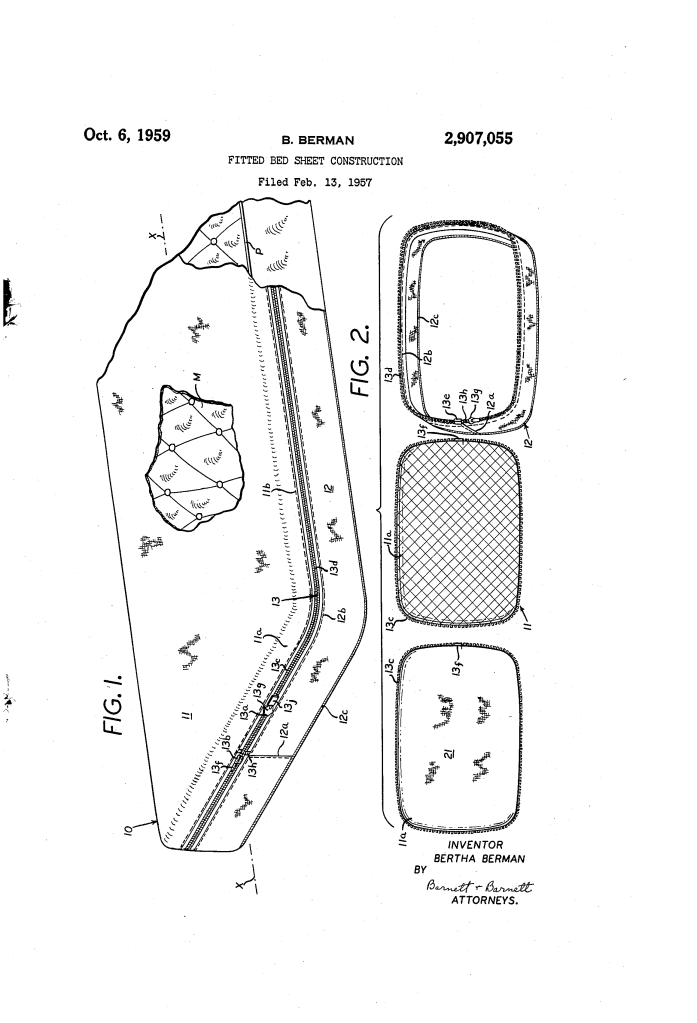
Fitted Bed Sheet Construction (1959)
U.S. Patent No. 2,907,039, granted on October 6, 1959, to Bertha Berman, describes an innovative two-piece mattress cover designed to simplify bed-making and reduce laundry costs. Bertha Berman, an inventor from Forest Hills, New York, sought to replace the bulky, difficult-to-handle contour sheets of the mid-20th century with a modular system.
This specific invention solved a persistent domestic problem: the physical strain of lifting heavy mattresses to change fitted sheets and the excessive bulk of laundering standard one-piece “tuck-under” or contour sheets.
The Innovation: The “Separable Band” System
Traditional fitted sheets are large, single-piece fabric structures that wrap entirely around and under a mattress. Berman’s breakthrough was the separation of the sheet into two distinct, functional components connected by a separable slide fastener (13) (commonly known as a zipper).
- The Dish-Shaped Cover Section (11)This is a rectangular section sized to overlie the top surface of the mattress. It features a shaped border (11a) that turns down over the mattress edges, positioning the zipper just below the piping (P) to ensure a smooth sleeping surface.
- The Mattress-Encircling Band (12)This is a continuous vertical strip of fabric that “hugs” the four sidewalls of the mattress. Once installed, this band can remain in place indefinitely, acting as a permanent anchor for the top covers.
How the Apparatus Functions
The modular design allows for a “quick-change” process that requires no lifting of the mattress:
| Step | Action | Safety & Efficiency Purpose |
| 1. Initial Setup | The band and top section are zipped together and fitted over the mattress corners. | Establishes the fitted structure for the first use. |
| 2. Detachment | When soiled, the user pulls the slider (13g) around the entire mattress periphery. | Completely separates the top section without moving the mattress. |
| 3. Independent Laundry | The top section is laundered separately from the vertical band. | Reduces laundry bulk and weight by approximately 50%. |
| 4. Replacement | A clean, spare cover (21) is zipped onto the existing band. | Allows for immediate bed-making even while the other section is in the wash. |
Technical Components
- Separable Slide Fastener (13): A heavy-duty zipper extending around the entire four-sided periphery of the mattress. The ends (13a, 13b) meet at the center line (XX) of the mattress foot for easy access.
- Coupling Bar and Pin (13c): A detachable end connector that allows the top stringer to be completely removed from the slider.
- Transverse Seams (12a): Strategic stitching in the band that aligns with the mattress corners to maintain a snug, “fitted” appearance.
- Multiple Cover Sections (21): The invention was designed as a “set,” allowing users to swap covers of different colors or patterns using the same universal band.
Historical and Scientific Impact
Bertha Berman’s invention was a precursor to modern modular bedding and addressed the growing demand for “labor-saving” devices in the post-war American home.
- Ergonomic Health: By eliminating the need to lift the mattress—which could weigh significantly—the design prevented back strain and made bed-making accessible to the elderly or those with physical limitations.
- Economic Efficiency: Commercial laundries of the era charged by weight and bulk. Berman’s design proved that by only washing the part of the sheet in contact with the sleeper, household costs could be halved.
- Space Optimization: The separate pieces were much easier to fold and store in linen closets compared to the notoriously difficult-to-fold traditional contour sheet.
About the Inventor: Bertha Berman
Bertha Berman was a practical innovator based in New York. Her work focused on the functional improvement of household textiles. She recognized that the “contour” sheet, while an improvement over flat sheets, was still fundamentally flawed in its maintenance. Her patent reflects a deep understanding of domestic labor, focusing on “efficiency and practicality to a high degree.”
Summary of Claims
The patent explicitly claims:
- A dish-shaped cover section with a border extending a short distance below the mattress piping.
- An endless band sized to snugly encircle the vertical sidewalls of the mattress.
- A separable slide fastener that detachably connects the cover border to the top edge of the band along the entire periphery.
- The ability to remove and replace the cover section while the band remains mounted in position on the mattress.
