
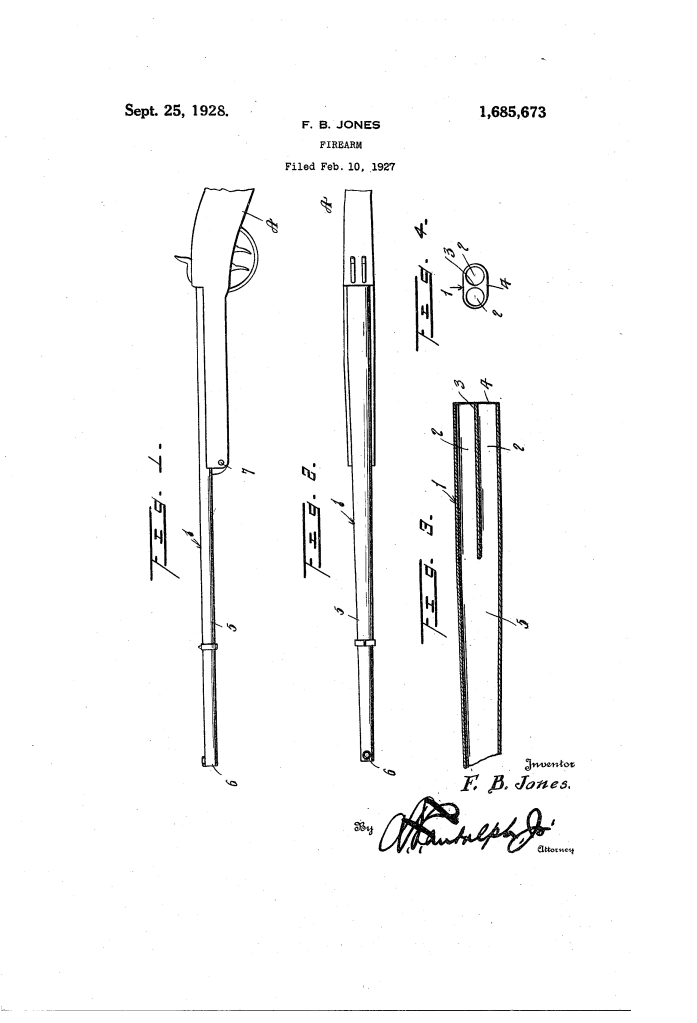
Single-Barrel Shotgun with Multiple Breech Bores (Felix B. Jones, No. 1,685,322)
The patent by Felix B. Jones of Chicago, Illinois, describes an improved Firearm (Patent No. 1,685,322, 1928). This invention is a unique shotgun barrel design that combines the capacity of a double-barrel shotgun with the lightweight, streamlined profile of a single-barrel gun. Jones’s primary objective was to reduce the weight and manufacturing expense of traditional multi-barrel firearms while simplifying the cleaning process for the operator. His innovation centers on a split-breech architecture where two independent firing chambers merge into a single, tapered muzzle bore.
Inventor Background: Felix B. Jones
Felix B. Jones was an African American inventor based in Chicago during the late 1920s. His 1928 patent addressed a specific “pain point” in the sporting and defensive arms market: the trade-off between fire capacity and portability. Double-barrel shotguns were effective but heavy and cumbersome to clean; single-barrel guns were light but limited to a single shot before reloading (in break-action models). Jones’s design demonstrated a sophisticated understanding of ballistic transition, managing the flow of shot from two separate points of origin into a unified exit path.
Key Mechanical & Ballistic Systems
The firearm utilizes a “Y-shaped” internal geometry within a single exterior barrel housing.
1. The Multi-Bore Breech (2, 3, 4)
- The Breech End (4): The rear of the barrel contains two distinct bores (2).
- The Partition (3): A longitudinal partition separates these two bores for a short distance in advance of the breech.
- Function: This allows the gun to be loaded with two shells simultaneously. It provides the utility of a double-barrel gun (two shots ready to fire) within the physical footprint of a single barrel.
2. The Convergent Single Bore (5)
- The Junction: In advance of the partition, the two separate bores communicate with a single bore (5).
- Function: This junction serves as a funnel. Whether the left or right chamber is fired, the shot column is directed into the common central barrel. This eliminates the need for two full-length barrels, significantly reducing the amount of steel required and lowering the overall weight of the gun.
3. The Tapered Full-Choke Muzzle (6)
- The Taper: From the point of convergence, the barrel is tapered forwardly to the muzzle (6).
- Choke Type: The barrel is designed as a full-choked type.
- Action: The tapering acts as a “constriction” that tightens the shot pattern as it exits. This ensures that even though the shot starts from an offset position in the breech, it emerges as a dense, centered cluster for maximum accuracy and range.
Improvements Over Standard Shotguns
| Feature | Standard Double-Barrel Guns | Jones’s Improved Firearm |
| Weight | Heavy due to two full-length barrels. | Significantly reduced; utilizes a single barrel. |
| Maintenance | Requires cleaning two separate tubes. | Easier cleaning; only one muzzle bore to maintain. |
| Cost | High material and manufacturing expense. | Inexpensive to produce with less material. |
| Aesthetics | Wide and bulky. | Sleek and streamlined single-barrel profile. |
Significance to Firearms Engineering
Felix B. Jones’s shotgun barrel influenced the development of multi-chambered single-bore systems and weight-optimized ballistics.
- Internal Geometry Optimization: Jones’s use of a internal partition to manage two ignition points into one exit path is a precursor to certain types of modern multi-shot volley guns and specialized gas-porting systems.
- Ergonomic Firearms Design: By prioritizing “reduced weight,” Jones anticipated the modern trend toward lightweight polymer and alloy firearms that aim to reduce user fatigue during long periods of carry.
- Simplified Logistics: The “one barrel to clean” philosophy is a foundational principle in military and sporting maintenance, where reducing the number of parts leads to better field reliability.
- Ballistic Sizing: The calculation required to ensure a shot column can travel from an offset breech through a tapered choke without excessive lead deformation showed an advanced grasp of fluid dynamics and metallurgy.
