
Fire-Escape (Joseph R. Winters, No. 258,186)
The patent by Joseph R. Winters of Chambersburg, Pennsylvania, describes an improved Fire-Escape (Patent No. 258,186, 1882). This invention focuses on a permanent, wall-mounted, folding ladder that occupies minimal space when closed, can be released instantly for use, and includes integrated safety and alarm features.
Inventor Background: Joseph R. Winters
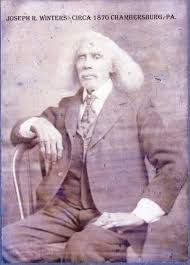
Joseph R. Winters (1840-1916) was an African-American inventor and firefighter, and this 1882 patent represents a significant refinement of his earlier ladder apparatus (patents in 1878 and 1879).
- Commitment to Safety: Winters applied his practical firefighting knowledge to develop safer and more accessible tools. His progression of patents for fire escapes—from truck-mounted to building-mounted—demonstrates his continuous effort to create reliable rescue solutions.
- The Problem Solver: This specific design addresses the logistical challenges of urban fire escapes: they must be readily accessible in an emergency yet unobtrusive when not in use.
Invention and Mechanism
The fire escape is a folding, permanently mounted system featuring a quick-release lock and an integrated alarm.
1. Folding Ladder Structure
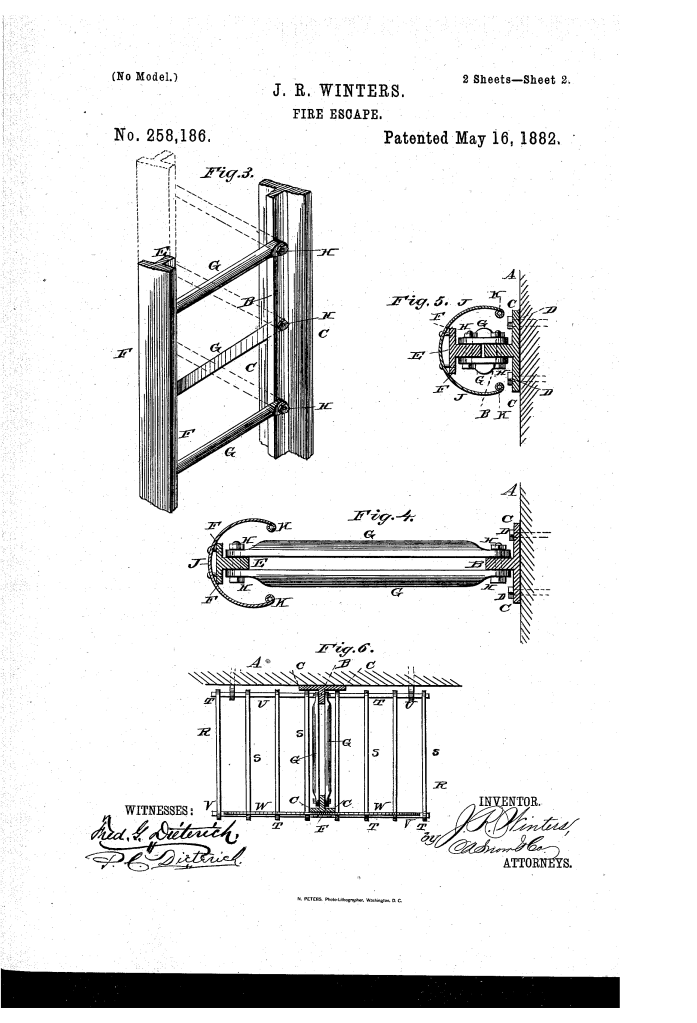
- Inner Rail (B): This rail is permanently secured to the wall (A) using flanges (C) and heavy bolts (D).
- Outer Rail (E): This rail is the movable component.
- Rungs (G): The rungs are pivoted (hinged by bolts H) between the fixed inner rail (B) and the movable outer rail (E).
- Alternating Placement: To facilitate folding without placing the rails too far apart, the rungs are placed alternately on opposite sides of the rails (B, E).
- Folding Action: When closed (Fig. 5), the movable rail (E) is raised, bringing the rails closely together and the rungs into a nearly vertical position, making the escape compact and unobtrusive.
- Safety Shield (J): A shield or casing (J) secured to the outer rail (E) with edges (K) formed as handles.
- Function: The shield protects the person descending and the edges (K) serve as handholds.
2. Deployment and Alarm (Key Innovation)
- Clutch/Bracket (L): A clutch secured to the wall (A) supports the lower end of the outer rail (E) when the ladder is in its closed position.
- Releasing Rope (M): A wire rope (M) leads from the clutch (L) to the top of the building, with branches (N) at every floor.
- Function: Pulling any branch (N) disengages the clutch (L), causing the outer rail (E) to drop instantly until it rests on the ground, extending the ladder for use.
- Integrated Alarm (O, P, Q): An alarm-bell (O) is connected to a trigger (P) via a rope (Q), which is attached to a movable part of the escape-ladder (e.g., a jointed brace).
- Function: The alarm (O) is instantly sounded when the ladder is extended, warning the building’s inmates of the danger or tampering.
3. Auxiliary Platform
- Folding Platforms (R): Optional small platforms formed by rungs (S) hinged to horizontal rods (U, V) on the wall and outer rail (E).
- Function: These fold with the ladder and are designed to make the escape easier for “females and children” when extended.
Concepts Influenced by This Invention
Winters’s building-mounted fire escape influenced subsequent life safety and security systems by pioneering remote, quick-deploy functionality with integrated anti-tampering alarms.
- Remote Quick-Deploy Systems: The concept of using a simple, accessible wire or cord (M, N) to instantly release a complex, gravity-deployed mechanism influenced the design of modern emergency releases, safety drop systems, and breakaway latches in buildings and industrial equipment.
- Integrated Alarm/Security Interlocks: The use of the ladder’s movement to automatically sound an alarm (O) is a precursor to modern security interlocks and tamper-detection systems in safety equipment. This ensures that unauthorized or accidental use immediately notifies occupants.
- Folding/Articulated Guard Rails: The design principle of hinging a rail (E) to collapse the entire structure into an unobtrusive, vertical profile influenced the design of modern fold-down guard rails, boat ladders, and accessible ramps that must be secured and hidden when not in use.
- Shielding for Safety: The inclusion of a shield or casing (J) on the outer rail to protect the user (and provide handles) influenced the ergonomic design of later safety equipment that requires protection from the rigid structure during dynamic use.
