
Fire Escape Bracket (1897)
U.S. Patent No. 596,427, granted on December 28, 1897, to Charles V. Richey, describes a multi-purpose window-sill bracket designed to anchor a flexible fire-escape ladder. Charles V. Richey, an inventor based in Washington, D.C., assigned one-half of the patent rights to Leonard C. Bailey, a prominent African American inventor and businessman from the same city.
This invention addressed two major challenges of urban life in the late 19th century: providing a reliable, easily accessible emergency escape route for multi-story buildings and conserving limited living space by creating a device that serves everyday furniture functions when not in use.
The Innovation: The Four-in-One Convertible Bracket
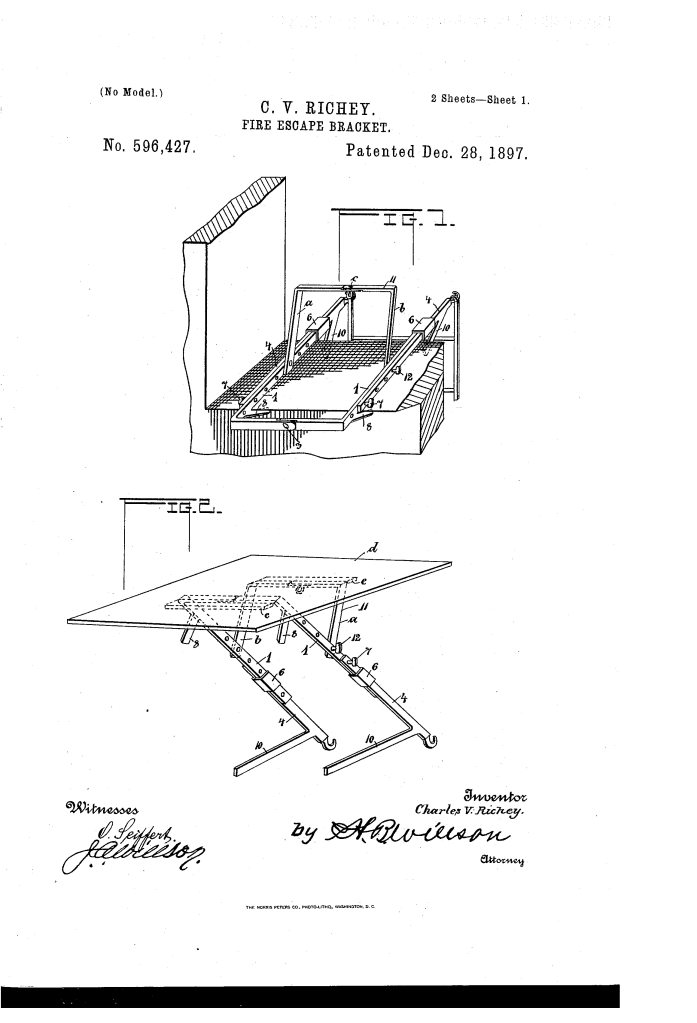
Rather than remaining an unsightly or space-consuming piece of single-use emergency hardware, Richey’s design functions as a four-in-one convertible structure. Depending on its orientation and adjustment, it serves four distinct uses:
- Fire-Escape Bracket: Anchors to a window sill to securely hold a jointed or flexible escape ladder.
- Center-Table: Converts into a small floor table by attaching a flat tabletop across its frame.
- Writing-Desk: Inverts to provide an inclined surface suitable for reading or writing.
- Umbrella-Rack: Positions vertically against a wall to hold umbrellas and walking sticks.
Key Structural Components
The apparatus relies on a telescoping, adjustable frame engineered to clamp securely across window walls of varying thicknesses:
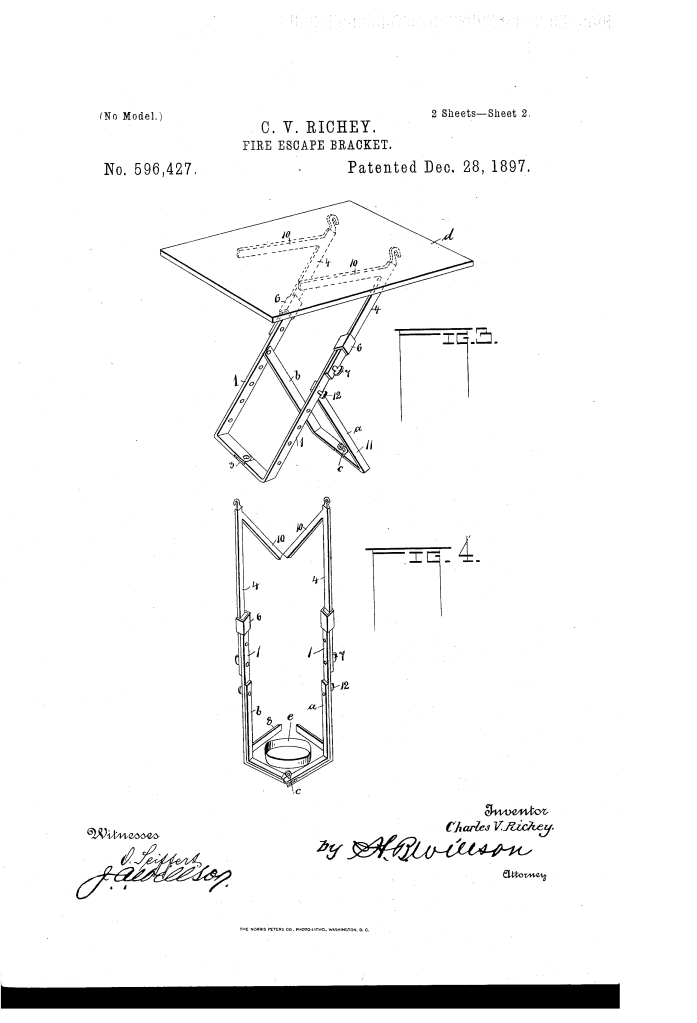
ComponentFunctionInner Arms (1)Provide the primary structural support; pivoted together at their overlapping inner ends by a central bolt (3) and feature horizontal rows of adjustment perforations.Outer Arms (4)Slide parallel along the inner arms via guide collars (6) and lock into position using set screws (7) engaged in the perforations.Inner Legs (8) & Outer Legs (10)Project downward at acute angles to clamp against the interior and exterior sides of the window wall, creating a rigid anchor.Terminal HooksLocated at the outer ends of the outer arms (4) to firmly hold the flexible rope or jointed ladder.Adjustable Bail (11)A two-part hinged handle (a, b) attached by set screws (12) that serves as a handhold for stability during an escape, a brace for table/desk configurations, or an attachment point for a hoist pulley.
How the Apparatus Functions
The operational sequence varies based on the selected mode:
Fire-Escape Deployment
- Adjustment: The sliding outer arms (4) are extended or retracted until the inner legs (8) and outer legs (10) firmly grip the inside and outside of the building wall at the window sill.
- Locking: Set screws (7) are tightened into the perforations of the inner arms (1) to prevent slipping under weight.
- Bail Elevation: The hinged bail (11) is rotated upward, offering a sturdy handrail for an individual stepping out of the window onto the suspended ladder.
Furniture Conversions
Center-Table Mode: The main frame sits flat on its legs, and a removable tabletop (d) fitted with retaining cleats (e) is placed across the bail and arm extensions to prevent tilting.
Writing-Desk Mode: The unit is inverted, and the bail (11) is adjusted along the perforations to act as an angled brace, creating an inclined writing surface when a board is laid across the legs.
Umbrella-Rack Mode: The assembly is leaned vertically against a wall, utilizing the open framework and leg spans to support umbrellas.
Historical and Scientific Impact
Richey and Bailey’s fire-escape bracket offered practical safety and economic advantages for urban residential spaces:
Space Efficiency: Designed explicitly for locations like hotel rooms and apartment dwellings, it eliminated the clutter of dedicated emergency equipment by integrating seamlessly into household furnishings.
Universal Fit: The telescoping arm mechanism allowed the bracket to fit non-standard wall thicknesses without requiring permanent structural modification to the building.
Collaborative Legacy: Co-owner Leonard C. Bailey was a notable Black inventor and entrepreneur in Washington, D.C., known for inventing the folding army bed (U.S. Patent No. 629,286) and serving as a board member of the Capital Savings Bank.
About the Inventor: Charles V. Richey
Charles V. Richey was an inventor operating out of Washington, D.C., during the late 19th century. His work focused on practical mechanical solutions, home utility devices, and hardware design aimed at improving personal safety and functional convenience in everyday living spaces.
Summary of Claims
The patent explicitly claims:
An adjustable bracket structure comprising two sets of telescoping arms, with one set sliding and locking relative to the other via set screws and perforations.
An arrangement of angular extensions pivoted together, paired with inner and outer downwardly projecting legs designed to grip a wall surface.
An outer arm assembly featuring dedicated attachment points for securing a flexible escape ladder.
A two-piece hinged bail adjustably attached to the frame to serve as a steadying handle, hoist mount, or structural brace.
