
Fire-Escape Bracket (Charles V. Richey, No. 596,427)
The patent by Charles V. Richey of Washington, D.C., describes an improved Fire-Escape Bracket (Patent No. 596,427, 1897) designed to be placed and retained in connection with a window-sill for supporting a fire-escape ladder. The core innovation is that when not in use, the device is convertible into four separate and distinct household items: a writing-desk, a center-table, or an umbrella-rack.
Inventor Background: Charles V. Richey
Charles V. Richey was an African-American inventor who focused on practical solutions for safety, convenience, and utility.
- Safety and Utility: Richey is also known for his patented improvements in Railroad Switches (e.g., No. 592,448), which focused on automated safety. This patent, the Fire-Escape Bracket, shows his versatility, addressing critical public and domestic safety needs (fire escapes) while maximizing the utility of the hardware in a domestic setting (convertible furniture).
- The Context of the Invention: His work, particularly the combined cot/hammock/stretcher and this bracket, often targeted solutions for military or institutional use while ensuring the design was simple and economical.
Invention and Mechanism
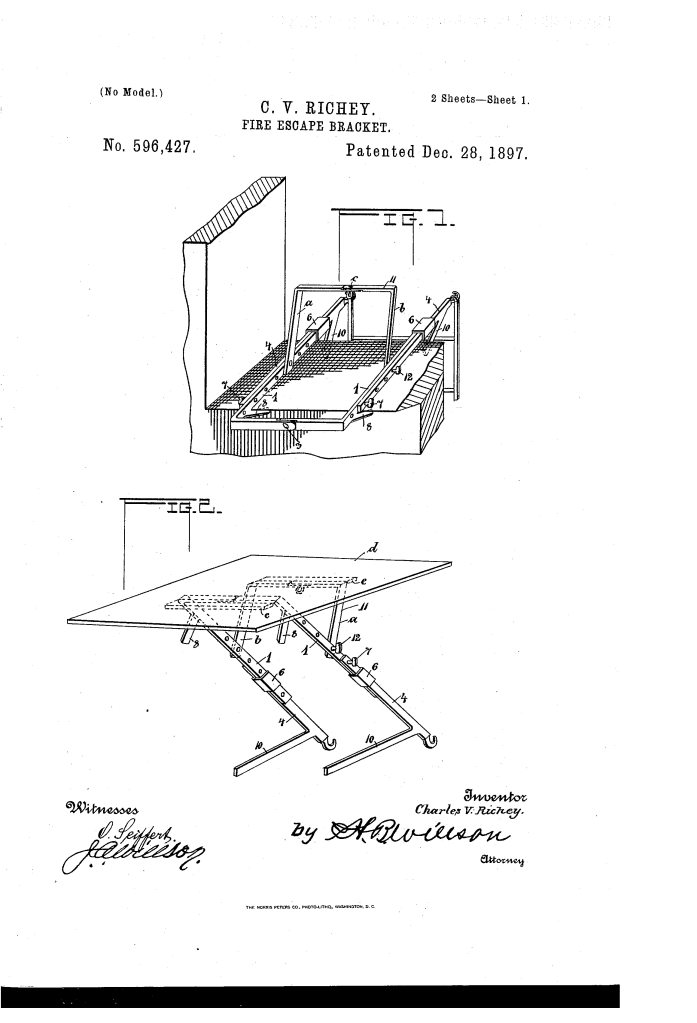
The device is a system of telescoping and hinged rods that clamp onto a window and can be configured into multiple structures.
1. Fire-Escape Bracket (Primary Function)
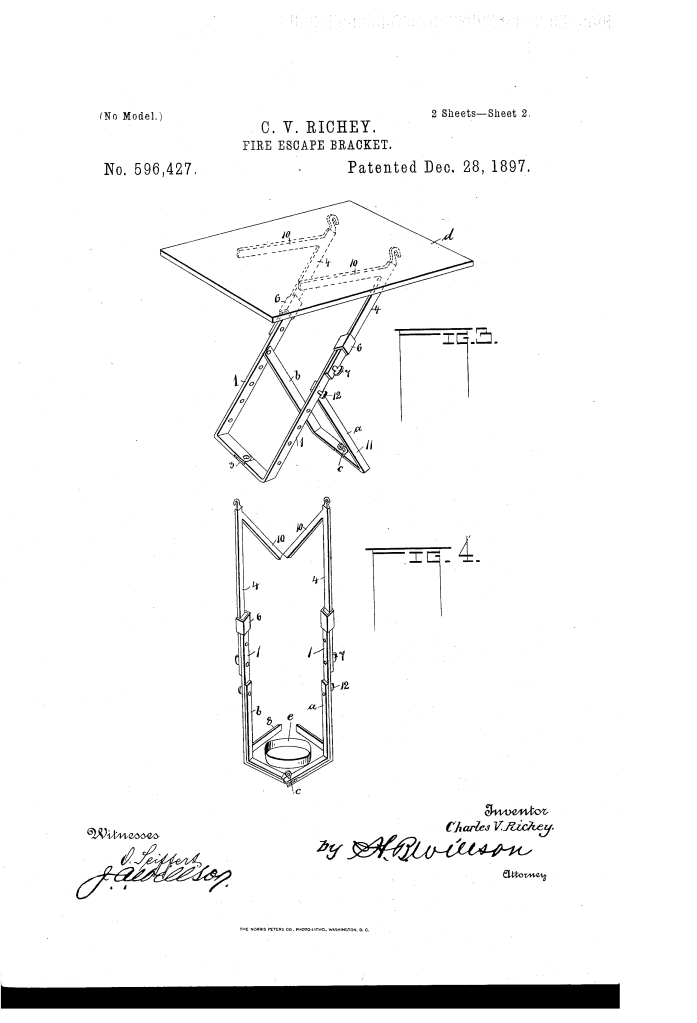
- Telescoping Arms: Consists of inner rods (1, 2) and outer arms (4) that slide over the inner arms via collars (6). Set screws (7) lock the arms in place, allowing for longitudinal adjustment to fit different wall thicknesses.
- Clamping: The inner arms are pivoted at the center (3), and both sets of arms have downwardly-projecting legs (8, 10).
- Function: The arms are adjusted so the legs (8 and 10) engage the inside and outside of the wall, securing the device to the window-sill.
- Ladder Attachment: The outer arms (4) are provided with hooks for securing the flexible fire-escape ladder.
- Bail (11): A hinged bail secured to the inner arms. When deployed, it affords a handle or means for a person to steady himself while getting onto the ladder.
2. Multi-Purpose Conversion (Key Innovation)
The adjustability of the arms and bail allows for three alternate uses when the ladder is detached:
- Center-Table (Fig. 2): The arms are configured horizontally, and the bail (11) is swung up. A removable top () is placed upon the bail and the lateral extensions of the inner arms, forming a level table.
- Writing-Desk/Table (Fig. 3): The entire device is inverted from its normal position. The bail (11) is swung out and adjusted to serve as a brace to achieve the proper writing inclination. A board is placed upon the now-upward-facing legs.
- Umbrella-Rack (Fig. 4): The arms are adjusted into a vertical or near-vertical configuration against the wall, with the outer legs leaned against the wall to act as a stand for umbrellas or canes.
Concepts Influenced by This Invention
Richey’s bracket influenced subsequent consumer and safety products by pioneering the concept of convertible, multi-functional safety equipment.
- Convertible Safety Hardware: The most direct influence is the idea of maximizing the utility of safety infrastructure by designing it for a secondary, mundane use. This influences modern design where safety equipment (like ladder access systems or utility boxes) is often disguised or converted into architectural features.
- Telescoping/Adjustable Clamping: The use of telescoping arms (4, 1) with set screws (7) to achieve adjustable, non-destructive clamping across a variable width (the wall thickness) influenced the design of universal mounting brackets and specialized clamping jigs.
- Kinematic Multi-Functionality: The reliance on reconfiguring a single set of hinged and pivoting rods (11) to achieve three entirely different geometric forms (a table, an inclined desk, and a vertical rack) influenced the engineering of modern convertible furniture and modular display systems that achieve multiple uses from minimal components.
- Integrated Handle/Stabilizer: The design of the bail (11) to serve both as a safety handhold and a structural table support/desk brace influenced the design philosophy of integrated utility components in portable equipment.
