

Fertilizer-Distributer (1894)
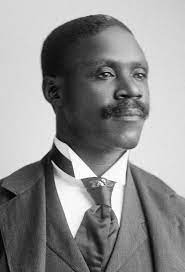
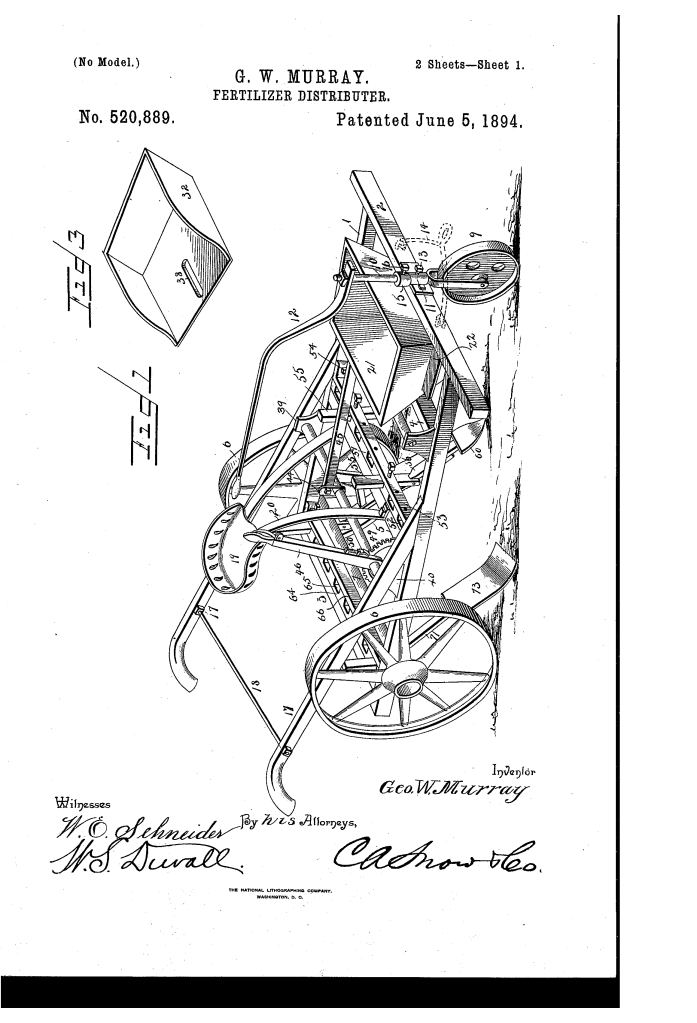
U.S. Patent No. 520,889, granted on June 5, 1894, to George W. Murray, describes a mechanical agricultural implement designed to automate the uniform drilling and covering of crop fertilizer. George W. Murray, an inventive genius, educator, and U.S. Congressman from South Carolina, dedicated his efforts to engineering advanced implements that optimized field efficiency for Southern farmers.
This specific invention solved a persistent problem in late 19th-century agriculture: the uneven distribution of commercial fertilizing agents when applied by hand, while simultaneously executing the separate tasks of furrowing the earth and burying the nutrients under a protective layer of soil.
The Innovation: The “Mechanical Vibration” Drive
Prior to Murray’s design, mechanical distributers often suffered from internal clogging, as heavy or moist fertilizers would compact within the dispensing mechanisms.
Murray’s breakthrough was a synchronized, ground-driven vibratory shoe mechanism. By pairing a chain-driven crank-shaft with a loosely pivoted distributing pan, the machine converted the smooth forward roll of the wheels into a rapid, short, jerky horizontal oscillation. This mechanical vibration continuously agitated the fertilizer, ensuring it broke apart and drilled evenly into the fresh furrows without bridging or packing.
Why the Integrated System Mattered
- Dual-Shovel Processing: The machine utilizes a specialized tandem plowing system. A pair of front shovels clears a fresh path directly in advance of the fertilizer drop, while a rear pair instantly throws the displaced soil inward to cover it.
- Vibration Calibration: Through a threaded adjustment rod, the operator could alter the pitch and physical clearance of the vibratory shoe, allowing more or less fertilizer to be cast off during each oscillation.
- Simultaneous Bedding: Rather than requiring three separate trips through the field (furrowing, distributing, and covering), this single machine successfully forms a complete, nutrient-packed planting bed in one pass.
Key Mechanical Components
The machine utilizes a chain-driven network to translate wheel rotation into precise horizontal movement:
| Component | Function |
| Sprocket-Wheel (8) & Transverse Axle (7) | Captures the rotational energy of the revolving main ground-wheels to power the distribution system. |
| Crank-Shaft (24) & Sprocket (25) | Driven by a continuous sprocket-chain; features an offset central crank (27) that dictates the oscillation rhythm. |
| Slotted Standard (29) & Vibrating Shoe (32) | The standard rides the spinning crank-shaft within an elongated slot, translating rotary force into a rapid, back-and-forth horizontal vibration of the dispensing shoe. |
| Adjusting-Rod (35) & Stud (37) | A threaded manual rod linked to a slot in the rear of the shoe, used by the operator to finely tune the width and intensity of the shoe’s vibrations. |
| Front Shovels (60) & Rear Shovels (73) | The front pair uncovers the soil ahead of the chemical drop; the rear pair is angled to sweep soil inward, burying the fertilizer. |
| Rock-Shafts (41, 42) & Operating-Lever (46) | A linked dual rock-shaft assembly that enables the driver to raise all four plows entirely off the ground for clean transport. |
How the Apparatus Functions
The machine executes a seamless sequence of mechanical actions to till, drop, and seal the field row:
- Activation: The operator pulls the sliding hopper cut-off (22) outward to allow the fertilizer to gravity-feed downward into the lower distributing shoe.
- Furrowing: As the horses pull the framework forward, the front plowing shovels (60) turn the soil over, creating a uniform ditch directly beneath the hopper.
- Agitation: The revolving axle drives the sprocket chain (26), spinning the crank-shaft. As the crank turns inside the elongated slot of the vertical arm, it shakes the distributing shoe (32) in a rapid, horizontal motion.
- Distribution: This steady, jerky vibration sifts the fertilizer evenly out of the open end of the shoe, drilling it directly into the freshly cleared furrow.
- Bedding: Trailing at the rear, the secondary angled shovels (73) immediately plow the surrounding earth back inward, burying the fresh nutrients and forming a reinforced crop bed.
About the Inventor: George W. Murray
George Washington Murray stands out as an extraordinary pioneer of industrial agriculture in the post-Reconstruction era.
- Patents: Born into enslavement, Murray went on to secure eight distinct U.S. patents between 1891 and 1894. His portfolio formed a comprehensive, modular mechanized farming suite, featuring an oil-press, a cotton-chopper, a combined planter, and multiple specialized distributors.
- Political Impact: Murray was elected to the 53rd and 54th U.S. Congresses as the sole Black representative of his tenure. On the house floor, he fiercely defended the intellectual and creative capacity of Black Americans, famously reading his own agricultural patents into the Congressional Record to secure national recognition for minority inventors.
- Legacy: His engineering work prioritized affordability, durability, and multi-functional operation, directly assisting independent farmers in maximizing crop yields while lowering grueling field labor hours.
Summary of Claims
The patent explicitly claims:
- The combination of a superimposed hopper and a vibrating distributing shoe operated via a crank-shaft moving inside a slotted vertical standard.
- A mechanical link configuration transmitting driving power directly from a transverse wheel axle to a cranked shaft via coordinated sprocket-wheels and chains.
- A threaded adjusting rod hooked via a sliding stud into the discharge-end of the vibratory pan to regulate distribution volume.
- The integration of adjustable front and rear shovel standards attached to a linked rock-shaft system, allowing the simultaneous opening, drilling, and closing of fertilizer beds.
