
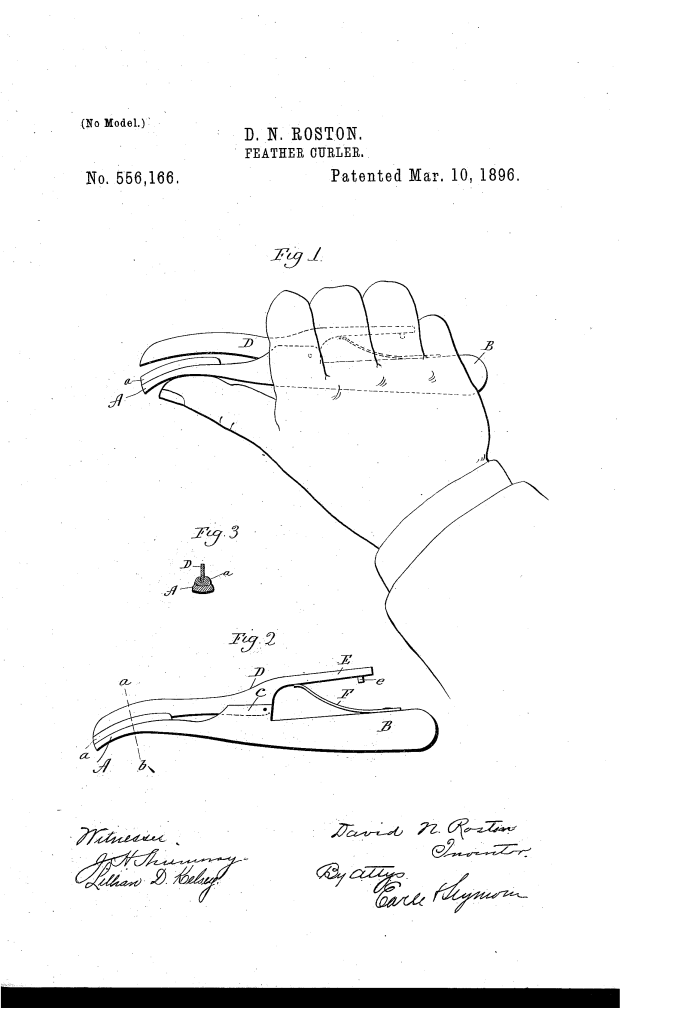
Feather-Curler (1896)
U.S. Patent No. 556,166, granted on March 10, 1896, to David N. Boston, describes an ergonomic hand tool designed to rapidly curl ornamental feathers without injuring the operator’s hands. David N. Boston, an inventor based in New Haven, Connecticut, developed this specialized apparatus during the height of the late-19th-century millinery movement, when feathered hats and decorative plumes were major staples of global fashion.
This specific invention solved a painful and persistent problem in the garment and millinery industries: the physical strain and severe bruising caused by manually curling thousands of individual feather flues by hand.
The Innovation: The Yielding Rubber Cushion
Traditionally, feather dressers curled flues (the delicate barbs branching off a feather’s main shaft) by pressing them against the hard edge of a knife or shears with their thumb and drawing the feather through under heavy pressure. Doing this repeatedly caused severe physical injury to the operator’s thumb over a short work shift.
Boston’s breakthrough was replacing the human thumb with a contoured, spring-loaded guard member featuring a flexible rubber cushion. By designing a mechanical cushion that duplicated the yielding feel and texture of human flesh, Boston allowed workers to achieve tight, uniform curls without applying direct thumb pressure.
Key Mechanical Components
The device operates via a dynamic lever-and-spring assembly engineered for one-handed operation:
| Component | Structural Reference | Function |
| Curved Guard Member | Handle base (B), Guard (a) | Shaped to match the natural anatomical curve of the human thumb, acting as a sturdy protective shield. |
| Rubber Cushion | Cushion (a’), Groove (b) | A yielding pad of rubber attached to the guard face that mimics flesh. Features a longitudinal groove (b) to receive the blade edge. |
| Pivoted Blade | Blade (D), Trunnions (C) | A curved metal blade mounted on pivot trunnions (C). Its curvature perfectly matches the rubber cushion below it. |
| Lever Tail & Stud | Tail (E), Stud (e) | An extension of the blade passing over the handle. A built-in stud (e) limits how wide the blade can open. |
| Tension Spring | Spring (F) | Mounted between the handle (B) and tail (E). Automatically applies constant, uniform clamping pressure to the feather flues. |
How the Device Functions
The tool is held in one hand—fingers wrapped around the handle and tail lever, with the thumb rested safely underneath the guard member.
- Opening: The operator squeezes downward on the rear tail (E) of the blade, compressing spring (F) and lifting blade (D) off the rubber cushion.
- Insertion: One or more feather flues are slipped between the raised blade edge and the grooved rubber cushion (a’).
- Clamping: Squeezing pressure on the tail is released. Spring (F) instantly snaps the curved blade edge down into the cushion’s longitudinal groove (b), clamping the flues with calibrated force.
- Drawing: Holding the feather stem in the opposite hand, the operator pulls the feather through the clamped tool. The rubber cushion flexes like a human thumb, curling the flues cleanly and consistently.
Practical and Industrial Impact
Boston’s feather-curler provided key operational advantages for 1890s manufacturing:
- Operator Protection: Completely eliminated thumb contact with sharp blades and friction surfaces, preventing occupational injuries in millinery workshops.
- Uniform Clamping Force: Because spring (F) supplied the holding pressure rather than human grip strength, every flue received identical friction, ensuring consistent curl quality across large batches.
- Increased Speed: Reduced worker fatigue, allowing operators to process decorative plumes at a significantly faster rate than manual blade-and-thumb drawing.
About the Inventor: David N. Boston
David N. Boston was an inventor operating out of New Haven, Connecticut, during the late 19th century—a period when New Haven was a bustling industrial hub for specialized metalwork, small hardware, and consumer goods manufacture. Boston’s patent for the feather-curler highlighted a practical approach to workplace ergonomics and hand-tool design, applying spring tension and vulcanized rubber to automate a delicate manual trade.
Summary of Claims
The patent explicitly claims:
- A feather-curler comprising a guard member with a handle, an outwardly curved blade pivoted at the inner end to move perpendicular to the guard, and a longitudinally curved cushion mounted on the guard matching the blade’s curvature.
- The combination of a flexible cushion mounted on a guard face featuring a longitudinal groove, paired with a pivoted blade whose edge enters the groove to grip feather flues.
