
Window-Sash Fastener (1893)
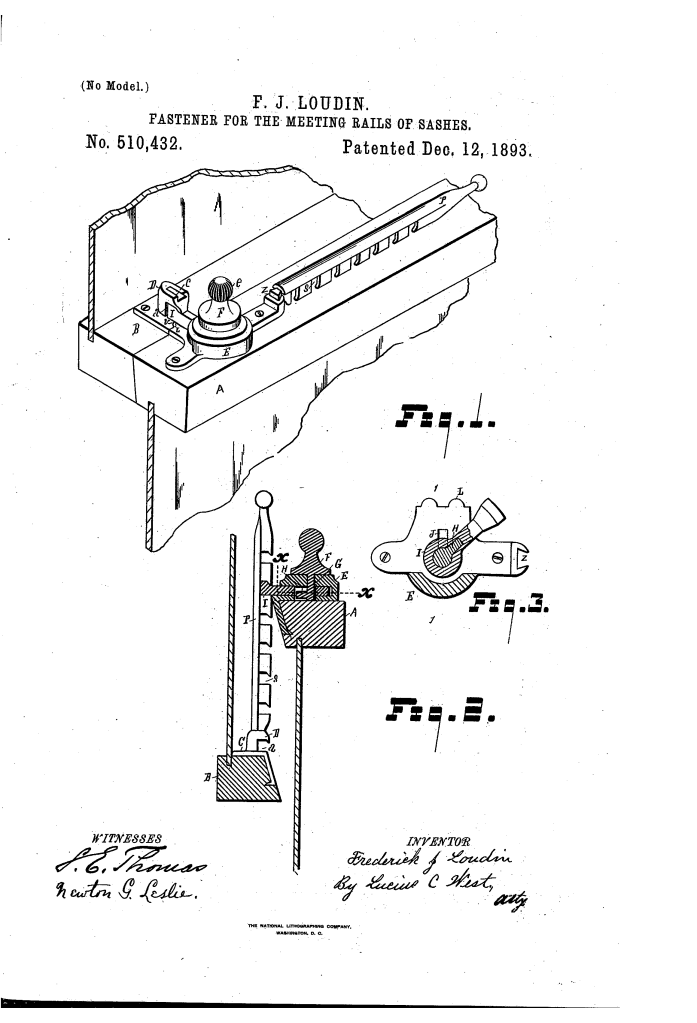
U.S. Patent No. 510,432, granted on December 12, 1893, to Frederick J. Loudin, introduces an ingenious home-security mechanism designed to prevent forced entry through windows. Loudin, a resident of Ravenna, Ohio, engineered a dual-action locking system that not only resisted common burglar tools but also offered a unique way to lock a window securely while leaving it partially open for ventilation.
This invention solved a critical vulnerability in standard 19th-century hardware: typical sash fasteners were easily bypassed by intruders inserting thin tools between the meeting rails to pry open the latch or force the screws out of the wood.
The Innovation: Anti-Burglar Ribs & The Keyed Turn-Cap
Loudin’s design moved away from simple, gravity-based or friction-latched crescent locks. Instead, he introduced an interconnected, internal locking mechanism housed within a recessed casting.
Why This Design Excelled:
- The Interlocking Guard: Loudin added vertical ribs (L) to the lower sash plate that slid into corresponding grooves (c) on the upper sash plate. This physical barrier made it practically impossible for a burglar to slide a saw or blade between the sashes to cut or manipulate the latch mechanism.
- Anti-Prying Prongs: Both plates featured sharp prongs (O) that bit deeply into the wooden window frames. If a housebreaker tried to pry the lower sash upward, these prongs transferred the force directly into the core of the timber, preventing the mounting screws from being stripped or pulled out.
How the Apparatus Functions
The locking mechanism utilizes a dual-motion turn-cap (F) that must be lifted before it can be rotated, creating a built-in deadbolt effect.
| Step | Action | Safety Purpose |
|---|---|---|
| 1. Locking | The turn-cap (F) is pushed down, dropping its keyed stem (G,H) into aligning keyholes in both the swinging lever (I) and the main housing (E). | Mechanically immoblizes the latch so it cannot be jimmied or vibrated loose from the outside. |
| 2. Disengaging | The homeowner pulls the milled turn-cap (F) upward, extracting the key (H) from the lower housing slot while keeping it engaged with the lever (I). | Clears the deadbolt obstruction, allowing the handle to turn freely. |
| 3. Opening | The cap is rotated, swinging the internal lever (I) completely out of the catch notch (a). | Unlocks the sashes so the windows can be raised or lowered. |
Technical Components
- Internally Recessed Casting (E): Mounted to the top rail of the lower sash (A), this heavy housing completely conceals the swinging lever, protecting it from external tampering.
- Swinging Lever (I): The primary latching arm that pivots horizontally into the keeper plate.
- Detachable Catch-Extension (P): A notched metal bar that solves a classic security dilemma. When inserted vertically into a specialized dovetailed mortise (c) on the upper catch plate, it allows the window to be raised several inches for fresh air while keeping the lever safely locked into a higher notch (s).
- Horizontal Storage Notch (z): When the extension bar is not being used to prop the window open, it snaps neatly into a horizontal resting position along the sash rail so it won’t be misplaced.
Historical and Scientific Impact
Frederick J. Loudin’s patent represents a sophisticated leap forward in building hardware and domestic security design during the late Victorian era.
- Integrated Home Security: Long before modern home alarm systems, Loudin recognized that true security meant reinforcing mechanical failure points (like screw extraction and tool-insertion gaps).
- The Ventilation Dilemma: Prior to this invention, opening a window for fresh air meant sacrificing security. Loudin’s adjustable extension bar provided a reliable “clamped” open state, a precursor to modern window ventilation locks.
About the Inventor: Frederick J. Loudin
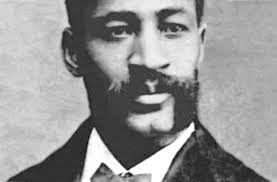
Frederick J. Loudin was an extraordinary 19th-century African American inventor, safety pioneer, and international public figure.
- Global Cultural Icon: Beyond his work as an inventor, Loudin was world-renowned as the leader, bass singer, and director of the Loudin Jubilee Singers (and previously a prominent member of the historic Fisk Jubilee Singers). He traveled the globe for years, introducing spirituals to international audiences and singing before royalty, including Queen Victoria.
- Business Leader and Activist: Based in Ravenna, Ohio, Loudin was a fierce advocate for civil rights and a successful businessman. He used the wealth earned from his musical career to invest in manufacturing and real estate, and he held multiple patents aimed at improving daily life and property safety.
- Legacy: Loudin’s multi-faceted career proved that artistic genius and technical engineering prowess could reside in the same individual, making him one of the most remarkable Renaissance men of the post-Reconstruction era.
Summary of Claims
The patent explicitly claims:
- A sash-fastener featuring an internally recessed casting housing a swinging lever, where both components utilize registering keyholes operated by a vertically adjustable, keyed turn-cap.
- The implementation of a interlocking notched catch-plate combined with a vertically deployed detachable catch-extension bar.
- The specific combination of a swinging lever on one sash rail acting in tandem with an adjustable, multi-notched extension attached to the opposing sash rail to allow secure, variable window positioning.
