
Patent Analysis: Fastener for the Meeting-Rails of Sashes
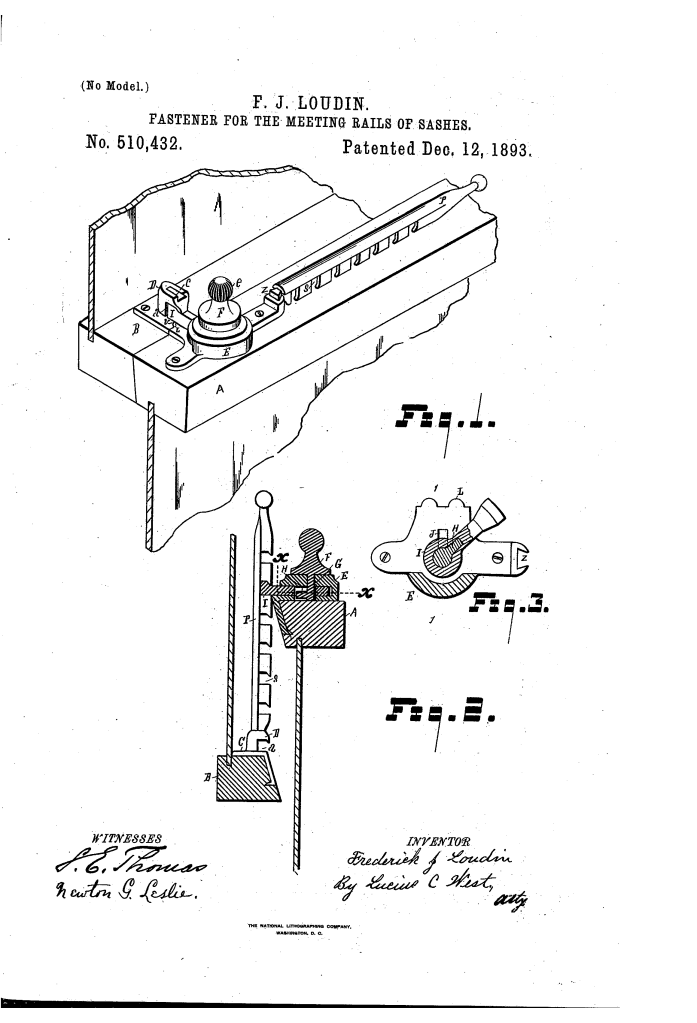
Patent No.: 510,432
Date: December 12, 1893
Inventor: Frederick J. Loudin, Ravenna, Ohio.
Title: Fastener for the Meeting-Rails of Sashes
The Invention
Frederick J. Loudin’s patent describes a highly secure and functional locking mechanism for double-hung window sashes (windows with two vertically sliding sections). The invention aims to improve upon existing sash fasteners by focusing on security, ventilation, and resistance to forced entry.
Key Features and Improvements:
- Locking Lever Mechanism: A swinging lever (I) on the lower sash’s upper bar engages a notched catch (D) on the upper sash’s lower bar.
- Burglar-Proof Lock: A key-operated turn-cap (F) with a pendent stem and key (H) can be vertically lowered to engage aligned key-holes in both the swinging lever (I) and its recessed housing (E). This action physically locks the lever from moving, preventing a burglar from swinging the lever out of engagement even if they manage to reach it.
- Anti-Pry Protection: Both the catch plate (C) and the housing (E) are fitted with ribs or prongs (O) designed to embed into the sash wood. This feature is explicitly intended to stop housebreakers from forcing the plates away from the sash by prying, which would typically draw out the fastening screws.
- Ventilation Fastening: A novel feature is the detachable catch-extension (P), a notched bar that slots into the main catch (D). When the upper or lower sash is opened for ventilation, the swinging lever (I) can engage one of the notches on this extension, locking the window in a partially open position.
Historical Significance and the Inventor
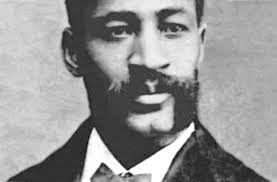
The inventor, Frederick Jeremiah Loudin (1836–1904), was a truly remarkable figure whose contributions went far beyond invention. Loudin was one of the foremost Black artists and entrepreneurs of the late 19th century.
- Pioneer and Artist: Loudin was best known as an internationally acclaimed singer, choral director, and manager of the famous Fisk Jubilee Singers, and later his own Loudin Jubilee Singers. He toured the world, performing spirituals and African American folk music for crowned heads of Europe and Presidents, using the proceeds to support Fisk University and other endeavors.
- Entrepreneur and Activist: Alongside his musical career, Loudin was an entrepreneur, owning a shoe manufacturing company in Ravenna, Ohio, that notably employed an integrated staff—a revolutionary act in the 1890s. He was also an activist, serving as a delegate to national conferences for Black men.
- The Context of Invention: In the late 19th century, with the rise of the Industrial Revolution, there was an increasing market for consumer hardware and security devices. The patenting of improvements to common household items, like the window sash lock, was booming. Loudin’s lock, patented just after a major world tour and while he was running his shoe factory, demonstrates the breadth of his innovation and his engagement with practical design problems.
The invention itself is a prime example of the focus on security and utility in Victorian-era hardware. The detailed features specifically to counteract common burglary techniques (prying, reaching the lever) reflect the public demand for a more secure home. Loudin’s design is a highly specialized improvement over the then-common Fitch sash fastener (a cam-action lock) by introducing a positive, key-based locking pin and anti-pry ribs.
Relation to Current Items
Loudin’s sash fastener represents a critical evolutionary step in window security, and its concepts are evident in contemporary hardware:
- Ventilation Locks: The concept of the detachable catch-extension (P) to lock a window in a partial-open state is used today in countless forms, from simple security bars to modern ventilation limiters or child-safety window restrictors. These devices serve the same dual purpose: allowing fresh air while maintaining security.
- Anti-Pry Design: While modern window frames are often metal or vinyl, the principle of securing the locking plate to resist prying is fundamental to today’s high-security door and window strikes, which use long, heavy-duty screws or anchors to penetrate deep into the framing structure.
- Key-Locking Fasteners: The idea of adding a separate, positive lock to the primary fastener is still a common security upgrade. Many contemporary window and door locks feature a cam-action primary lever combined with a secondary, cylinder-pin key lock—a clear descendant of Loudin’s two-part mechanism (swinging lever + key-locked stem).
