
Extension-Step for Cars (Daniel L. White, No. 574,969)
The patent by Daniel L. White of Cincinnati, Ohio, describes an Extension-Step for Cars (Patent No. 574,969, 1897). This invention provides a mechanically hinged, multi-section step unit that deploys to increase the number of steps in a car’s flight and features a crucial automatically folding safety device.
Invention and Mechanism
The device is a complex hinged assembly designed to add a lower step for safer passenger access and retract automatically to ensure clearance.
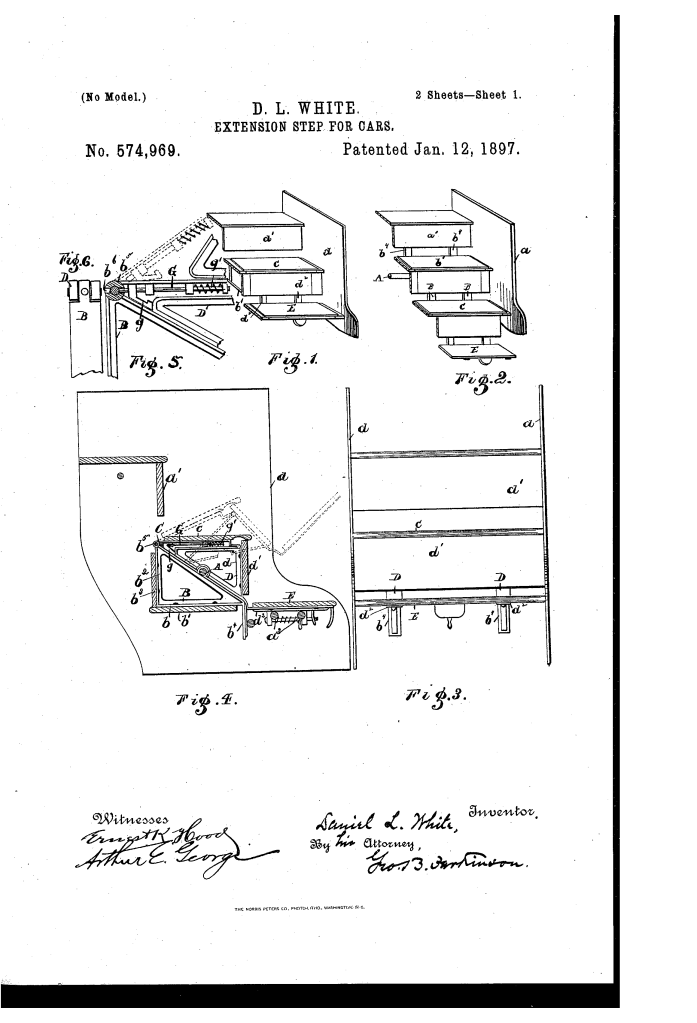
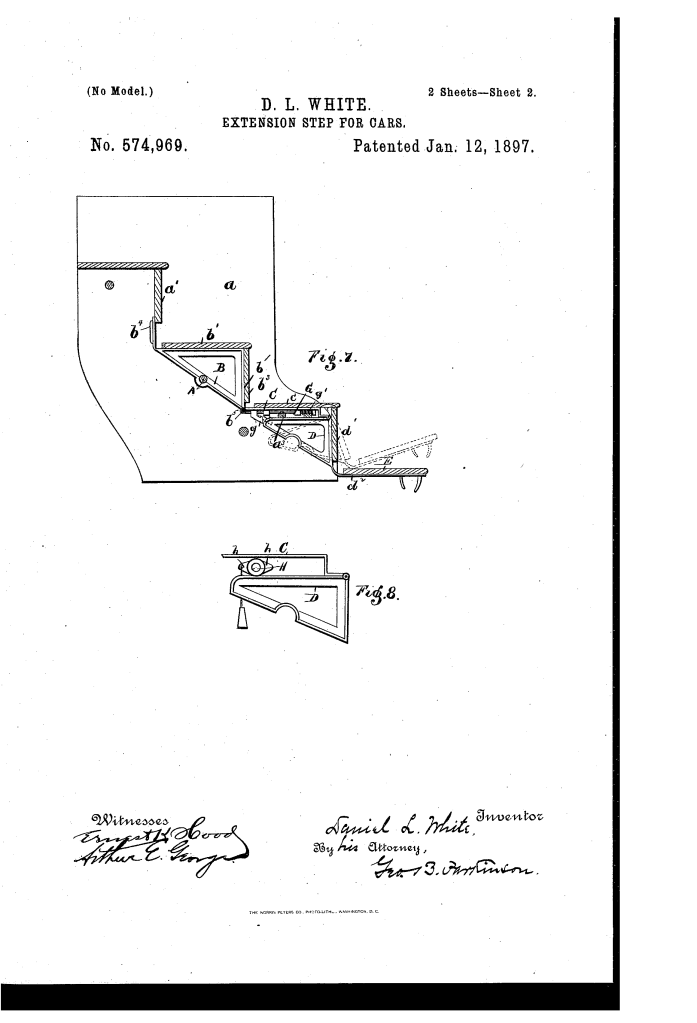
- Step Structure and Deployment: The device consists of one or more triangular main frames (B) and a final hinged frame (D) carrying the extension step (E). These frames are linked so that when deployed, the whole assembly advances downward by one step’s height, reducing the gap between the car and the platform.
- Locking and Unlocking: The frames are secured in the extended position by a sliding pin (G) that engages an aperture. The pin is actuated by the movement of the final step frame (D).
- Automatic Folding Safety Device (Key Innovation): The lock includes a weighted arm (H) connected to the pin (G). This arm is designed to swing upon receiving the jar incident to the car starting. The swing releases the locking pin (G), causing the steps to automatically fold back into the retracted position.
- Function: This ensures the steps cannot be left down as the train pulls away, preventing a major equipment clearance hazard.
Historical Significance and the Inventor
- Passenger Safety: The invention addressed a critical issue in 19th-century transit: the high step and large gap between the car and varying platform heights, a major source of passenger accidents. White’s device improved safety by providing a mechanical means to reduce the drop height.
- Automatic Safety: The most significant innovation is the jar-actuated automatic folding mechanism. This simple inertial lock was a vital early solution to ensure equipment integrity and safety without relying on complex electrical systems or operator memory.
- The Inventor (Daniel L. White): White contributed a highly practical safety solution to the necessary infrastructure of the expanding American railway and streetcar systems.
Concepts Influenced by This Invention
White’s design influenced subsequent mechanical safety, deployment, and retraction systems in transportation by pioneering inertia-based safety overrides.
- Inertial/Vibration-Actuated Safety: The core concept of using a weighted arm (H) triggered by inertia or vehicle vibration to disengage a safety lock is a crucial precursor to modern:
- Inertial Switches: Used in vehicles to activate safety features (like airbags or fuel pump cut-offs) upon sudden impact.
- Vibration-Based Interlocks: Safety systems on machinery that detect the start of motion to lock or unlock essential components.
- Multi-Stage Articulated Deployment: The use of complex, hinged linkages and triangular frames to achieve a controlled, non-linear (pivoted) extension and retraction of a stable, horizontal structure influenced the design of modern folding access ramps, telescopic bus steps , and specialized vehicle gangways.
- Self-Contained Folding Mechanisms: The overall goal of designing a system that will automatically fold when its lock is released (often relying on gravity and hinge placement) is a principle of efficiency used in aircraft landing gear and other mechanisms where retraction must be rapid and reliable.
