
Extension Banquet Table (1898)
U.S. Patent No. 614,468, granted on November 22, 1898, to Felix Hadley Harding, describes an adaptable, multi-configuration table designed to expand from a modest domestic table into a large banquet layout. Harding, an inventor based in Cleveland, Ohio, created a mechanical frame assembly capable of shifting between circular and oblong forms while incorporating a built-in centerpiece mechanism directly into the base.
This invention addressed the mechanical rigidity and aesthetic limitations of conventional extension tables: how to provide seamless support for diverse table shapes while discreetly concealing expansion hardware and integrating living floral displays or water features directly into the furniture.
The Innovation: The Concealed Extension and Centerpiece Tank
Standard extension tables of the late 19th century relied on linear wooden slides that limited configurations to simple elongated rectangles. Harding’s design combined a multi-directional folding perimeter framework with an integrated, vertically adjustable reservoir housed inside the central column.
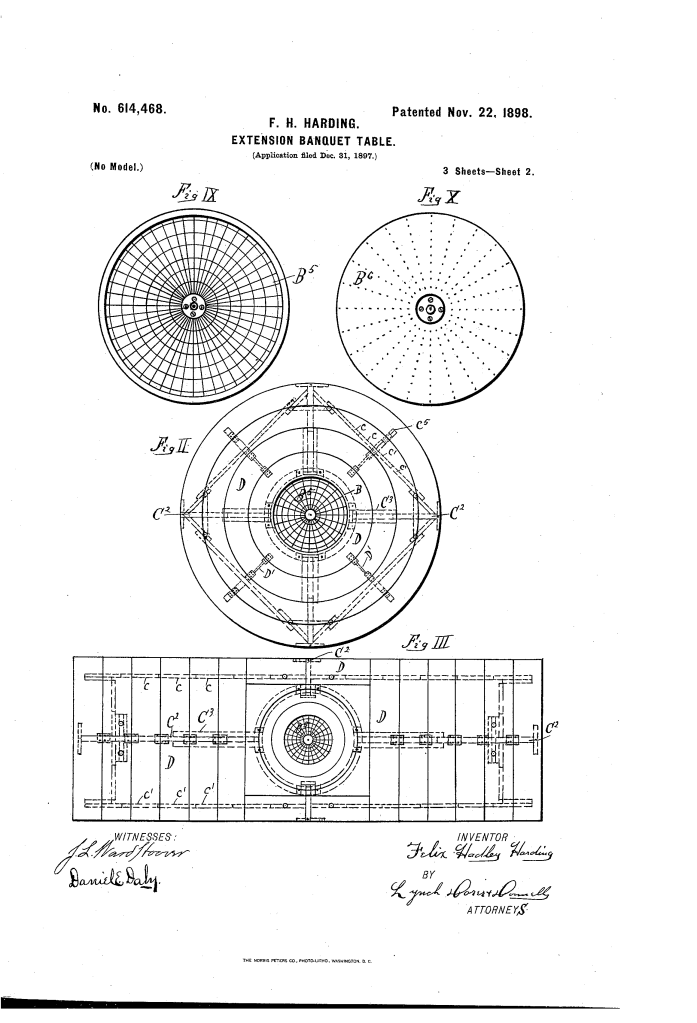
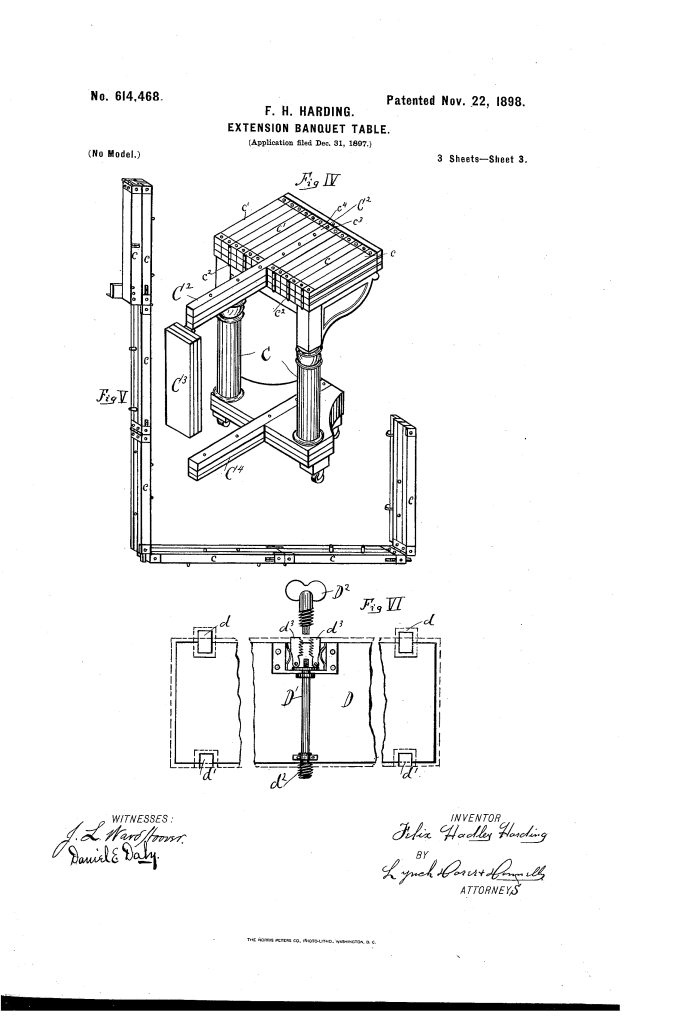
- The Articulated Folding Frame (c, c1, c2, c3)The framework under the leaves uses a network of folding bars hinged together at alternating ends (c4, c5).
- Flexibility: The hinged links swing outward into curved or rectilinear arrangements, allowing the table to convert into a round breakfast format or an extended oblong banquet structure.
- Support: Four sliding leg platforms (C, C1) extend outward on grooved tracks (C2, C4) guided by spuds (a3), keeping the outer edges rigidly supported regardless of footprint.
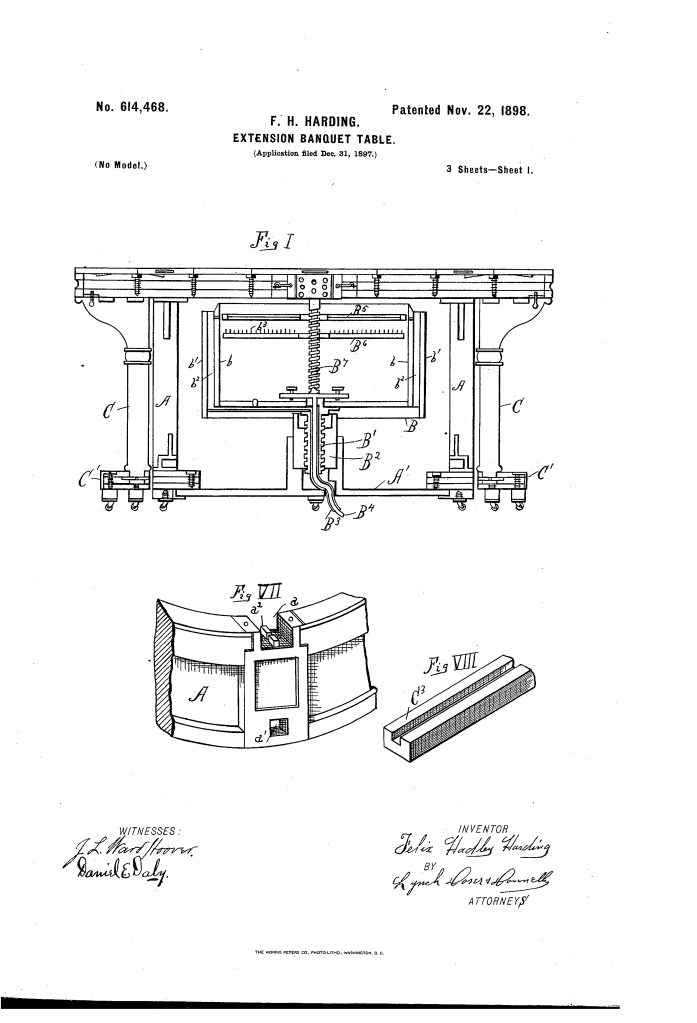
- The Pedestal and Vertical Centerpiece (A, B)The central cylindrical pedestal acts both as structural storage for the retracted framework and as a protective housing for an adjustable water tank.
- Elevation Mechanism: The tank is mounted on a hollow threaded stem (B1) running into a threaded standard (B2). Rotating the tank raises it to expose floral displays above the tabletop or lowers it completely out of view beneath removable leaf inserts.
- Integrated Plumbing: Harding incorporated a feed pipe (B5) and double-walled overflow jacket (b, b1, b2, B4), allowing the unit to act as a living botanical container or an active tabletop fountain.
Technical Components
Pedestal (A): The cylindrical core column; receives the retracted slides and concealed extension bars when closed.
Centerpiece Tank (B): Double-walled reservoir adjustable in height via central screw threads.
Stem Retaining Disks (B6, B7): An upper perforated guide plate (B6) and lower pin plate (B7) that keep cut flower stems upright and hydrated.
Interlocking Leaf Fasteners (D1, d1, d2): Transverse rods traversing the table leaves, pairing an external screw thread (d1) with spring-loaded toothed jaws (d2) and alignment cleats (d) to lock leaf joints securely against gaps.
Structural Configurations and Operations
Harding’s design adjusts across configurations using a structured sequence of mechanical changes:
| Configuration | Structural Action | Intended Use |
| Compact (Closed) | Slides (C2, C4) fully retracted into pedestal (A); folding bars collapsed; centerpiece lowered and covered. | Everyday breakfast table, utility table, or compact domestic furniture. |
| Circular Banquet | Outer legs (C) extended radially; bars (c, c1, c2, c3) unfolded into a curved perimeter; central leaves removed to expose floral basin. | Round dining arrangement with prominent botanical centerpiece. |
| Oblong Banquet | Slides extended outward in opposite directions; bars locked end-to-end (c6) linearly; leaves joined with rod fasteners (D1). | Extended formal banquet seating accommodating large gatherings. |
Mechanical Advantages
- Structural Concealment: When collapsed, the dropped slides, frame links, and reservoir descend within the cylindrical pedestal, hiding the mechanical elements from view.
- Joint Rigidity: The spring-actuated jaws (d2) grab the threaded rods (d1) instantly upon insertion, drawing leaf edges tightly together without surface hardware.
- Dynamic Centerpiece Display: The dual-disk floral anchoring system prevents arrangements from shifting or wilting during extensive banquet service.
About the Inventor: Felix Hadley Harding
Felix Hadley Harding was an inventor operating in Cleveland (Cuyahoga County), Ohio, during the height of late-19th-century American mechanical patent innovation. His work on convertible furniture demonstrated a sophisticated command of mechanical linkages, fluid management, and structural wood-and-metal engineering tailored to urban domestic spaces and formal social halls.
Summary of Claims
The patent explicitly claims:
- A convertible table combining a hollow pedestal support with an integrated, vertically adjustable central reservoir equipped with water-supply and overflow channels.
- A internal floral support assembly featuring a lower pin-studded plate and an upper perforated guide plate adjustably positioned within the reservoir.
- A transverse leaf-locking mechanism featuring an external screw thread that engages spring-actuated, internally threaded jaws.
