
Extension Banquet-Table (Felix Hadley Harding, No. 614,468)
The patent by Felix Hadley Harding of Cleveland, Ohio, describes an Extension Banquet-Table (Patent No. 614,468, 1898). The invention’s primary objective is to provide a versatile table that can be quickly and easily adjusted in size and shape, transforming from a small breakfast or work-table into a large banquet-table. A secondary, ornamental feature is a central, adjustable flower container.
Inventor Background: Felix Hadley Harding
Felix Hadley Harding was an inventor focused on domestic and commercial furniture design, specifically targeting modularity and space-saving utility. His invention addresses the need for flexible dining and meeting spaces in homes, hotels, or clubs, where the table size must change frequently to accommodate varying numbers of guests.
Invention and Mechanism
The table uses a central pedestal and multiple collapsible, folding support bars to allow for a dramatic expansion of the tabletop.
1. Frame Extension and Modularity (Key Innovation)
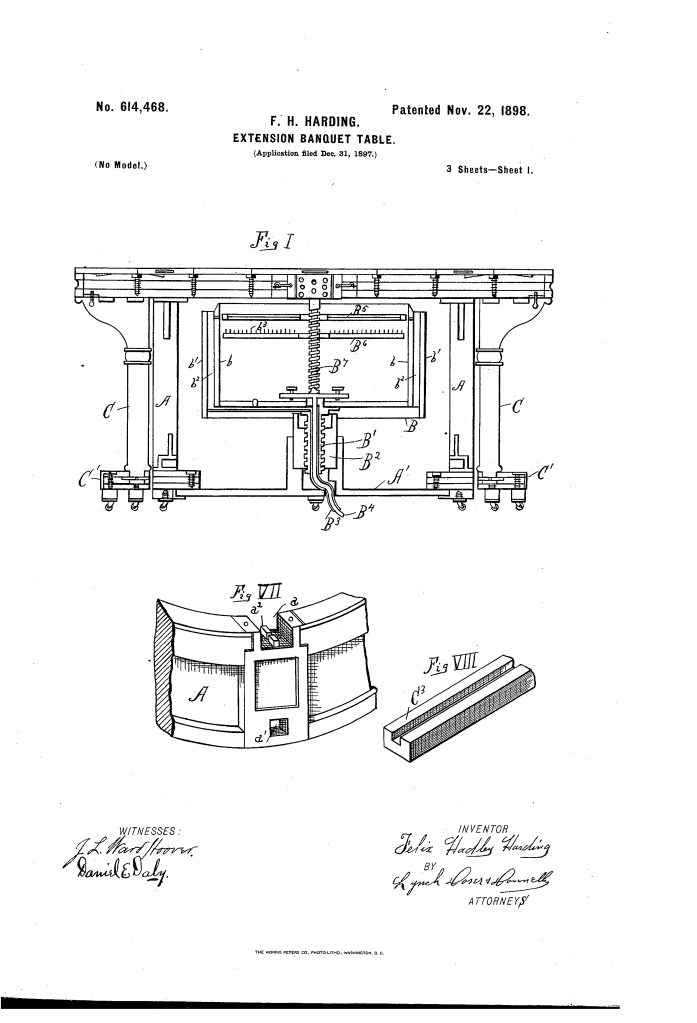
- Central Pedestal (A): The main support, which also acts as a repository for folded internal parts.
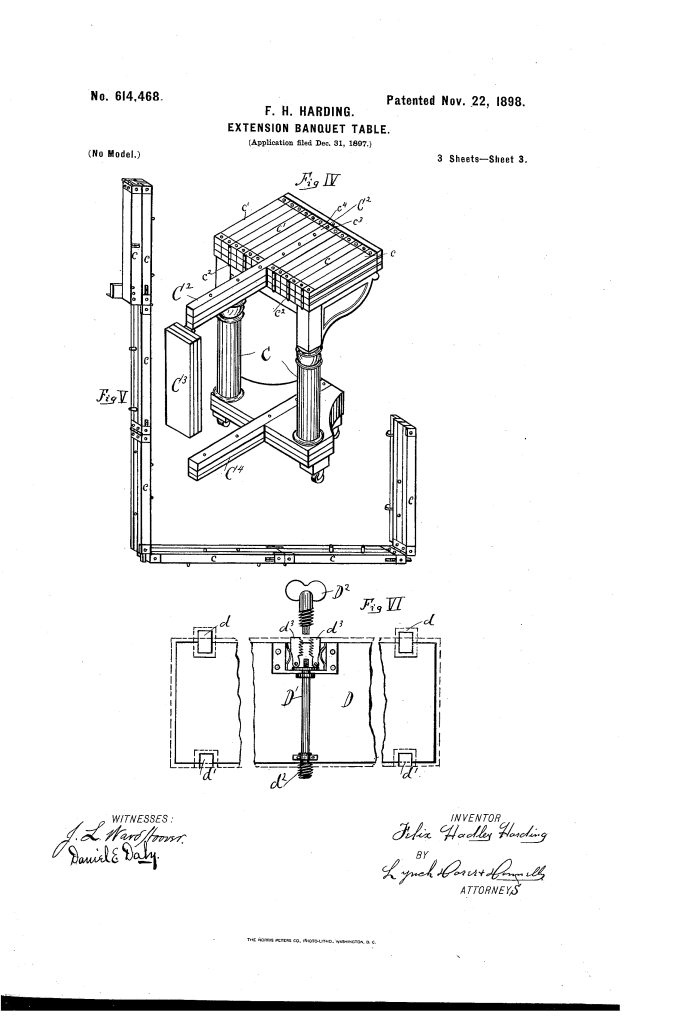
- Legs/Supports (C): Four adjustable legs/supports, often on casters, that are initially close to the pedestal.
- Folding Bars (): The tops of the legs (C) are equipped with a series of hinged bars that can be unfolded (unlatched from slide
) to form an expansive support frame.
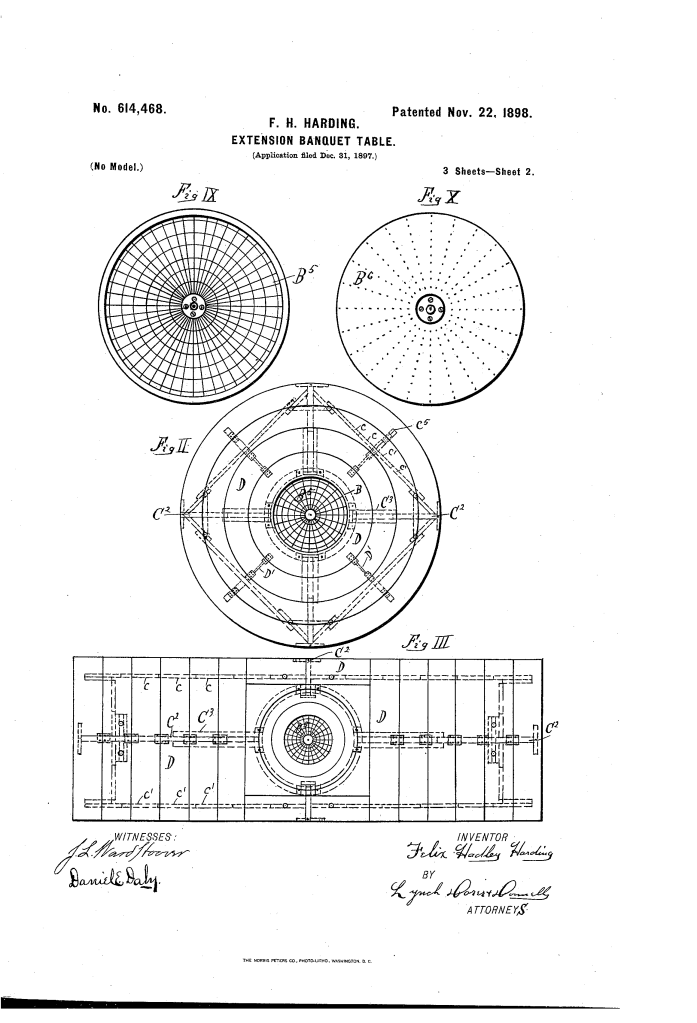
- Function: When unfolded, these bars connect the four corner legs to form a massive external support structure. The various tabletop sections are then laid upon this extended frame to convert the table into a circular (banquet) or oblong shape (Figs. II and III).
- Slides (): Slides on the legs (C) and the pedestal (A) engage ways (
) to guide and secure the legs as they are moved out from the center.
2. Tabletop Locking
- Table Sections (D): The tabletop is made of multiple sections (leaves) that fit together.
- Locking Bolt: A bolt extends transversely through a table section. One end has external screw-threads (), and the opposite end has internally-threaded spring-pressed jaws ().
- Function: This mechanism allows the screw-threaded end of the bolt from one leaf to be easily inserted into the opposing spring-pressed jaws of the next leaf, where it securely engages, holding the contiguous sections firmly together.
3. Adjustable Center Ornament (Flower Tank)
- Tank (B): A double-walled, watertight tank mounted in the center of the pedestal (A). The space (
) between the walls collects overflow.
- Vertical Adjustment: The tank has a hollow screw-threaded stem () that operates in an internally-threaded standard () in the pedestal floor.
- Function: Revolving the tank (B) causes it to be raised or lowered vertically, allowing flowers or foliage to project more or less above the tabletop level, or to be lowered and covered entirely.
Concepts Influenced by This Invention
Harding’s table influenced subsequent furniture design by pioneering modular support structures and integrated adjustable features.
- Concealed Folding Structures: The concept of using folding, hinged bars (c,
,
,
) within the table structure to achieve massive, stable expansion influenced the design of modern extendable dining tables that hide their support and leaf mechanisms within the frame when retracted.
- Integrated Screw-Jack/Elevation: The use of a threaded stem () and standard () to provide smooth, controlled vertical adjustment to a central feature influenced the design of various pieces of adjustable furniture, such as adjustable-height desks and modular workstations that use screw-jacks or cranks for elevation.
- Spring-Jaw Locking for Modularity: The locking system using external screw threads engaging internal spring-pressed jaws is a design precursor to modern quick-release clamps and spring-lock connectors used in furniture and equipment assembly, emphasizing speed and rigidity when joining sections.
- Multi-Format Convertible Furniture: The table’s ability to cleanly transform into multiple stable geometric forms (small circle, large circle, oblong) influenced the design of modern modular office and conference furniture that can be rapidly reconfigured to suit different meeting needs.
