
Exhausting Method and Apparatus: David N. Crosthwait, Jr. (Patent No. 2,096,226)
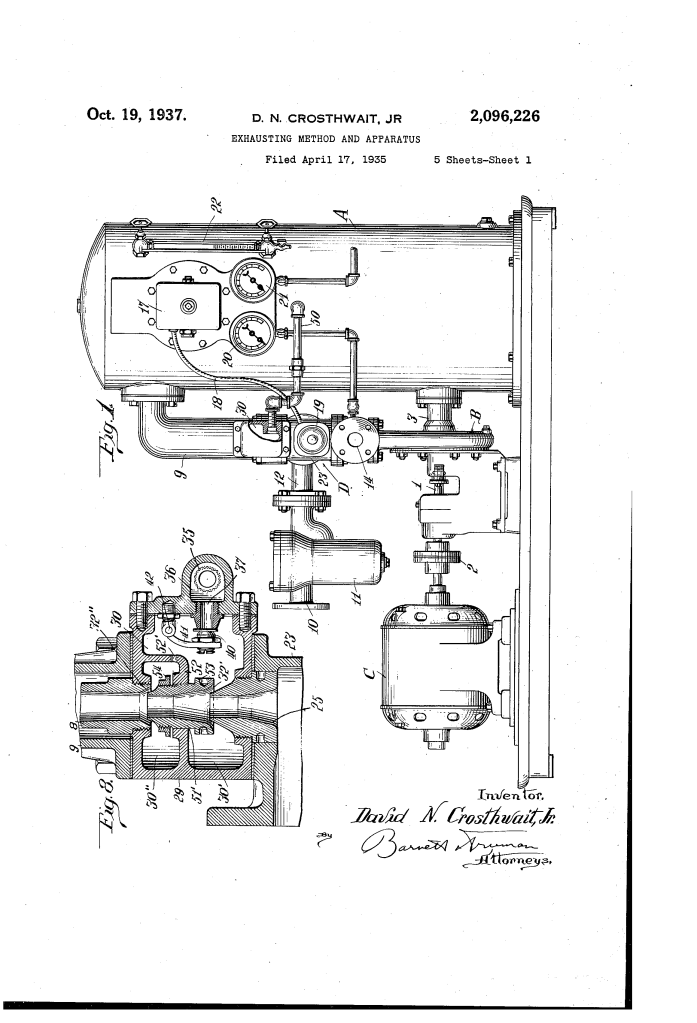
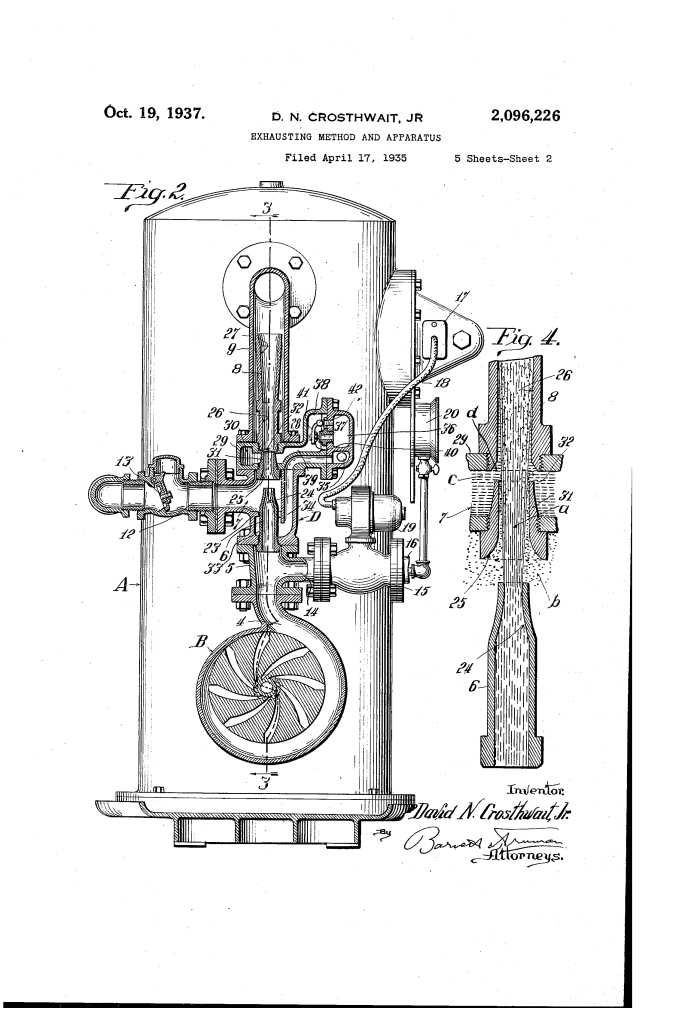
The patent by David N. Crosthwait, Jr. of Marshalltown, Iowa, describes an Exhausting Method and Apparatus (Patent No. 2,096,226), granted on October 19, 1937. This invention is a highly efficient kinetic jet exhauster designed to remove non-condensable gases and condensate (liquids) from vacuum heating systems. By introducing a revolutionary “liquid lining” or “elastic throat” within the delivery tube, Crosthwait solved the problem of energy loss caused by friction and inelastic impact, significantly increasing the vacuum-pulling capacity of industrial pumps.
The “Why”
In standard 1930s vacuum pumps, a high-velocity water jet was used to “suck” air out of pipes. However, a major “pain point” was mechanical inefficiency: as the water jet struck the hard, stationary walls of the metal delivery tube, it created turbulence and friction, causing entrained air bubbles to “pop” and leak back into the system. Crosthwait sought to create a frictionless environment where the water jet would be cushioned by an “enveloping wall of liquid,” allowing for a much higher ratio of air-to-water movement and a deeper, more stable vacuum.
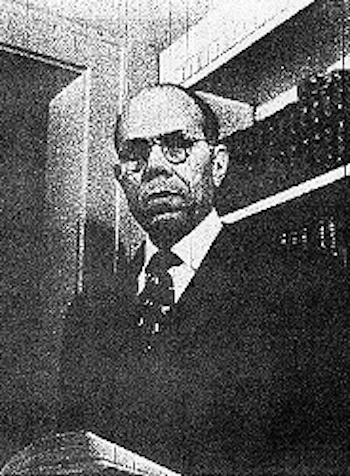
Inventor Section: David N. Crosthwait, Jr.
David N. Crosthwait, Jr. was a master of fluid kinetics and thermodynamics. His engineering philosophy was centered on minimizing resistance through fluid-on-fluid interaction. Rather than fighting the laws of physics with harder materials, he used the properties of water to solve the problems of water. This patent represents a peak in his career at C.A. Dunham Co., where his innovations in “kinetic exhausting” allowed skyscrapers like the Rockefeller Center to stay heated efficiently.
Key Systems Section
1. The Elastic Liquid Throat (Ring of Water)
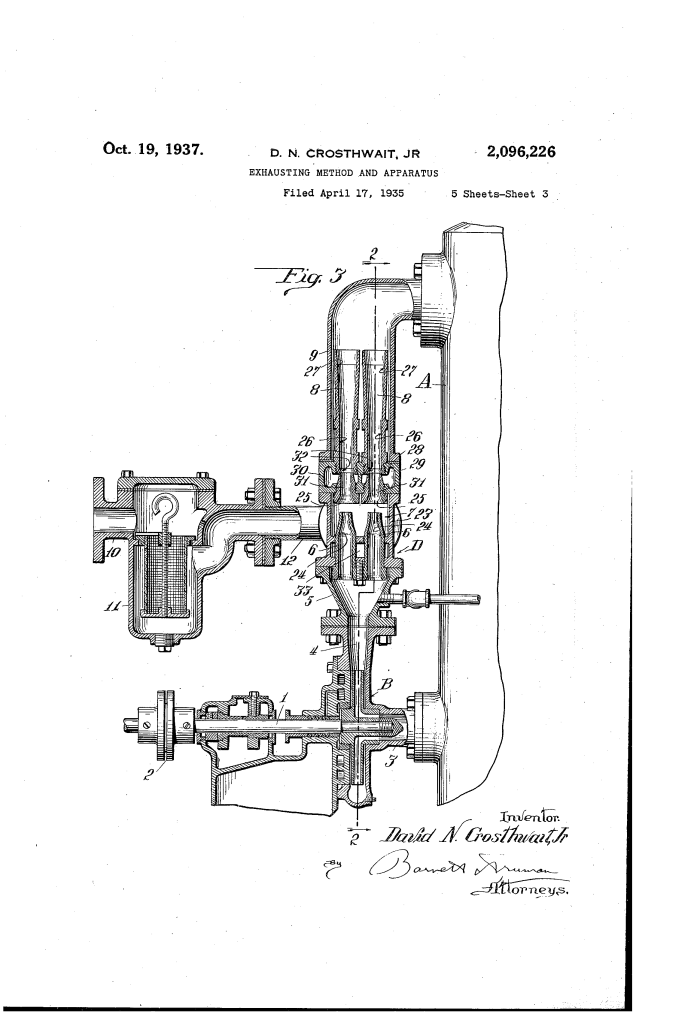
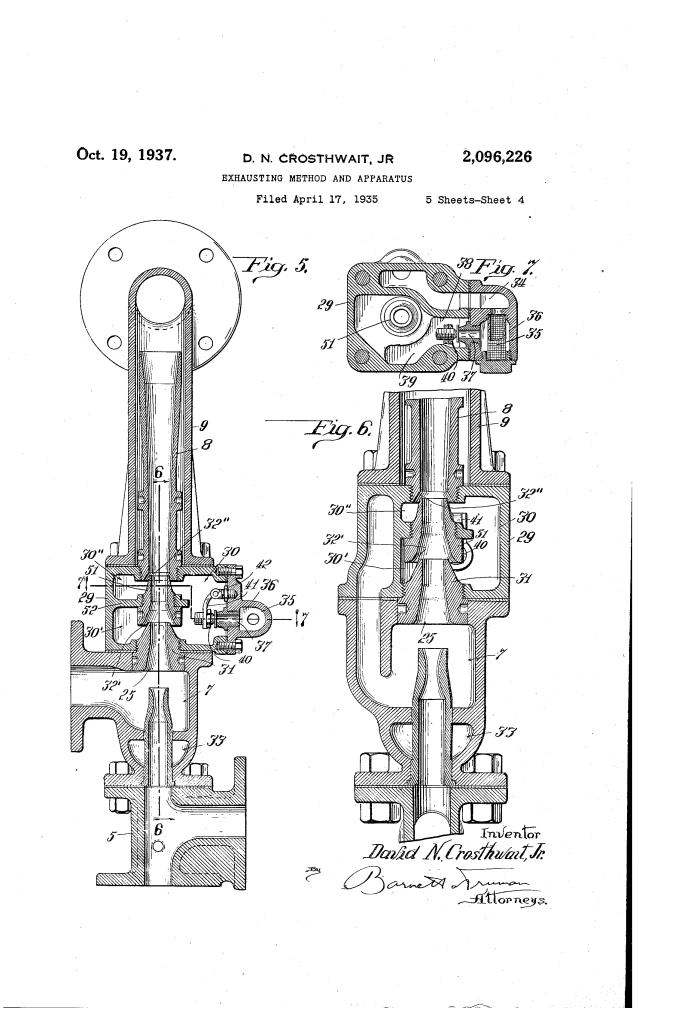
The delivery tube (8) is designed with a small gap (32) connected to a storage chamber (30).
- Modern Term: Boundary Layer Liquid Injection.
- As the main jet (a) shoots through, it draws a “lining” of water from the chamber. This forms a moving, elastic sleeve that prevents the air-carrying jet from touching the stationary tube walls.
2. The Two-Stage delivery Tube (Sections 31 & 51)
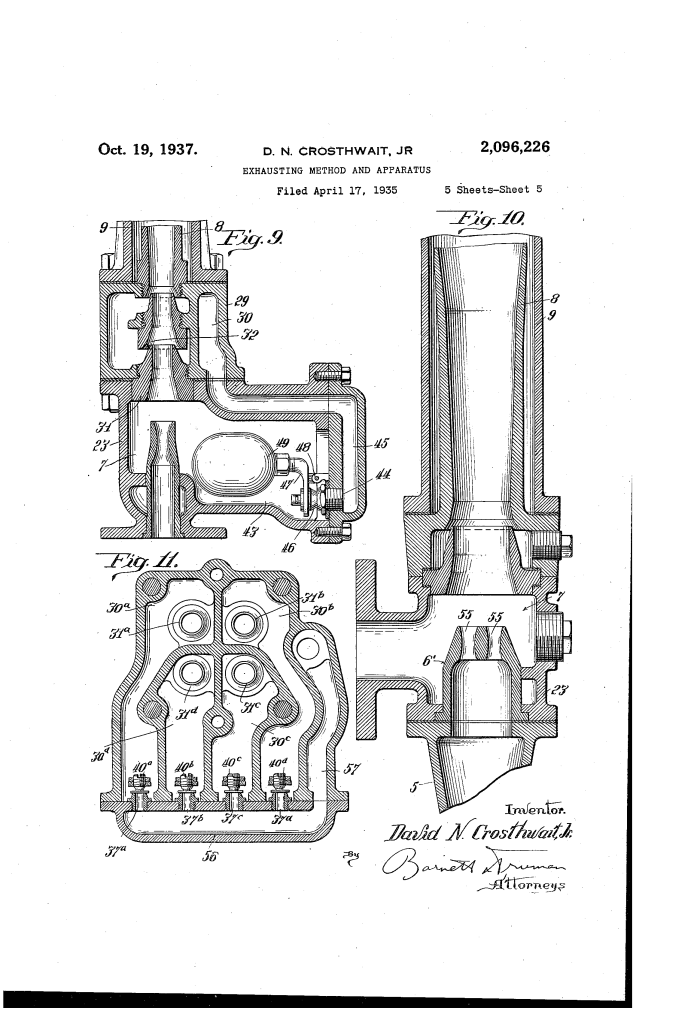
In advanced models, Crosthwait utilized a multi-stage entrance for the delivery tube.
- Modern Term: Cascade Eductor.
- By providing two separate “rings” of water, the apparatus creates a more stable, reinforced envelope, ensuring that even under high-pressure fluctuations, the vacuum remains unbroken.
3. The Floating Intermediate Section (51′)
In one variation (Fig. 8), the section between the two water rings is not fixed but “floats” vertically.
- Modern Term: Pressure-Balanced Dynamic Sleeve.
- This component automatically adjusts its position based on the suction of the jet, widening or narrowing the water gaps to perfectly balance the lateral pressures.
4. The Condensate Recovery Loop
The storage chamber (30) is replenished by the very condensate it is exhausting from the heating system.
- Modern Term: Self-Sustaining Regenerative Loop.
- A one-way check valve (40) ensures that water is sucked into the chamber by the vacuum but cannot fall back down when the pump turns off.
Comparison Table
| Feature | Standard Kinetic Exhauster | Crosthwait’s Elastic Exhauster |
| Jet Interaction | Jet strikes solid metal walls (high friction). | Jet strikes a moving liquid lining (low friction). |
| Air Entrainment | Air bubbles break on impact. | Air is “cushioned” and carried through. |
| Efficiency | High energy loss via turbulence. | Kinetic energy preserved via elastic throat. |
| Reliability | Prone to “losing prime” or suction breaks. | Self-sealing via the liquid ring. |
Significance Section
- Aerodynamic Precursor: The principle of using a fluid “envelope” to reduce friction is a fundamental concept now used in modern aerodynamics and high-speed fluid transport.
- Industrial Vacuum Stability: This method allowed for the first reliable, large-scale vacuum systems in industrial architecture, preventing “air lock” in heating pipes.
- Cohesion Physics: Crosthwait utilized the viscosity and cohesion of water (the way it sticks to itself) to entrap air—a brilliant application of molecular physics to heavy machinery.
- Sustainability: By using returning condensate to fuel the “elastic throat,” the system minimized the need for fresh water intake.
