
Water-Evaporator Attachment for Hot-Air Registers, Andrew F. Hilyer, Patent Number: 435,095
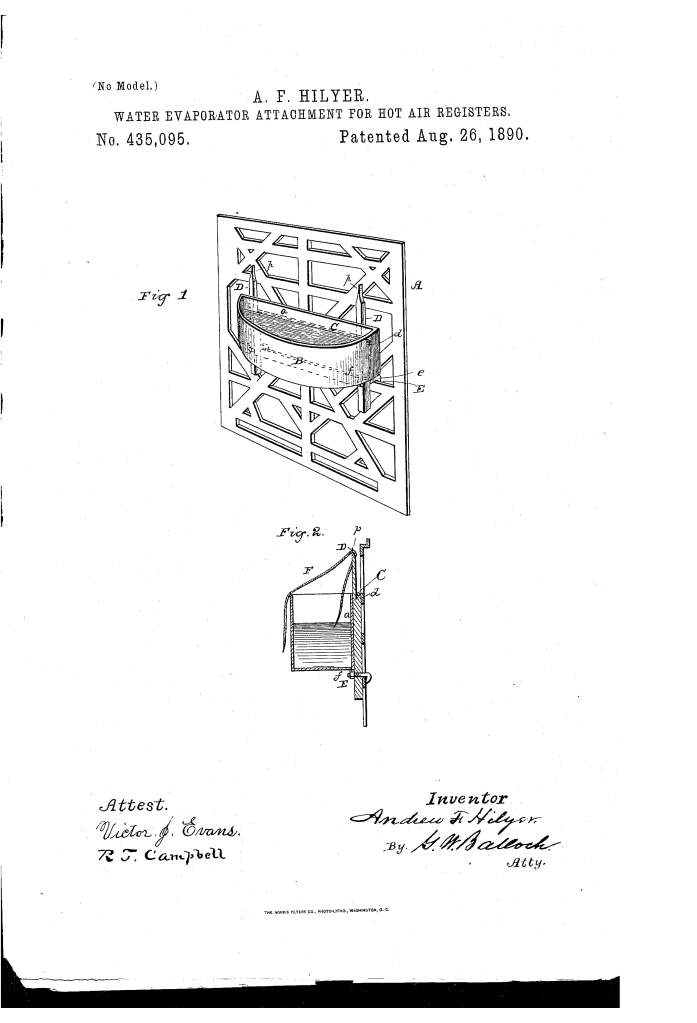
The patent by Andrew F. Hilyer of Washington, District of Columbia describes a Water-Evaporator Attachment (Patent No. 435,095), dated August 26, 1890. This invention is a modular humidification and air-filtration system designed to be mounted directly onto the face of heat registers to improve indoor air quality.
The “Why”
During the late 19th century, the transition to coal-fired “hot air” furnaces created a new set of domestic problems: extremely dry indoor air and the constant circulation of coal dust and soot. These conditions led to respiratory discomfort and “parched” living environments. Hilyer sought to solve this environmental health pain point by creating a device that simultaneously added moisture to the air and acted as a mechanical filter for escaping particulates.
The Inventor: Andrew F. Hilyer
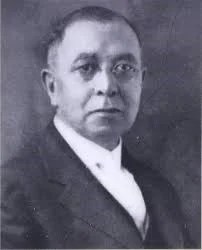
Andrew F. Hilyer was a distinguished Black inventor, author, and civil rights advocate who worked for the U.S. Treasury Department. His engineering philosophy was rooted in social hygiene and domestic efficiency. Operating during the Jim Crow era, Hilyer was a key figure in the “Union League” and focused on innovations that improved the daily lives of urban residents. His work on the evaporator demonstrates an early understanding of psychrometrics—the physical properties of gas-vapor mixtures—applied to the home.
Key Systems Section
Capillary Diffusion System
- Modern Equivalent: Wicking humidifier filter.
- Hilyer utilized a “capillary cloth” (F) supported by brackets (D). By dipping one end into the water reservoir (B), the cloth stayed saturated through capillary attraction, creating a massive surface area for evaporation compared to a stagnant pool of water.
Particulate Arrestance Grid
- Modern Equivalent: HEPA or furnace filter.
- The moist cloth served a dual purpose: as heated air passed through or over the damp fabric, the moisture trapped dust and soot “escaping from the register,” acting as a primitive but effective air scrubber.
Universal Tension-Lock Mounting
- Modern Equivalent: Toggle bolt or clamp mount.
- To ensure the device could fit any “reticulated” (gridded) register, Hilyer designed a hooking-key (E) with a screw-threaded stem and adjustable nut (f). This allowed the user to lock the brackets into the decorative ironwork of the register without permanent drilling.
Comparison: 19th Century Air Management
| Feature | Standard Methods (pre-1890) | Hilyer’s Innovation |
| Moisture Delivery | Open bowls of water (low surface area). | Wicking cloth; exponential increase in evaporation rate. |
| Air Purity | No filtration; soot settled on furniture. | Active arrestance; moist cloth traps particulates. |
| Mounting | Built-in or floor-standing units. | Modular attachment; fits any existing wall register. |
| Maintenance | Difficult to clean stagnant basins. | Removable reservoir; easy to refill and clean. |
Significance
- Precursor to Modern HVAC: This is one of the earliest integrated “add-on” units for residential climate control, combining humidification and filtration.
- Environmental Health: Hilyer’s focus on “arresting dust” anticipated modern indoor air quality (IAQ) standards.
- Mechanical Efficiency: By utilizing the waste heat of the register to drive the latent heat of evaporation, the device operated with zero external power, a hallmark of sustainable design.
