
The Invention
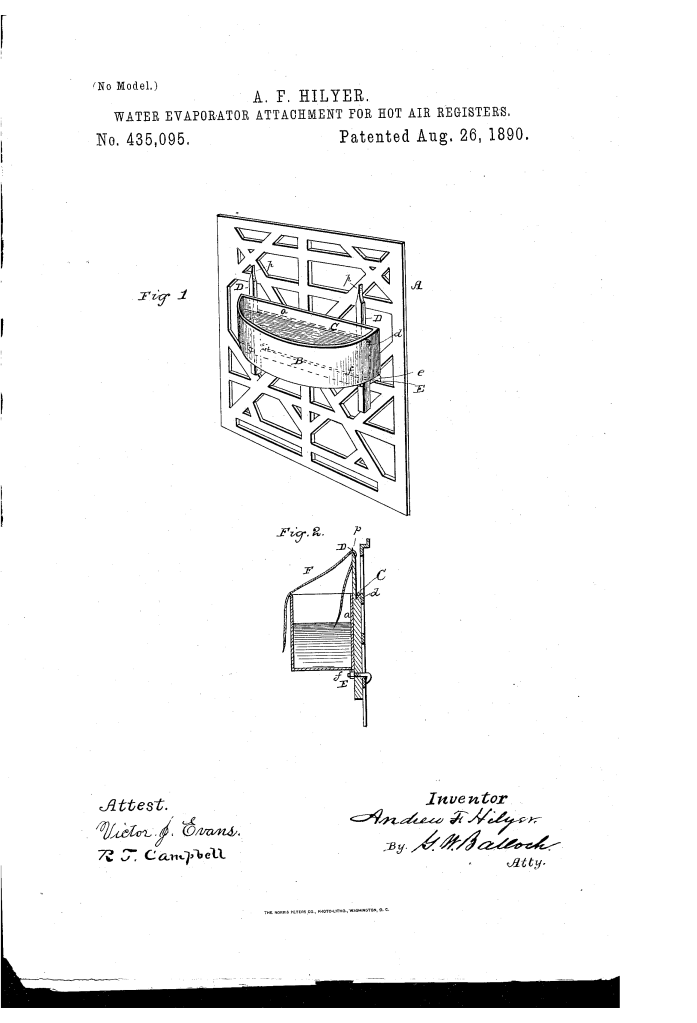
The patent, US435095A, granted to Andrew F. Hilyer of Washington, D.C., on August 26, 1890, is for a water evaporator attachment for hot-air registers. This invention is designed to add moisture to the air in a room heated by a hot-air furnace, thereby improving health and comfort.
Key Features:
- Water Receptacle: The core of the invention is a water-holding vessel or receptacle (B), which is shown in a “segmental” or half-round shape with a flat back to fit against a flat wall register.
- Bracket-and-Hook System: A key aspect of this invention is the mounting system. The receptacle is suspended from the register by a rod or wire (C) on its back. This rod rests in the beveled notches (
d) of two supporting brackets (D). - Adjustable Locking Brackets: The brackets themselves are secured to the register using a novel locking system. Each bracket has a “beveled or hooked locking-key” (E) with an adjustable nut. This key is designed to pass through the open spaces of the register’s grating and then be turned and tightened with the nut, creating a secure attachment.
- Capillary Cloth for Enhanced Evaporation: The brackets have pointed ends at their tops, designed to act as “towel-holders.” The user can hang a cloth (F) over these points, with a portion of the cloth dipping into the water. The cloth absorbs water through capillary action, providing a large, moist surface area to expose to the heated air, which significantly increases the rate of evaporation.
- Dust Arrester: Hilyer notes that the moistened cloth also serves a secondary purpose as a “dirt” or “dust arrester,” catching dust particles as the air flows from the register.
Significance of the Invention and Inventor
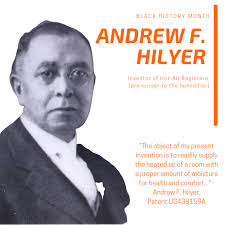
Andrew F. Hilyer was a notable African American inventor, civil rights activist, and educator. This patent is one of his contributions to improving everyday life.
- Solving a Common Problem: As hot-air heating became more widespread, the issue of excessively dry indoor air became a common problem. This dryness could be uncomfortable and even lead to health issues. Hilyer’s invention offered a simple and effective solution.
- Practical and Versatile Design: The invention’s design is highly practical. The adjustable brackets and hooked keys allow it to be easily mounted on different types of registers and even on ornamental work on stoves. This versatility made it a more marketable and user-friendly product.
- An Innovative Mind: The patent demonstrates Hilyer’s inventive and problem-solving mindset. He not only designed a container for water but also figured out an efficient and adjustable way to attach it and maximize its function through the use of a capillary cloth. His work is part of a larger, collective history of African American inventors who made crucial, but often unheralded, contributions to American technology.
