
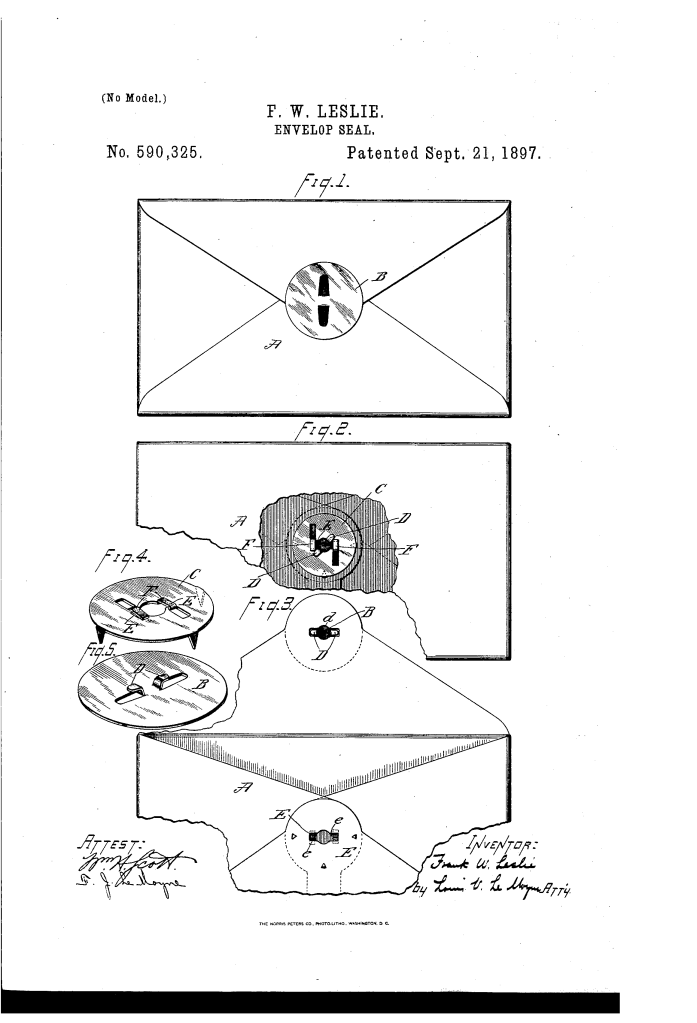
Envelop Seal (1897)
U.S. Patent No. 590,325, granted on September 21, 1897, to Frank W. Leslie, describes a tamper-evident metallic locking seal designed to securely fasten envelopes and packages. Leslie, an inventor based in Chicago, Illinois, assigned half of his patent rights to Samuel C. Kanter and Isaac M. Rice.
This invention solved a critical security and handling issue in 19th-century mail transit: how to provide an envelope closure that cannot be opened without evident destruction, while avoiding the bulk, heat, or damage associated with traditional wax seals or heavy riveting tools that risked damaging enclosed letters.
The Core Design: The Interlocking Disk System
The Leslie seal consists of two complementary metallic disks that clinch together through the envelope flaps using a press-and-twist snap action.
- The Inner Base Disk (C) Attached to the interior back of the envelope, engaging all underlying folds. It features dedicated recesses (E) positioned under cut-away openings (c) in the envelope paper, with flexible spring-fingers (F) extending over the sides of the recesses.
- The Outer Locking Disk (B) Affixed to the exterior closure flap through pre-cut openings (d). It features two downward-protruding metallic lugs (D) designed to engage the corresponding recesses and spring mechanism on the inner disk.
How the Seal Functions
The closure relies on a continuous mechanical progression to lock the disks irreversibly:
| Step | Action | Mechanical Purpose |
|---|---|---|
| 1. Alignment | The outer flap is folded down so the lugs (D) on Disk B enter the cut-away opening (c) over recesses (E) on Disk C. | Centers the locking components into position across the paper flaps. |
| 2. Depression | The user presses Disk B inward against Disk C, forcing the lugs (D) down into the recesses (E). | Compresses and forces back the flexible spring-fingers (F). |
| 3. Rotation | Disk B is rotated partially to the right. | Shifts the lugs (D) past the edges of the spring-fingers (F). |
| 4. Locking | The spring-fingers (F) snap back into their resting positions. | Traps the lugs under the metal body, preventing reverse rotation and locking the disks permanently. |
Technical and Structural Advantages
- Low-Profile Clearance: Stamped from thin sheet metal, the completed assembly adds minimal thickness to the envelope, preventing snagging in postal sorting machinery or mail bags.
- Tool-Free Application: Eliminates the need for hand clinchers, hot sealing wax, or heavy riveting hammers that could tear fragile paper or crush enclosed contents.
- Broad Compatibility: Readily manufactured to integrate into standard paper envelopes, mail packets, and commercial parcel wrappings.
Summary of Claims
The patent explicitly claims:
- An envelope seal combining an outer disk (B) with projecting lugs (D) and an inner disk (C) containing matching recesses (E).
- Spring-fingers (F) mounted at one side of and extending over the recesses (E) that depress under the insertion of the lugs and snap back to lock them upon partial rotation.
