
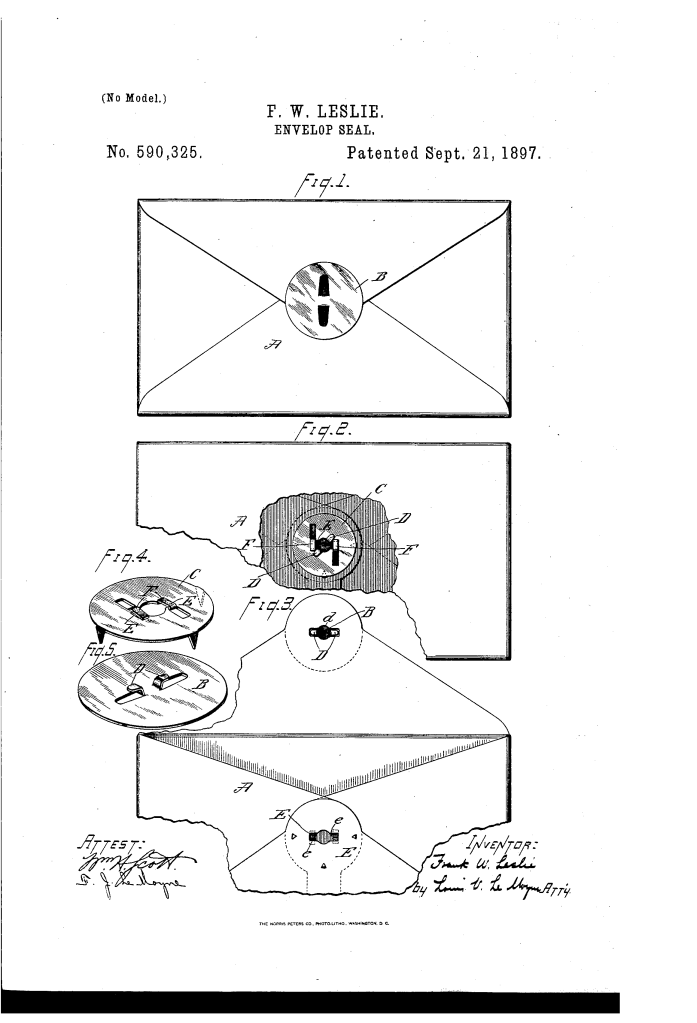
Envelop-Seal (Frank W. Leslie, No. 590,325)
The patent by Frank W. Leslie of Chicago, Illinois, describes a new and useful improvement in Envelop-Seals (Patent No. 590,325, 1897). The invention belongs to the class of seals using two metallic disks and is designed to provide a secure, tamper-evident lock without needing to rivet or glue the components, which might otherwise damage the letter’s contents.
Inventor Background: Frank W. Leslie
Frank W. Leslie was an inventor based in Chicago, specializing in mechanical and hardware solutions. His invention addresses a common commercial and personal need for reliable, secure envelope closure, particularly in high-volume settings or for valuable correspondence. The co-assignment of one-half interest to Samuel C. Kanter and Isaac M. Rice suggests a commercial partnership intended to market the seal.
Invention and Mechanism
The seal consists of two metallic disks that lock together using a simple, spring-actuated cam mechanism.
1. Components and Attachment
- Inner Disk (C): Attached to the inside back of the envelope. It features two recesses (E) and spring-fingers (F) located beside and extending over these recesses.
- Outer Disk (B): Attached to the outer flap of the envelope by inserting its two projecting lugs (D) through an opening (
) in the flap.
- Assembly: When the envelope is sealed, the outer flap is closed over the back, and the lugs (D) align with the recesses (E) (which are exposed by a cutaway in the envelope’s back,
).
2. Locking Mechanism (Key Innovation)
- Engagement: The two disks are brought together, forcing the lugs (D) into the recesses (E). The lugs press against the spring-fingers (F), forcing them back.
- Rotation and Lock: By turning the outer disk (B) partially around to the right, the lugs (D) pass off of the spring-fingers (F). The spring-fingers then spring back into place, effectively locking the two disks together.
- Tamper-Evidence: The two disks cannot be separated without breaking the seal (either by tearing the envelope or bending the metal).
3. Advantages
The seal is compact, easily applied to an ordinary envelope, and can be securely locked without the necessity of riveting, thereby avoiding damage to the contents.
Concepts Influenced by This Invention
Leslie’s envelope seal influenced subsequent small-scale mechanical fasteners and security devices by pioneering a snap-and-rotate locking principle for temporary yet secure closure.
- Snap-and-Twist Fasteners: The core locking mechanism—lugs enter slots, rotate to engage a stop, and are held by a spring—is a foundational design for bayonet mounts, twist-lock closures, and quick-release fasteners . This principle is used in bottle caps, camera lenses, and industrial panels requiring quick assembly and secure retention.
- Spring-Interference Locks: The use of flexible spring-fingers (F) as the passive locking element (the spring acting as the barrier once the lug has passed) influenced the design of various mechanical locks where a spring element holds a rotational component in place once it has been turned.
- Security Seals: The invention contributed to the design philosophy of tamper-evident seals and quick-locking mechanisms used on small commercial packages and containers where a non-destructive opening is impossible.
