
Engine Actuated Ventilating System, Charles E. Blundell (1950)
Patented on September 26, 1950, this invention (U.S. Patent No. 2,523,273) offers a brilliant, dual-purpose solution for one of the most dangerous environments on Earth: the soft coal mine.
In the 1940s, coal mines were plagued by “firedamp”—explosive methane gas that naturally seeps from coal deposits. This gas is both a health hazard to miners and a constant threat of catastrophic explosion. Charles E. Blundell’s system doesn’t just remove this dangerous gas; it uses the mine’s own power-generating engine as a giant vacuum cleaner to suck the gas out and burn it as free fuel.
The “Why”
- The Methane Problem: Natural gas in mines is highly explosive. Traditional ventilation required massive, expensive fans that added to the mine’s operating costs.
- Wasted Energy: Internal combustion engines (like Diesels) used to power mine lights and air compressors require a constant, massive supply of air for combustion. Normally, this air is taken from the surface and wasted.
- The Safety Risk: If a ventilation fan fails, gas builds up instantly. Blundell wanted a system that was “actuated” by the engine itself—if the power is on, the ventilation is working.
The Solution: Enclose the mine’s main engine in a hermetically sealed chamber. Force the engine to “breathe” through a pipe connected to the deep mine shafts. The engine sucks out the foul, explosive air, burns the methane as supplementary fuel, and exhausts the harmless waste into the atmosphere.
Key Systems Section
1. The Hermetically Sealed Power Plant
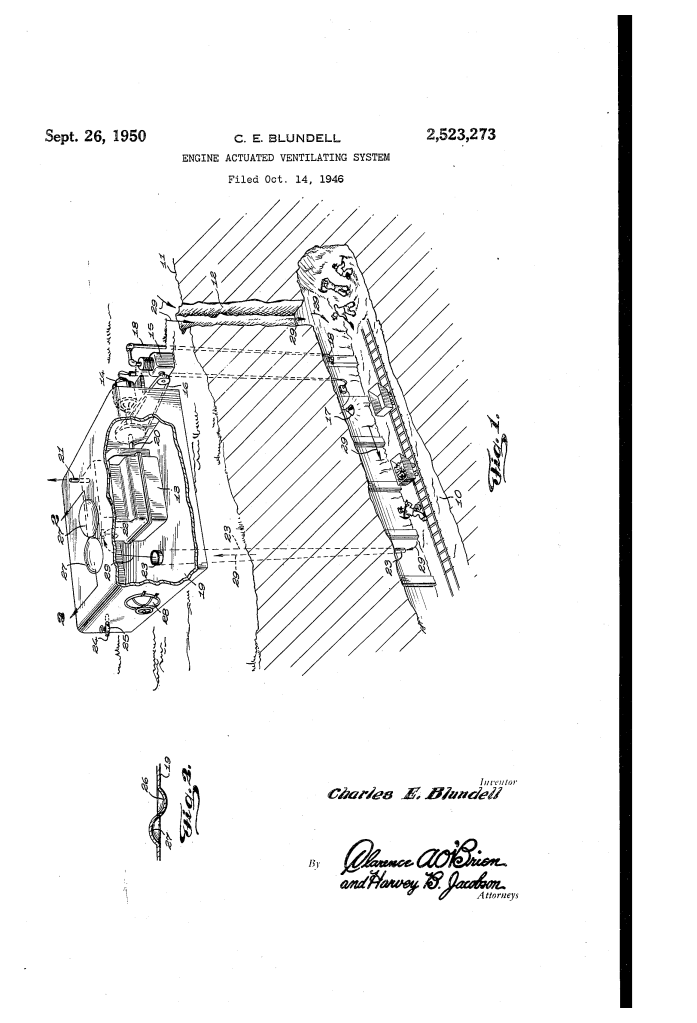
The heart of the invention is the sealed chamber (19).
- The Vacuum Effect: Because the engine (13) is inside a sealed box, it creates a powerful low-pressure zone. To keep running, it must pull air from somewhere.
- The Intake Duct (23): This pipe goes deep into the mine shaft. The engine’s “inhale” creates a continuous draft that pulls fresh air down the main shaft (12) and pulls foul air/gas out through the duct.
2. Converting Hazard to Fuel
This is the most innovative part of Blundell’s design.
- Methane as Fuel: Since methane (the primary explosive gas in coal mines) is combustible, when the engine sucks it in, the gas acts as a supplementary fuel source.
- Efficiency: This reduces the amount of diesel or gasoline the engine needs to run the generator (14) and compressor (15). It literally turns a safety hazard into an economic benefit.
3. The “Fail-Safe” Rupturable Depressions
Mining is a violent and unpredictable business. Blundell included two mechanical safety valves built directly into the chamber walls:
- The Vacuum Safety (26): An inwardly concaved, thin metal area. If the mine duct (23) gets crushed or blocked, the engine’s suction would normally “strangle” itself. Instead, the outside air pressure will rupture this depression, letting the engine breathe surface air so it doesn’t stall.
- The Explosion Relief (27): An outwardly convexed area. If the engine backfires or there is an internal explosion in the chamber, this piece pops outward to relieve the pressure, preventing the entire building from blowing up.
Operational Control: The Auxiliary Valve
Blundell recognized that sometimes you need more ventilation than others. He included an Auxiliary Air Inlet (24) with a Control Valve (25).
- Valve Closed: 100% of the engine’s air comes from the mine (Maximum Ventilation).
- Valve Open: The engine pulls some air from the surface and some from the mine (Adjustable Ventilation).
This allows the mine foreman to balance the “draft” in the shafts to ensure miners aren’t working in a wind tunnel while still keeping gas levels safe.
Visual Component Breakdown
| Part Number | Component | Function |
| 12 | Air Shaft | The “Inlet” for fresh atmospheric air into the mine. |
| 19 | Sealed Chamber | The “Vacuum Box” housing the engine. |
| 21 | Exhaust Pipe | Vents the burned gas and foul air safely into the atmosphere. |
| 23 | Ventilation Duct | The “Straw” that sucks gas out of the mine depths. |
| 26 / 27 | Rupturable Depressions | Mechanical fail-safes for high/low pressure. |
Significance
Charles E. Blundell’s patent represents a peak of integrated engineering.
- Zero-Cost Ventilation: By using the engine that was already required to run the mine’s lights and tools, ventilation becomes “free.”
- Portability: The chamber was designed to be metallic and portable, allowing it to be moved as the mine expanded or moved to new locations.
- Environmental Safety: By burning the methane, the system prevents large plumes of explosive gas from hovering around the mine entrance, which was a common cause of surface fires.
Final Insight: Blundell’s system was a precursor to modern “Gas-to-Energy” systems used in landfills today. He saw the coal mine not just as a place to find fuel, but as a source of fuel that was actively trying to kill the workers—and he found a way to make the engine “eat” the danger.
