
Emergency Release for Extraction Chute (1966)
U.S. Patent No. 3,257,089, granted on June 21, 1966, to Adolphus Samms, addresses a life-threatening hazard encountered during military and cargo airdrop operations: the failure of palletized cargo to release from an aircraft after the extraction parachute has deployed.
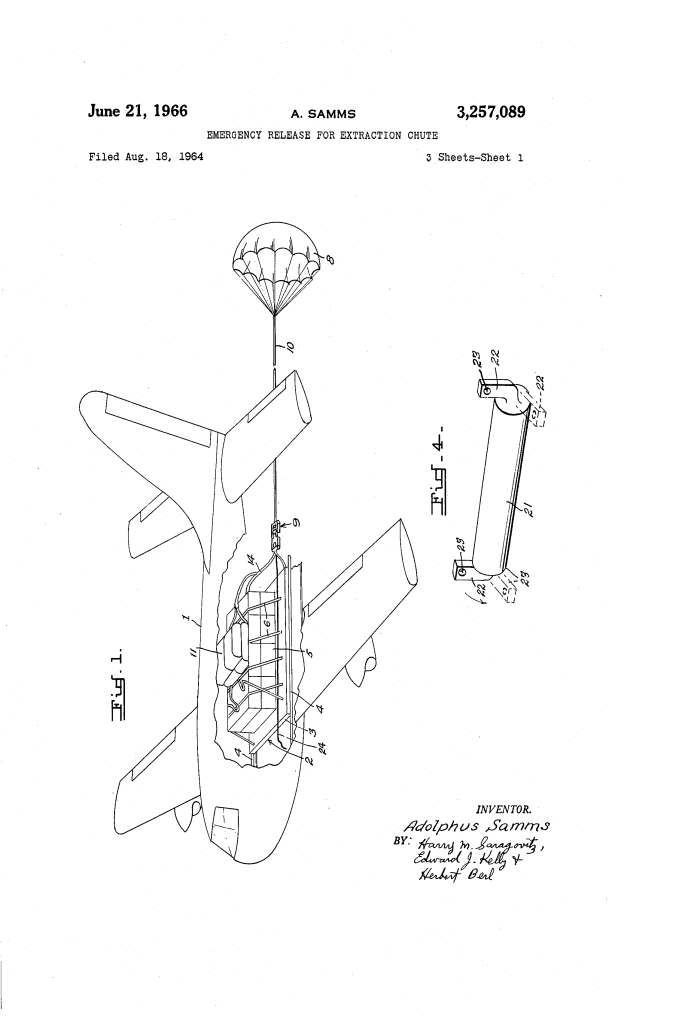
In aerial delivery, a small extraction parachute deploys behind the cargo plane to pull heavy pallets along floor-mounted guide rails and out the rear cargo ramp. If the rail restraint system jams or malfunctions, the deployed chute acts as a high-drag anchor, rapidly reducing the aircraft’s airspeed and risking an aerodynamic stall or crash. Historically, a crew member had to walk directly between the hung cargo and the open ramp under high tension to manually sever the line. If the load broke free during this procedure, the crew member faced near-certain death. Samms, based out of Yuma, Arizona, engineered a positive mechanical coupling that enables crew members to jettison the extraction chute from a safe distance, or detach it automatically via a timed pyrotechnic charge.
The Core Mechanism: Spring-Biased Release Arms
The heart of the mechanism is a bifurcated clevis coupled to a rotatable lock pin that holds under tension but releases instantly when triggered.
- Pivoting Arms and Biasing Spring (12, 15, 20)
- A primary clevis (12) mounts to the cargo pallet (5) and load parachute system (11).
- Two release arms (15) are hinged to the clevis at pivot points (16).
- A coil spring (20) positioned between the arms continuously forces them apart into an open, release position.
- The outer ends (17) of the arms feature internal bores (18) and longitudinal exit slots (19).
- The Offset Retaining Pin (21, 22)
- An extraction pin (21) connects to the main extraction parachute line (10).
- The pin features integral offset extensions or lugs (22).
- When inserted into bores (18) and rotated perpendicular to slots (19), the lugs lock arms (15) together against the outward push of spring (20).
How the System Operates
Samms designed two distinct configurations to ensure crew safety: a remote manual trigger and a fully automatic timed cutter.
| Step | Manual Mode Action | Automatic Mode Action | Safety Function |
| 1. Armed State | Arms (15) are locked over pin (21); safety line (24) is routed forward. | Pin (26) with pivoted lugs (28) is secured by heavy-gauge wire (35). | Maintains load connection under standard flight conditions. |
| 2. Deployment | Extraction chute (8) deploys from rear ramp to yank load (5). | Chute deploys; extraction line pulls firing pin (36) from cutter (31). | Initiates pallet pull while arming the emergency safety system. |
| 3. Malfunction Trigger | If load hangs, a crew member pulls line (24) from a safe distance. | Pyrotechnic 10-second cutter (31) burns through heavy wire (35). | Eliminates the need for personnel to enter the dangerous rear cargo path. |
| 4. Chute Jettison | Arms (15) spring outward via coil (20); pin (21) slips out. | Lugs (28) drop; spring (20) pushes arms apart, freeing pin (26). | Instantly vents drag and prevents the aircraft from stalling. |
Technical Components
- Clevis Base (12): High-strength mounting bracket joined to the cargo by a shear line or mounting pin (13).
- Safety Release Line (24): Flexible remote tether tied through hole (23) in extension (22), running forward to the flight deck or cabin safety zone.
- Timed Cutter Assembly (31, 32, 34): A hinged bracket carrying an explosive line-cutting charge that severs retaining wire (35) after a preset 10-second delay.
- Lanyard Coupling (37): Direct linkage between extraction line (10) and firing pin (36) ensuring positive initiation during chute deployment.
Historical and Military Significance
Granted under royalty-free government rights, Samms’s invention provided crucial advancements in aerial logistics during the height of the Vietnam War, when high-altitude low-opening (HALO) and heavy equipment drops became standard tactical operations.
- Crew Survival: Eliminated the hazardous practice of stationing loadmasters near open cargo ramps with axes or mechanical cable cutters.
- Prevention of Catastrophic Stalls: Guaranteed immediate chute separation if a multi-ton vehicle or equipment pallet jammed on cargo rollers.
- Operational Simplicity: Utilized mechanical spring bias and line tension rather than complex hydraulic or electrical links that could fail in harsh weather.
About the Inventor: Adolphus Samms
Adolphus Samms was an African American inventor who contributed significant mechanical designs to United States military aviation and aerospace programs during the Cold War and Space Race eras. Working from Yuma, Arizona—home to critical military proving grounds—Samms held multiple patents addressing life-safety equipment, parachute hardware, and multi-stage rocket technology, including patents assigned or licensed to the U.S. Government for defense applications.
Summary of Claims
The patent explicitly claims:
- An emergency release mechanism having a plate attached to an aircraft load and spring-biased arms pivotally secured to the plate.
- A rotatable locking pin connected to the extraction parachute and releasably held within the ends of the arms.
- Manual control linkages to rotate the pin relative to the slotted arm ends, allowing outward spring displacement and parachute detachment.
- A positive release linkage operative from a safe position away from the load extraction pathway.
