
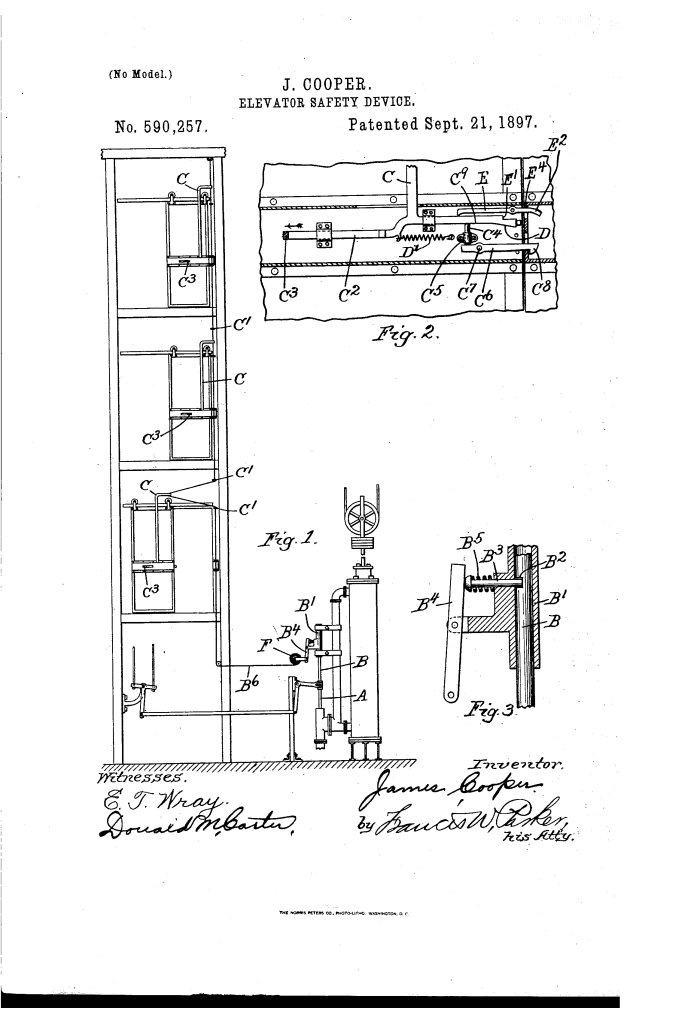
Elevator Safety Device (1897)
U.S. Patent No. 590,257, granted on September 21, 1897, to James Cooper, describes an automatic interlock system designed to prevent elevator cars from moving while shaft doors are open. Cooper, an inventor based in Chicago, Illinois, developed a mechanical safety mechanism to eliminate passenger injuries caused by elevators prematurely starting during boarding or alighting.
This invention addressed a common hazard of early passenger elevators: operator error leading to cars moving before the hoistway door was latched, or doors opening while the car was in transit. Cooper solved this by creating a physical interlock where the motor mechanism is locked against motion before the landing door can be unlocked.
The Innovation: Sequential Mechanical Interlock
The core design of Cooper’s device relies on a strict sequence of mechanical operations controlled by a single continuous motion from the elevator operator.
- Pre-Unlock Motor Locking: The sliding handle on the door is linked directly to the motor valve. The first fraction of movement locks the drive mechanism completely before the door latch itself is physically lifted.
- Integrated Shaft-Wide Linkage: A transmission cord extends along the elevator shaft, allowing the same motor-locking assembly to interface with doors across multiple floors.
- Differential Travel Accommodation: Because the locking pin moves only a short distance while the door slides open several feet, a specialized spring mechanism absorbs the extra travel without straining the lock.
How the Safety Mechanism Functions
The mechanical sequence ensures zero overlap between motor operation and door release:
| Step | Action | Safety Purpose |
| 1. Initial Pull | Operator pulls the sliding piece (C2). | Tensions the cord (B6), pulling the lever (B4) to force the locking pin (B3) into the valve notch (B2). The motor is now locked. |
| 2. Door Unlatching | Sliding piece moves further, engaging the beveled edge (D). | Moves pin (C4) downward to lift the door latch (C3), unlocking the door only after the motor is secured. |
| 3. Door Hold-Open | Pawl (E) engages notch (E1) on the sliding piece. | Retains the assembly in position so the locking pin (B3) cannot slip out while the door remains open. |
| 4. Door Closing | Door slides shut; beveled end (E2) strikes trip part (E3). | Releases pawl (E), allowing spring (D1) to return the slider to normal, locking the door and releasing the motor lock. |
Key Mechanical Components
- Valve Rod Extension (B): Reciprocates with the main valve rod (A) and features a precise notch (B2) positioned to accept the locking pin only when the motor valve is fully closed.
- Locking Sleeve (B1) and Pin (B3): Houses the locking pin, which is normally held clear by spring (B5) until forced inward by lever (B4).
- Door Slider Assembly (C2): A reciprocating piece mounted on each floor’s door containing beveled profile (D) to create delayed latch actuation.
- Latch & Holding Pawl (C3, E): Ensures the hoistway door stays securely fastened during transit and locks the mechanism in a safe state during passenger transfer.
- Compensating Spring (F): Interposed along the linkage to absorb extended door motion after the locking pin is fully seated.
Historical and Industrial Significance
Cooper’s patent represented an early, robust approach to elevator hoistway door interlocks—a technology that eventually became standard building and safety code nationwide.
- Failsafe Pre-Lock Principle: By mechanically preventing door release until physical motor immobilization was verified, the design eliminated human timing errors.
- Universal Power Compatibility: While illustrated using a hydraulic control valve, the patent provided for electrical and mechanical elevator drives using the same interlocking principle.
- Passenger Transit Safety: Directly reduced catastrophic shaft-fall and crushing accidents during the rapid expansion of multi-story commercial buildings in late 19th-century urban centers.
About the Inventor: James Cooper
James Cooper was an inventor working in Chicago, Illinois, during the city’s architectural boom following the Great Chicago Fire. His contributions to elevator mechanics focused on passive, fail-safe passenger protections during the foundational era of modern skyscraper infrastructure.
Summary of Claims
The patent explicitly claims:
- The combination of an elevator motor-locking device linked to multiple floor doors, arranged to lock the drive before unlocking occurs.
- A control rod moving freely during transit but engageable by a transverse pin when brought to rest.
- A sliding door-operating member with a beveled surface providing predetermined lost-motion travel, actuating the motor lock before engaging the door latch.
- A holding mechanism (pawl and trip) to maintain the locked-motor state throughout the entire open-door cycle.
