
Electrogasdynamic Method and Apparatus for Detecting the Properties of Particulate Matter Entrained in Gases (1969)
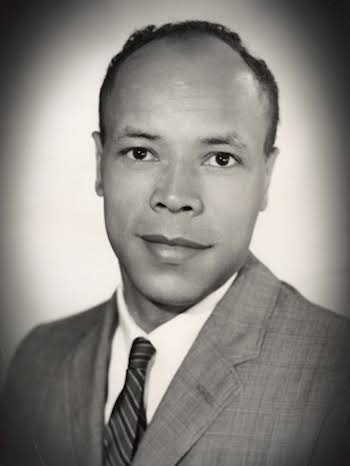
U.S. Patent No. 3,449,667, granted on June 10, 1969, to Meredith C. Gourdine, describes an advanced electrogasdynamic (EGD) system designed to detect and measure the physical properties of particulate matter and aerosols suspended in flowing gases. Meredith Gourdine, a pioneering physicist, engineer, Olympic medalist, and founder of Gourdine Systems, Incorporated, was a global leader in harnessing electrogasdynamics for practical industrial applications.
This specific invention solved a persistent problem in environmental monitoring and industrial exhaust analysis: how to accurately measure aerosol concentration, particle mobility, particle size, and mass flow rate in real time without resorting to delicate optical systems or fragile, high-voltage concentric electrode traps prone to arcing and fouling.
The Innovation: The “Self-Generated Axial Field” and Ion Slip
Earlier aerosol detection methods suffered from major practical limitations. Optical detectors required long, unobstructed light paths and were notoriously difficult to calibrate. Alternative electrical methods used concentric electrode tubes that required massive external power supplies (several thousand volts) to drive particles outward, creating high-voltage arcs and dielectric breakdowns whenever conductive soot accumulated on the walls.
Gourdine’s breakthrough eliminated the secondary high-voltage power supply entirely. He designed an electrogasdynamic channel in a dielectric conduit that converts the flow energy of the gas stream itself into a self-limiting electrical barrier. By terminating the downstream collector through a high-impedance indicating circuit, the unit builds up its own retarding axial electric field.
Why Electrogasdynamics and Ion Slip?
- Natural Space-Charge Drift: As particles carry electrical charge downstream, they establish an outward radial space-charge field that naturally pushes them toward the channel boundaries, where they can be collected without requiring external deflecting voltages.
- Pure Particle Selection (Ion Slip): The self-generated axial electric field acts like a brake against downstream movement. Highly mobile, unattached molecular ions are turned back or driven out upstream, while heavier, low-mobility aerosol particles push through to reach the collector.
- Non-Fouling Operation: Because the collector does not rely on an externally applied transverse field to pull particles across high-voltage gaps, particulate deposits on the collector walls will not cause dielectric breakdown, arcing, or catastrophic power supply damage.
Key System Components
The apparatus integrates aerodynamic shaping and electrical fields across a streamlined dielectric tube:
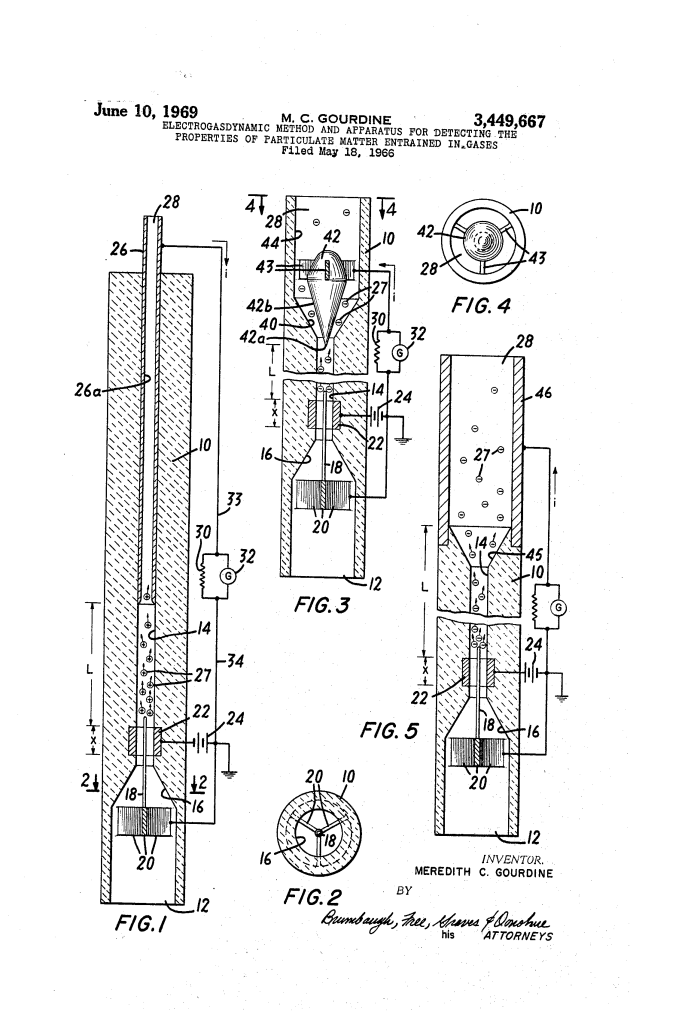
| Component | Function |
| Dielectric Conduit (10) | Insulating tube defining the flow boundary (14), including a convergent entrance nozzle (16) that accelerates the incoming gas stream. |
| Corona Electrode (18) | Axially centered discharge needle positioned in the nozzle and energized by a low-current power supply (24) to charge incoming particles. |
| Annular Attractor Electrode (22) | Concentric ground or reference ring surrounding the corona tip to establish a uniform, localized ionization zone across the gas path. |
| Sliding Collector Electrode (26) | Conductive sleeve (26a) spaced an adjustable distance L downstream that neutralizes charges (27) delivered by arriving particles. |
| High-Impedance Meter Circuit (30, 32) | Resistor and galvanometer (or electrometer) loop connecting collector 26 to corona ground; develops the counter-potential that sets up the axial field. |
| Divergent Expansion Nozzle (40 / 45) | Downstream diffuser section that slows gas velocity, enhancing space-charge density and ensuring complete charge transfer before exhaust. |
| Tapered Centerbody Collector (42) | Alternative pointed collector element (42a) oriented into the gas stream; uses incoming space charge to induce a localized neutralizing counter-discharge. |
How the Apparatus Functions
The measurement sequence relies on the aerodynamic transport of electrostatic charge:
| Step | Action | Operational Purpose |
| 1. Ingestion & Acceleration | Gas containing particulate matter enters inlet 12 and accelerates through converging nozzle 16. | Establishes a uniform, controlled gas velocity u past the charging electrodes. |
| 2. Corona Charging | Stream passes between corona electrode 18 and attractor ring 22. | Charges particulate matter to a single electrical polarity until saturated. |
| 3. Electrostatic Separation | Gas flows across dielectric length L; the circuit builds an opposing axial electric field. | Creates ion slip, rejecting free molecular ions while allowing charged aerosol mass to proceed. |
| 4. Space-Charge Discharge | Aerosol particles drift radially outward against collector surface 26a (or central tip 42a). | Transfers particulate charge to the collector, generating measurable discharge current i. |
| 5. Direct Readout | Current i is read across galvanometer 32. | Current is correlated directly to particle concentration, mobility, size, or mass flow. |
Measuring Diverse Properties by Adjusting Length L
Gourdine showed that the particle flow is governed by a characteristic aerodynamic-charge length parameter lambda (defined by the gas velocity, dielectric constant, electron charge, particle concentration, saturation charge, and mobility). By mechanically adjusting the sliding collector electrode 26 along length L, a single instrument measures different physical properties:
- Particle Mobility and Size (Condition: L/lambda much greater than 1): The collector is slid further downstream. Under this condition, the measured current i is inversely proportional to particle mobility K. Because mobility correlates directly with particle radius a, the system directly measures particle size independent of the initial particulate concentration.
- Particle Concentration (Condition: L/lambda much less than 1): The collector is slid closer to the ionization nozzle (while remaining far enough away that free molecular ions have been separated out). In this position, the collected current i is directly proportional to the incoming aerosol concentration n(0).
- Total Mass Flow Rate: By correlating the measured current i with the density of the aerosol material, the device provides real-time monitoring of particulate mass flow per second (such as smoke emission rates).
Historical and Scientific Impact
Meredith Gourdine’s patent marked a significant leap forward in air quality monitoring, industrial emission control, and aerosols physics:
- Smokestack & Pollution Monitoring: The device enabled factory and utility operators to monitor particulate emissions directly inside high-temperature smokestacks and industrial flues without clogging delicate optical lenses or maintaining bulky electrostatic precipitators.
- Solid-State Aerodynamic Simplicity: By replacing complex multi-electrode traps with a single dielectric tube and using the gas flow itself to generate the needed electric fields, Gourdine created an exceptionally rugged, low-maintenance analytical instrument.
- Pioneering Electrogasdynamics: This patent formed part of Gourdine’s broader portfolio demonstrating that electrogasdynamic principles could revolutionize power generation, paint spraying, particle separation, and environmental sensing.
About the Inventor: Meredith C. Gourdine
Dr. Meredith Christ Gourdine was one of the most prominent African American physicists and inventors of the 20th century.
- Academic and Athletic Excellence: After winning an Olympic silver medal in the long jump at the 1952 Helsinki Games, Gourdine earned his B.S. in Engineering Physics from Cornell University and his Ph.D. in Engineering Science from the California Institute of Technology (Caltech) in 1960.
- Entrepreneur and Innovator: In 1964, he founded Gourdine Systems, Inc. in New Jersey, where he served as chief executive and laboratory director, eventually amassing over 30 patents in electrogasdynamics, thermoelectrics, and energy conversion.
- Legacy: Gourdine broke racial barriers in high-tech corporate entrepreneurship, pioneering applications that ranged from industrial powder coating and clean air filtration to fog-dispersal systems for airport runways. He was later inducted into the National Inventors Hall of Fame.
Summary of Claims
The patent explicitly claims:
- A method and apparatus for determining properties of entrained particles by flowing gas through a dielectric boundary, charging the particles via upstream electrical discharge, and generating an outward radial space-charge field.
- Applying a self-generated axial electric field in an intermediate conduit zone of sufficient polarity and magnitude to induce ion slip and prevent unattached ions of the same polarity from entering the collector.
- Collecting charges transferred to a boundary collector surface and measuring the resulting current to determine particle mobility, concentration, size, and mass flow.
- An adjustable-length dielectric channel where the ratio of length L to characteristic parameter lambda is configured to be either substantially greater than 1 (for mobility and size detection) or substantially less than 1 (for direct concentration measurement).
- The use of divergent flow nozzle sections and tapered, pointed central collector elements to decelerate gas and induce space-charge neutralizing discharges.
