
Electroacoustic Transducer (1964)
U.S. Patent No. 3,118,022, granted on January 14, 1964, to Gerhard M. Sessler and James E. West, represents one of the most significant milestones in the history of audio technology. Developed at Bell Telephone Laboratories, this invention introduced the foil electret microphone, a device that eliminated the need for bulky, expensive external power sources to provide a direct current (DC) bias.
Today, the principles outlined in this patent are used in over 90% of all microphones produced annually, including those in smartphones, hearing aids, and professional recording equipment.
The Innovation: The Permanent Electrostatic Charge
Before this invention, high-quality “condenser” microphones required an external power supply to maintain an electrical charge between the diaphragm and the backplate. This made them heavy, fragile, and impractical for portable use.
Sessler and West discovered how to create a “permanent” charge within a thin plastic film (such as Mylar). By heating the film and exposing it to a high-voltage electric field, they “trapped” the charge inside the material as it cooled. This created an electret—the electrostatic equivalent of a permanent magnet.
Why the Electret Was Revolutionary
- No External Bias: Because the diaphragm itself is “prepolarized,” the microphone works without a heavy high-voltage power pack.
- Miniaturization: The use of thin plastic films allowed microphones to be shrunk to a fraction of their previous size without losing sound quality.
- High Fidelity: Despite its small size, the transducer offered a remarkably flat frequency response (30 to 11,000 cycles), capturing sound with extreme accuracy.
- Durability: The “trapped” charge was estimated to last for hundreds of years, making these devices incredibly reliable for long-term use.
Key Technical Components
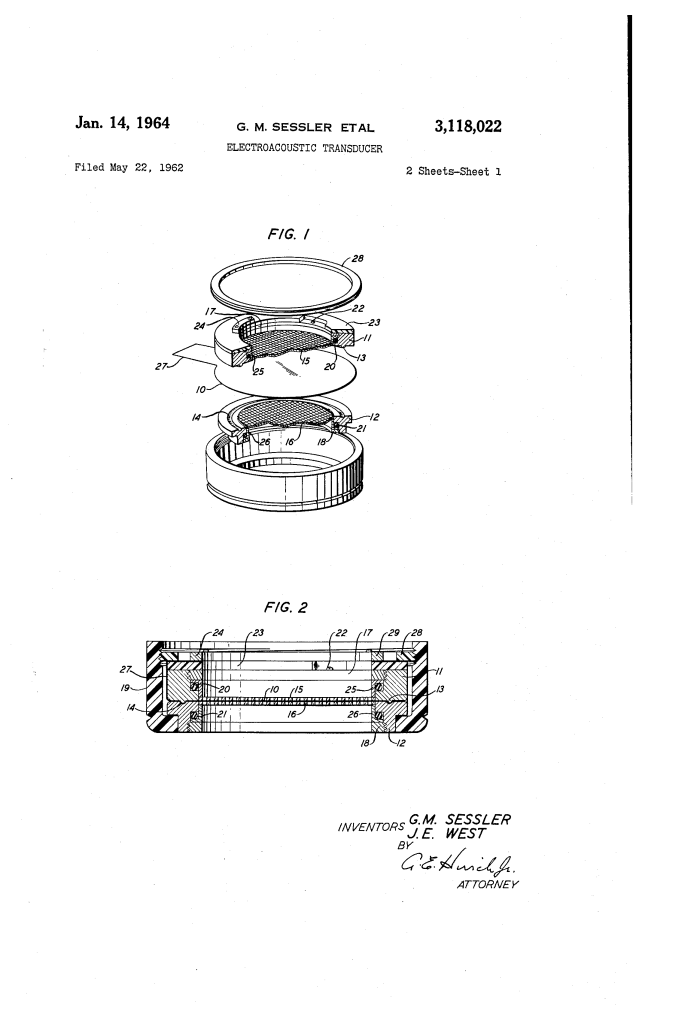
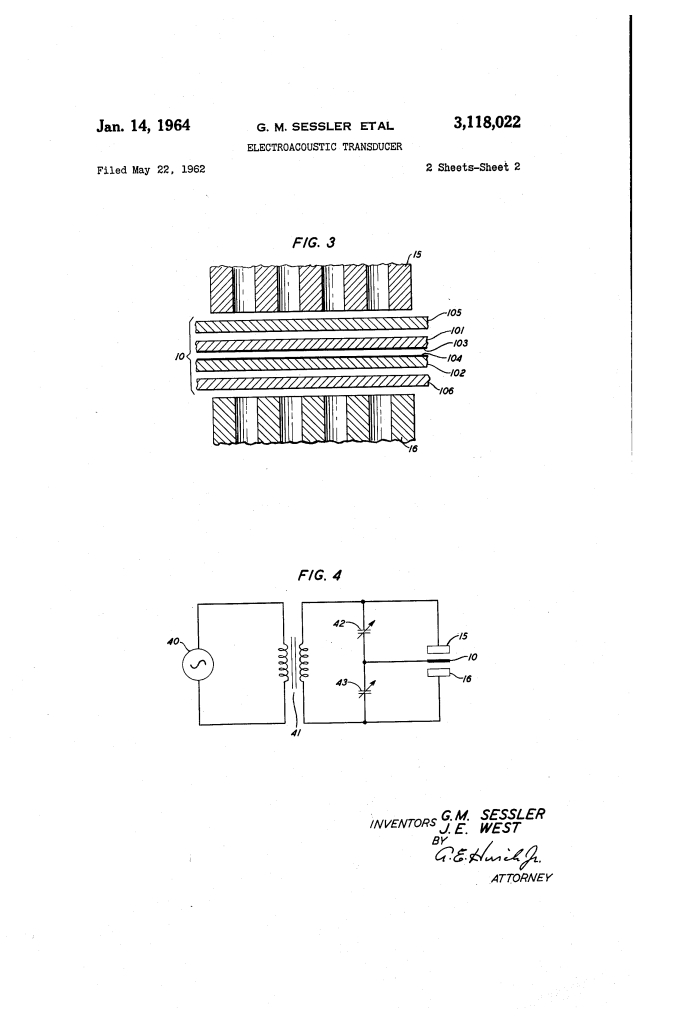
The patent describes a “push-pull” configuration that maximizes efficiency and minimizes sound distortion:
| Component | Function |
| Multilayer Diaphragm (10) | A sandwich of thin Mylar films, metallized with aluminum, acting as the vibrating element. |
| Electret Material | Prepolarized plastic layers that provide the “permanent” electrostatic field. |
| Perforated Plates (15, 16) | Rigid brass discs with tiny holes that allow sound to pass through while acting as fixed electrodes. |
| Air Pockets | Microscopic gaps between layers that act as a “cushion,” preventing the diaphragm from hitting the plates during loud sounds. |
| Clamp Rings (11, 12) | Metal rings that hold the diaphragm under high mechanical tension, similar to a drumhead. |
Performance: Eliminating Distortion
The “push-pull” design—placing the diaphragm between two plates—ensures that the force moving the diaphragm is perfectly linear. According to the patent, this symmetry removes the “nonlinear distortion” common in older designs.
Technical Capabilities:
- Efficiency: High conversion of acoustic energy to electrical signals with minimal power consumption (approx. 0.1 milliwatt).
- Sound Pressure: Capable of producing or receiving high volume levels (up to 100 dB SPL) with “exceedingly low harmonic distortion.”
- Reciprocity: The device is versatile; it can function as either a high-quality microphone or a miniature earphone.
The Manufacturing Process: “Freezing” the Charge
Sessler and West outlined a precise method for creating the electret foils:
- Preparation: Place thin Mylar foil (0.25 mil thick) between two electrodes.
- Heating: Raise the temperature to 120°C (the forming temperature).
- Polarization: Apply a high DC potential of 3,500 volts across the gap.
- Cooling: Gradually decrease the temperature back to room temperature while maintaining the voltage. This “freezes” the ionic space charge within the plastic.
About the Inventors: James E. West and Gerhard Sessler
James Edward West and Gerhard Sessler are legendary figures in the world of acoustics.
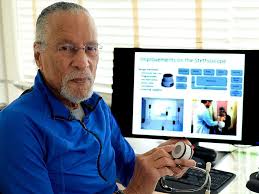
- James E. West: An African American inventor who spent 40 years at Bell Labs. He holds over 250 patents and was inducted into the National Inventors Hall of Fame in 1999.
- Gerhard Sessler: A German physicist and inventor who co-developed the electret principle. He later became a professor of electroacoustics, continuing to advance sensor technology.
- Impact: Every time you speak into a cell phone or use a voice assistant, you are using the technology they patented in 1964. Their partnership changed the global communications landscape forever.
Summary of Claims
The patent explicitly protects:
- An electroacoustic transducer with a prepolarized diaphragm composed of electret and conductive layers.
- A push-pull structure using two perforated conductive plates to eliminate sound distortion.
- The use of microscopic air pockets trapped between layers to improve the mechanical performance of the diaphragm.
