
Electrical Resistance Element (1967)
U.S. Patent No. 3,304,199, granted on February 14, 1967, to William M. Faber, Sr., Gaylord L. Francis, Curtis L. Holmes, and Otis F. Boykin, addresses a critical limitation in microelectronics and precision circuit manufacturing: the inability of ceramic resistors to maintain stable, high electrical resistance across wide temperature fluctuations. The inventors, working on behalf of CTS Corporation of Elkhart, Indiana, developed a revolutionary oxide-glass glaze formulation that fundamentally expanded the capabilities of ceramic film resistors.
This invention overcame a longstanding dilemma in mid-century electronic hardware: prior art ceramic resistors could not reliably achieve resistance values exceeding 30,000 ohms per square without suffering severe instability and erratic temperature drift. Faber, Francis, Holmes, and Boykin solved this by breaking with established industry doctrine, utilizing ruthenium and iridium oxides to produce precision resistors capable of operating reliably at values up to and exceeding 180,000 ohms per square.
The Innovation: Rutile-Lattice Oxide Formulation
Before this patent, the industry operated under the conviction that conductive elements in ceramic resistors had to be pure, nonreactive noble metals (like silver, gold, or palladium) or mixtures with palladium oxide. However, those formulations proved erratic—minor variations in furnace firing temperatures caused wild swings in sheet resistance, and lowering the conductive fraction to achieve higher resistance caused the element to exhibit an excessively high negative temperature coefficient of resistance (TCR).
The inventors discovered that oxides of ruthenium (RuO2) and iridium (IrO2) possessed a unique rutile crystal lattice structure distinctly different from earlier metal oxides. When finely dispersed throughout a borosilicate glass matrix and fired onto a nonconductive substrate, these oxides preserved an unbroken, stable conductive path across an unprecedented resistance range while keeping thermal drift nearly negligible.
Why Ruthenium and Iridium Oxides?
- Extended Ohmic Range: Enabled high-yield manufacturing of resistors exceeding 180,000 ohms per square—a 600% increase over the prior art threshold of 30,000 ohms per square.
- Exceptional Temperature Stability: Maintained an ultra-low TCR of approximately 0.01% per degree centigrade (100 parts per million) or less across the entire spectrum, preventing circuit failure caused by ambient heating.
- Predictable Manufacturing Yields: Eliminated the abrupt, unpredictable resistance drops that plagued other metal oxides, removing the expensive requirement of blending in pure gold or exotic modifiers.
- Miniaturization: Allowed high-resistance components to be produced without artificially elongating the conductive path, saving critical space inside compact circuit designs.
Key Chemical and Structural Components
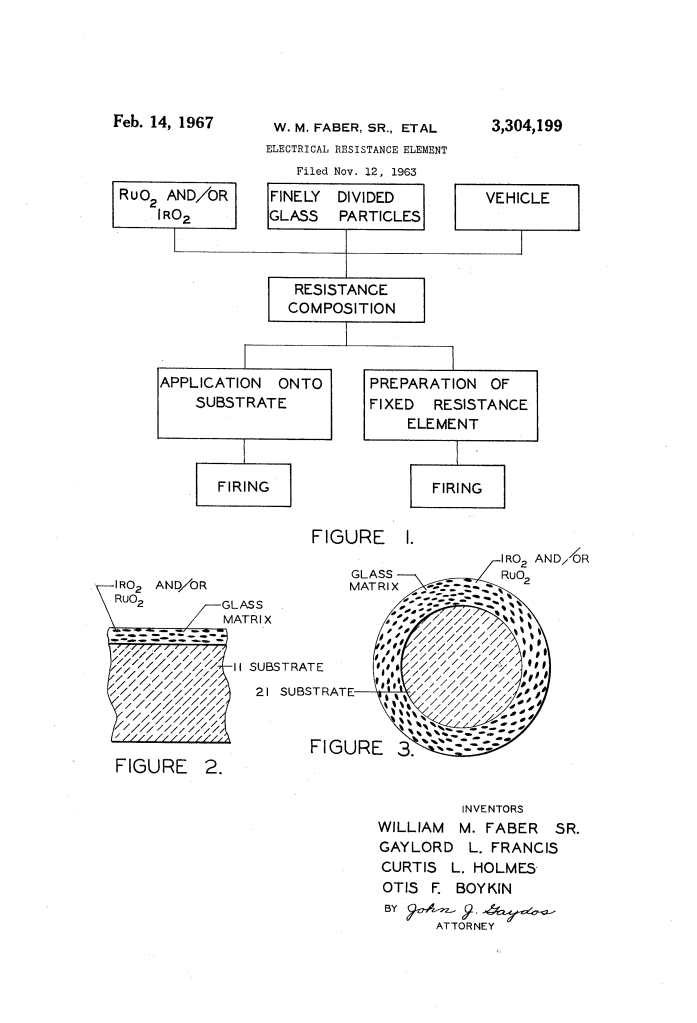
The composition is an engineered system where conductive oxides and a vitreous matrix fuse into an integrated electrical film:
| Component | Function |
| Ruthenium Dioxide (RuO2) / Iridium Dioxide (IrO2) | The finely divided conductive fraction (2% to 70% by weight); provides the stable rutile-lattice conduction pathways. |
| Powdered Glass Frit (e.g., Lead Borosilicate) | The vitreous insulating binder (30% to 98% by weight; e.g., 63% PbO, 25% B2O3, 12% SiO2) that melts between 500 C and 1000 C to lock particles into a glassy matrix. |
| Organic Vehicle (Screening Agent) | A temporary carrier (such as ethyl cellulose dissolved in acetone-toluene or trichloroethylene-fenchone) that suspends the particles for screen printing and burns off cleanly during firing. |
| Ceramic Substrate (Base 11 / 21) | A high-temperature-resistant, electrically nonconductive flat or cylindrical base that anchors the fired-on resistance film. |
| Cupric / Manganese Oxide Additives | Minor stabilizing agents dissolved into the glass frit to enhance long-term operational resistance stability. |
Performance: Precision Across Wide Ohmic Values
CTS Corporation’s extensive laboratory tests demonstrated that altering the ratio of metal oxide to glass produced smooth, predictable increases in sheet resistance while maintaining strict temperature tolerance.
Representative Formulations and Thermal Performance:
- Low Resistance (26% RuO2, 74% Glass): 24.8 ohms/sq; TCR of 0.007%/ C.
- Medium Resistance (20% RuO2, 80% Glass): 2,860 ohms/sq; TCR of 0.002%/ C.
- High Resistance Threshold (9% RuO2, 91% Glass): 19,000 ohms/sq; TCR of 0.003%/ C.
- Extended High Range (4.5% RuO2, 95.5% Glass): 128,000 ohms/sq; TCR of 0.005%/ C.
- Ultra-High Range (4.5% IrO2, 95.5% Glass): 181,000 ohms/sq; TCR of 0.01%/ C.
The Manufacturing Process
The patent details a repeatable, industrial screen-printing and firing sequence:
- Ball Mill the RuO2 or IrO2 powder and powdered glass frit (both ground finer than 325 mesh) in water for 2 hours to create a uniform slurry.
- Evaporate the liquid carrier to leave a completely homogeneous, dry powdered cake.
- Blend the dry mixture with an organic vehicle (such as ethyl cellulose in acetone-toluene) at roughly 1 part solids to 3 or 4 parts vehicle to establish ideal printing viscosity.
- Screen Print the paste onto a lapped and polished ceramic substrate, forming a wet film deposit of approximately 0.003 inch.
- Fire in an oxidizing furnace between 500 C and 1000 C (typically around 750 C) to volatilize all organic screening compounds and fuse the glass and metal oxide into a resilient film between 0.0002 and 0.003 inch thick (nominally 0.001 inch).
- Attach terminal leads to opposite ends of the fired element for circuit integration.
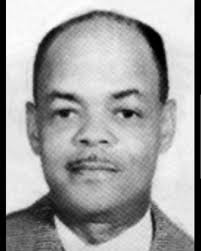
About the Inventor: Otis F. Boykin
Among the team of CTS Corporation engineers, Otis Frank Boykin stands out as one of the most prolific and impactful African American inventors in the history of modern electronics.
- Prolific Innovator: Boykin held over 25 patents covering precision electrical components, variable resistors, capacitor units, and consumer electronic controls.
- Microelectronics Revolution: His breakthroughs in precision wire-wound and cermet film resistors made high-precision electronic circuitry durable, cheap, and compact. His components were adopted globally across commercial televisions, military guided missile systems, radar arrays, and computers.
- Biomedical Legacy: Boykin adapted his precision control resistor technology into a control unit for the artificial cardiac pacemaker. His design provided the exact, reliable pacing signals necessary to maintain consistent human heart rhythms, saving countless lives worldwide.
Summary of Claims
The patent explicitly claims:
- A resistance composition for application to nonconductive substrates comprising 2% to 70% by weight of a finely divided metal oxide selected from RuO2 and IrO2, and 98% to 30% by weight powdered glass frit.
- A high-temperature-resistant, electrically nonconductive base having fired thereon a solidified glass matrix film containing finely divided RuO2 or IrO2 dispersed in conductive relationship.
- A precision resistance film having a controlled thickness between 0.0002 and 0.003 inch with an ultra-low temperature coefficient of resistance across wide ohmic ranges.
