
Electrical Resistance Element and Method of Making the Same (1966)
U.S. Patent No. 3,271,193, granted on September 6, 1966, to Otis F. Boykin, addresses a major reliability and manufacturing challenge in electronic components: electrical noise, rapid wear, and unpredictable resistance in “cermet” (ceramic-metal) thin-film variable and fixed resistors.
Boykin, a prolific inventor working for CTS Corporation in Elkhart, Indiana, developed precision electrical components that became standard across military, consumer, and aerospace electronics. This specific invention solved a persistent defect in high-performance circuitry by fundamentally re-engineering how conductive metals are embedded into protective glass films.
The Innovation: The “All-Liquid Resinate” Formulation
Prior cermet resistors were manufactured using a mechanical mixture of solid, ground glass particles (glass frit) and metal powders or metal resinates. Because the glass frit particles varied widely in size and could not be evenly mixed on a microscopic scale, the metal particles clumped together during firing—often forming agglomerations 10 to 20 times larger than intended.
This uneven dispersion created rough film surfaces, irregular contact resistance, and electrical noise. To quiet the noise, engineers had to apply excessive contact pressure, which caused premature wear and dramatically shortened the component’s rotational life.
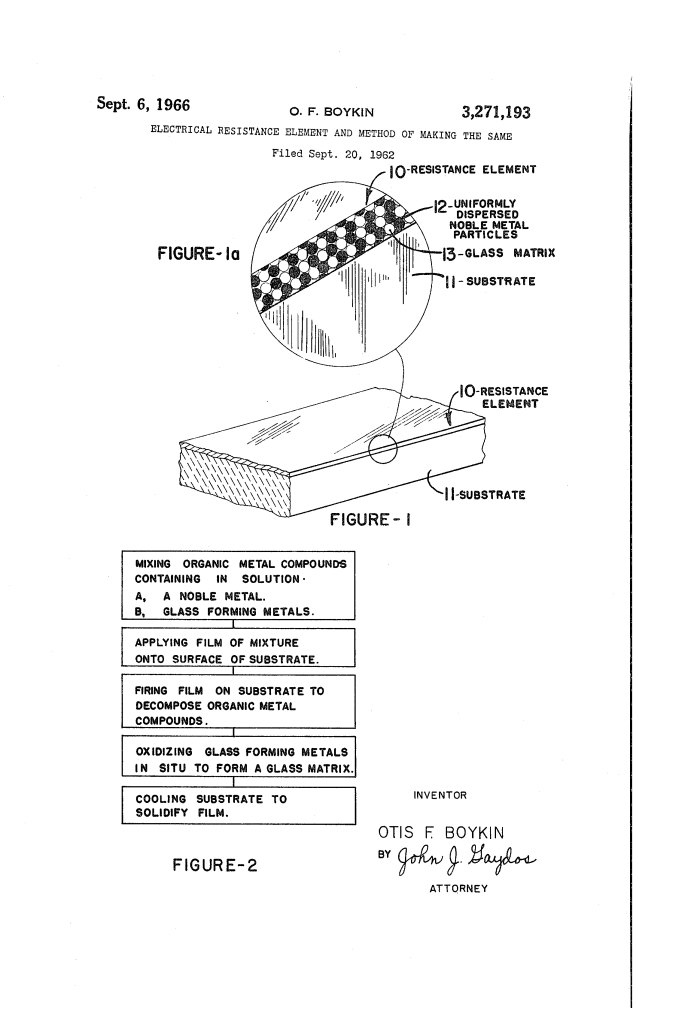
Boykin eliminated ground glass frit entirely. His breakthrough was using completely miscible liquid resinates for both the conductive metals and the glass-forming ingredients. By blending them as homogenous liquids, the glass matrix and conductive particles form simultaneously during firing, distributing the conductive particles evenly at a molecular scale.
Why All-Liquid Resinates?
- True Homogeneity: Mixing liquids ensures complete, uniform distribution that mechanical grinding of solid powders can never match.
- Ultra-Smooth Surface: The absence of large frit particles produces an exceptionally smooth, microscopic film (5 to 20 microns thick), drastically reducing friction and contact wear.
- Noise Suppression: Stable, uniform particle spacing prevents erratic contact resistance jumps, eliminating electrical noise without requiring heavy mechanical contact pressure.
- Predictable Resistance: Standardizes manufacturing outcomes, drastically lowering production waste and batch-to-batch variation.
Key Chemical Components
The formulation uses organometallic resinates that decompose under heat to leave behind an integrated network of conductors suspended in glass:
| Component | Function |
| Noble Metal Resinates (e.g., Silver, Palladium, Ruthenium, Rhodium) | Decompose during firing to provide conductive particles (or conductive oxides) that establish the desired electrical resistance. |
| Glass-Forming Resinates (e.g., Lead, Boron, Silicon, Bismuth) | Thermally decompose and oxidize during firing to generate a lead borate or lead boro-silicate glass matrix in situ. |
| Screening Agent (e.g., Ethyl Cellulose) | An organic medium added after mixing to provide proper screening consistency; burns off cleanly during firing without affecting composition. |
| Ceramic Substrate (e.g., Alumina or Steatite) | A heat-resistant, electrically nonconductive ceramic base that supports the thin resistive film without softening at high temperatures. |
Performance: Noise Reduction and Extended Lifespan
Boykin’s liquid-derived resistive films demonstrated superior electrical and mechanical stability compared to traditional frit-based elements.
Operational Advantages:
- Extended Rotational Life: The ultra-smooth film surface allowed wiper contacts to operate with far lighter contact pressure, multiplying the component’s mechanical lifespan.
- Low Voltage Coefficient: Uniform dispersion throughout the glass layer stabilized resistance values across changing voltage loads.
- Broad Resistance Range: By switching from high-conductivity conductors (silver/palladium) to high-resistivity metals (ruthenium) and varying layer counts, resistance was easily tuned from 8 to 12 ohms per square up to 12,000 ohms per square.
The Manufacturing Process
Boykin outlined a multi-step thermal synthesis process to produce the uniform glass-metal element:
- Blend the liquid noble metal resinates with liquid glass-forming resinates (lead, boron, or silicon) in specified ratios.
- Add the screening agent to achieve uniform paste viscosity for application.
- Screen a thin film of the mixture onto a clean alumina or steatite ceramic substrate.
- Fire the coated substrate in a kiln at 750°C to 900°C for 5 to 30 minutes, burning off organic carriers, reducing noble metals, and fusing the glass-forming oxides into a continuous matrix.
- Repeat application and firing for two to five layers to build the exact target thickness and adjust overall resistance.
Historical and Scientific Impact
Otis Boykin’s work on precision resistors arrived at a pivotal moment in the transition to solid-state electronics:
- High-Reliability Electronics: His resistors were sought after for demanding applications where failure was not an option, including early guided missile control systems, computers, and medical pacemakers.
- Consumer Cost Reductions: Replacing haphazard, trial-and-error frit recipes with precise, reproducible chemical solutions reduced manufacturing costs for precision potentiometers across consumer and commercial markets.
- Foundation for Modern Thick-Film Technology: Boykin’s methodology of generating conductive metal-glass cermets directly through liquid resinates helped establish principles still referenced in microelectronics and hybrid integrated circuits.
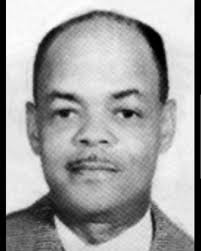
About the Inventor: Otis F. Boykin
Otis Frank Boykin was an extraordinarily inventive African American engineer and inventor whose contributions shaped modern electronic circuitry.
- Patents: Boykin earned over 25 patents across his career, focusing on precision electrical resistors, capacitors, and specialized control units.
- Impact: In addition to his groundbreaking cermet resistor designs, Boykin created an improved wire-wound resistor that could withstand extreme temperature swings and mechanical acceleration, as well as a specialized control unit for the artificial heart pacemaker that greatly improved its reliability.
- Legacy: Working in Chicago, Indiana, and internationally in Paris, Boykin proved that molecular-level control over materials engineering was the key to building miniature, durable, and fault-tolerant electronic components.
Summary of Claims
The patent explicitly claims:
- A method of manufacturing a resistive element by mixing solutions of thermally decomposable noble metal organic compounds and glass-forming organic compounds.
- Applying the liquid mixture to a heat-resistant, nonconductive substrate and firing at 750°C to 900°C to decompose the organics and form the glass matrix in situ.
- A resistive element comprising noble metal particles (such as ruthenium, rhodium, iridium, or palladium) or their oxides uniformly dispersed in a thin glass film formed simultaneously on a ceramic base.
