
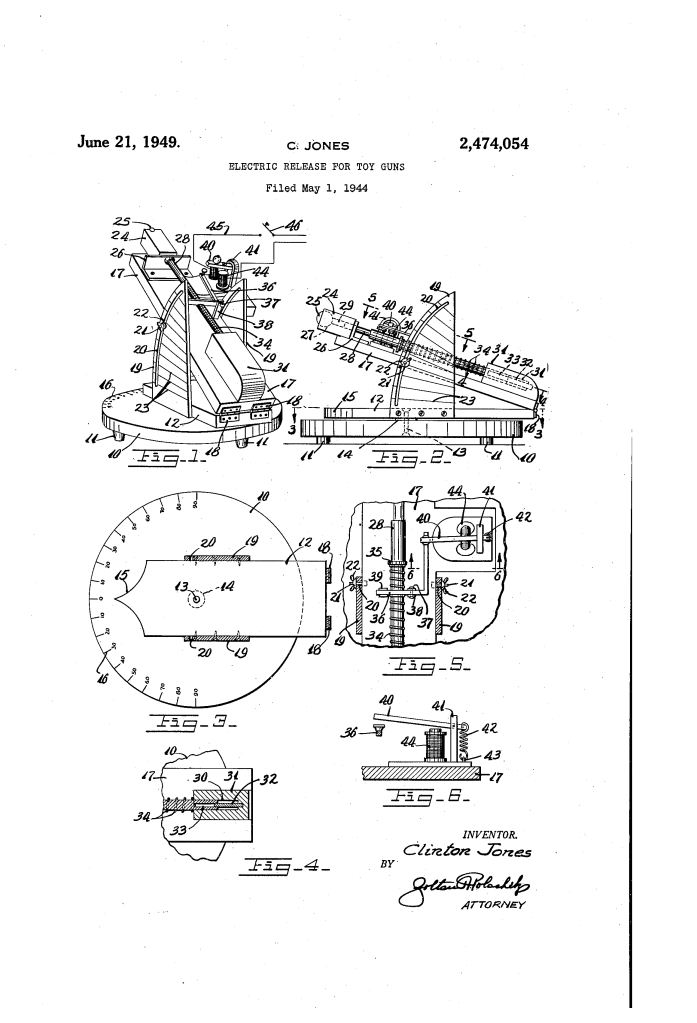
Electric Release for Toy Guns, Clinton Jones (1949)
Patented in June 1949, this invention by Clinton Jones (U.S. Patent No. 2,473,885) was designed as an “artillery trainer.” While it is technically an electric release for toy guns, its primary purpose was to provide a safe, scaled-down device for students to learn the complex mathematics and mechanics of operating large artillery pieces under simulated battle conditions.
The device allows for precise adjustments in both azimuth (horizontal rotation) and elevation (vertical angle), and it features a unique electromagnetic firing mechanism that can be triggered remotely.
The “Why”
In the 1940s, training soldiers to operate heavy artillery was expensive and dangerous. Instructors needed a classroom-safe tool that behaved like a real cannon—requiring accurate aiming and “powder charge” calculations—without the need for actual explosives.
- The Problem: Most toy guns used a simple manual trigger, which lacked the “remote command” feel of real artillery and didn’t allow for variable firing power.
- The Solution: Jones created a spring-loaded bolt that could be “locked” at different tensions and released by an electric switch. This simulated the lanyard pull of a large gun and allowed students to calculate how different “charges” (spring tensions) affected the projectile’s trajectory.
Inventor Section: Engineering Philosophy
Clinton Jones’s philosophy was Simulated Precision. He believed that for a trainer to be effective, it had to be more than a toy; it needed calibrated scales and repeatable results. By using a Compression Spring (34) and a Latch Arm (36) that could hook into specific coils of the spring, he turned a simple toy into a scientific instrument capable of being used for ballistic recordings.
Key Systems Section
1. Azimuth and Elevation Controls
To hit a target, the student must adjust two axes of movement:
- Azimuth Base (10, 12): The entire gun sits on a disc-shaped base with a calibrated scale (16). A pointer (15) allows the student to rotate the gun to a specific degree left or right.
- Elevation Plane (17): The firing platform is hinged at the back. It can be raised or lowered and locked into place using Thumb Nuts (22) that slide along an arcuate slot (20) marked with angular scale marks (23).
2. Variable Tension Firing Bolt
Unlike a standard toy gun, this device allows the user to choose the “muzzle velocity” of the projectile.
- The Latch Arm (36): This is the “trigger” mechanism. Instead of catching the bolt at a single point, the latch can be inserted between selected turns of the spring (34).
- The Physics: Inserting the latch into a turn closer to the front of the bolt compresses the spring more, storing more potential energy. This allows the student to experiment with different “charges” to see how they affect distance.
3. The Electromagnetic Release
This is the core of the 1949 patent—the “Electric Release.”
- Electro-magnets (44): Mounted beneath a magnetic bar (40).
- Remote Switch (46): When the student closes the circuit, the magnets pull the bar down.
- The Trip: The bar strikes the end of the latch arm (36), pivoting it out of the spring coils. This releases the bolt (28), which shoots forward and strikes the steel ball projectile (25).
Technical Components of the Jones Artillery Trainer
| Part Number | Component | Function |
| 16 | Calibrated Scale | Measures the horizontal (azimuth) angle. |
| 23 | Angular Scale Marks | Measures the vertical (elevation) angle. |
| 25 | Projectile | A steel ball launched from the block. |
| 34 | Compression Spring | Stores energy; tension is adjustable by the latch. |
| 36 | Latch Arm | Holds the spring under tension; the “firing” point. |
| 44 | Electro-magnets | Pulls the release bar to fire the gun electronically. |
Significance
Clinton Jones’s invention bridged the gap between a toy and a military training aid:
- Ballistic Education: It allowed for “recording time” using stopwatches to determine velocity, teaching students the relationship between distance, time, and angle.
- Safety in Classrooms: It simulated the “Fire!” command of artillery without any pyrotechnics, making it a staple for ROTC or classroom physics demonstrations.
- Remote Triggering: The electric release allowed the student to stand at a distance, mimicking the safety protocols used with real high-caliber weaponry.
Final Insight: The Jones trainer is a classic example of “functional play.” While it looks like a toy, the inclusion of rubber feet (11) to prevent slipping on desks and the “pin-in-opening” (32/33) design to ensure the bolt strikes the projectile perfectly square shows that Jones was focused on the scientific repeatability of the machine.
