
Electric Railway (1894)
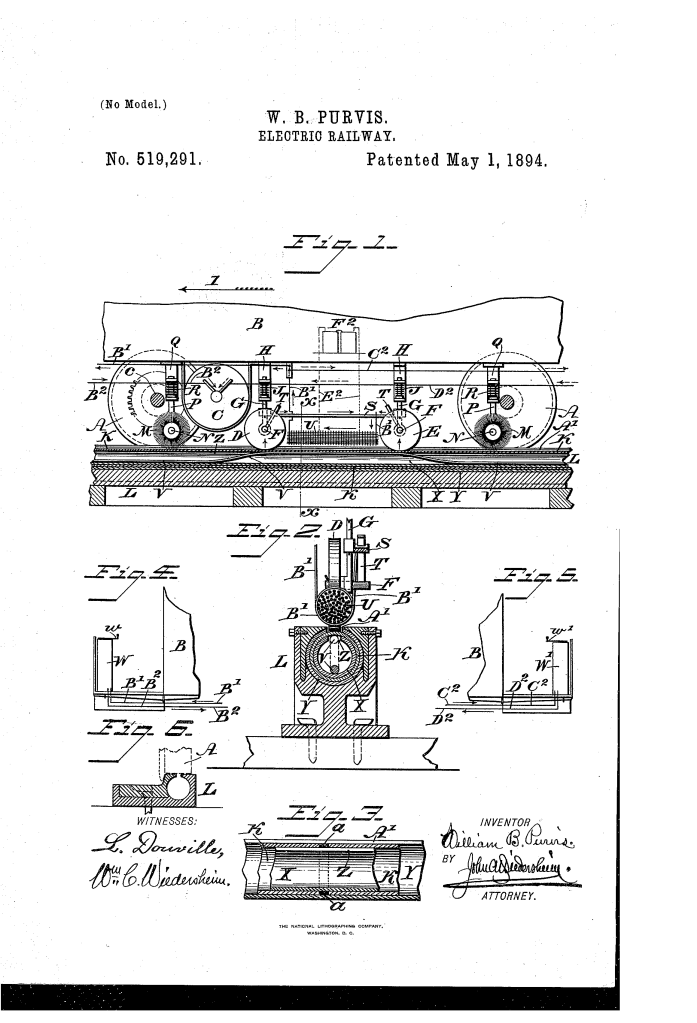
U.S. Patent No. 519,291, granted on May 1, 1894, to William B. Purvis, describes an innovative underground conduit system designed for electric streetcars. The invention automatically closes an electric circuit to power a moving vehicle while keeping the high-voltage electrical conductor safely isolated from the street surface and pedestrians.
This specific invention solved a critical safety and infrastructure problem in early urban transit: how to supply constant electrical power to a moving trolley without relying on dangerous, exposed overhead wires or permanently live third rails embedded in public streets.
The Innovation: The “Dynamic Magnetic Pick-Up” System
Traditionally, electric railways risked public safety by leaving electrified rails open to the elements and accidental contact. Purvis’s breakthrough was a closed underground system where the main power line remains completely inert at the bottom of a protective trench until the moment a streetcar passes directly over it.
The system relies on a flexible, loose electric wire resting inside an insulated underground tube. When the car moves along the track, powerful electromagnets suspended from the undercarriage physically attract and lift the underground wire, bringing it into contact with the metallic surface tube to transfer power straight to the car’s motor.
How the Apparatus Functions
The operation follows a continuous loop as the car travels down the track:
| Step | Action | Safety & Mechanical Purpose |
| 1. Priming | An onboard battery passes an initial current to charge the car’s suspended electromagnets. | Creates the initial magnetic field required to engage the underground components. |
| 2. Magnetic Lift | The electromagnet passes over a track section, pulling the loose internal wire upward. | Physically lifts the live wire off the floor of the insulated underground conduit. |
| 3. Contact & Charge | The moving wire touches the inner wall of the slotted metallic tube section. | Electrifies only the specific, isolated section of track directly beneath the vehicle. |
| 4. Power Transfer | Current flows through contact wheels and brushes to the car’s motor, grounding through the rails. | Propels the car forward while leaving preceding and succeeding track sections dead and safe. |
Key Technical Components
The system is a highly synchronized combination of rolling stock components and subterranean engineering:
- Underground Conduit (L): A protective housing embedded between or within the rails. It contains a metallic tube (K) insulated on the inside and outside by slotted non-conducting tubes (X and Y) to prevent accidental grounding.
- Loose Conductor (V): A flexible electric wire that rests safely at the bottom of the conduit when not influenced by a magnetic field.
- Spring-Controlled Contact Wheels (D, E): Mounted to the bottom of the car, these wheels ride continuously against the underground metallic tube to draw the current. The springs allow the car body to bounce smoothly without breaking electrical contact.
- Electro-Magnet (U): Suspended from a crossbar beneath the car, this magnet sustains the upward pull on the wire and powers the vehicle’s propulsion system once the circuit is closed.
- Dual Switchboards (W, W’): Control levers that allow the motorman to break or route the circuit, enabling the car to easily change direction or come to a full stop.
Historical and Scientific Impact
William B. Purvis’s electric railway design was a forward-thinking contribution to late-19th-century mass transit expansion:
- Enhanced Urban Safety: By keeping the primary voltage line enclosed within an insulated, slotted sleeve deep inside a trench, it eliminated the risk of electrocuting pedestrians or horses on city streets.
- Weather Proofing: Early electric rail systems frequently short-circuited due to rain, snow, or debris. Purvis’s design utilized internal and external non-conducting shields to protect the contact points from environmental interference.
- Operational Flexibility: The integration of dual switchboards and specialized wiring allowed for seamless bi-directional travel without needing to physically turn the streetcar around at the end of a line.
About the Inventor: William B. Purvis
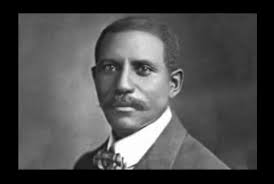
William B. Purvis was a remarkably prolific African American inventor based in Philadelphia during the late 19th and early 20th centuries.
- Patents: Best known for his significant improvements to the fountain pen (holding several key patents that made it more efficient and less prone to leaking), Purvis’s brilliant mechanical mind spanned multiple industries. He held numerous patents for diverse technologies, including edge-cutting machines, paper bag manufacturing devices, and self-inking stamps.
- Legacy: Purvis operated at a time when urban centers were rapidly transitioning from horsepower to electricity. His contributions to both office utility and heavy industrial transit showcased the versatility of Black inventors during the height of the American Industrial Revolution.
Summary of Claims
The patent explicitly claims:
- An insulated subterranean tube composed of distinct sections, featuring slotted inner and outer non-conducting jackets housing a loose internal electric wire.
- A specialized car undercarriage featuring hangers, spring-controlled contact wheels, and cleaning brushes designed to maintain a consistent connection with an underground conduit.
- The combination of an onboard vehicle motor, an operating battery, suspended electromagnets, and a dual-switchboard system capable of regulating power and altering the travel direction of the railway car.
