
Electric Railway (William B. Purvis, No. 519,291)
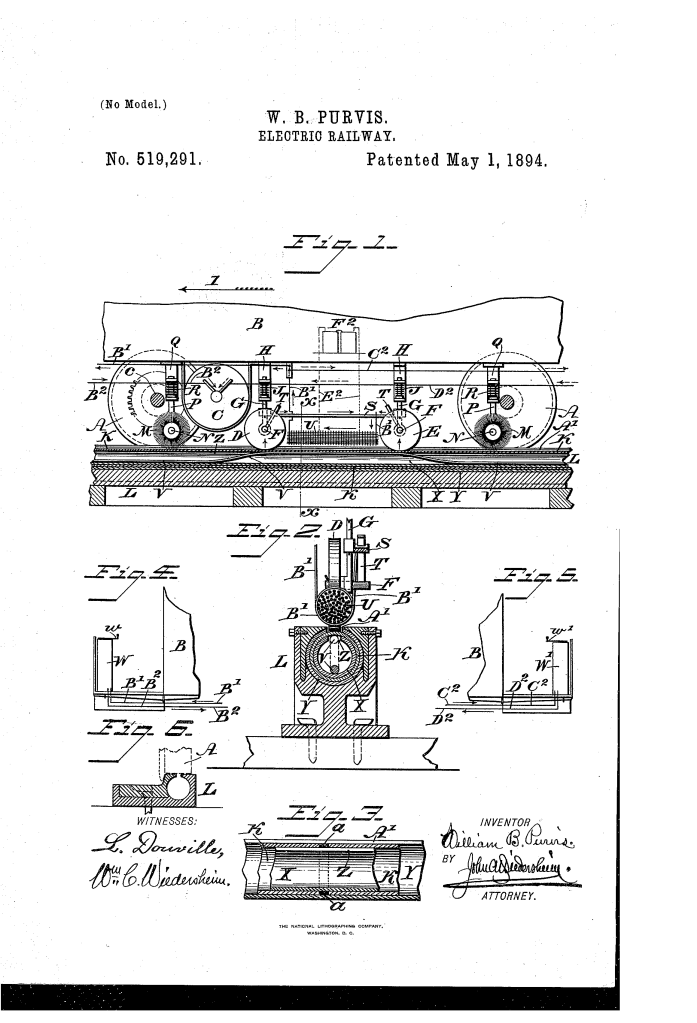
The patent by William B. Purvis of Philadelphia, Pennsylvania, describes an improvement in Electric Railways focusing on a novel method of power collection from an underground or enclosed conduit. The core innovation is a system that uses an on-board electromagnet to automatically lift the power conductor within the conduit only when the car is directly above it, ensuring that only the relevant section of the power supply is charged.
Invention and Mechanism
The system is a complex electro-mechanical arrangement involving a specialized conduit and a power-receiving assembly on the car.
1. The Conduit and Conductor System
- Conduit (L): An enclosed channel, possibly formed in the rail itself (Fig. 6).
- Conductor (V): A loose electric wire that normally rests in the bottom of the conduit, uncharged.
- Metallic Tube (K): A segmented metallic tube running through the conduit, composed of insulated sections.
- Insulating Tubes (X and Y): Inner (X) and outer (Y) tubes made of non-conducting material. They are slotted (Z and A’, respectively) to expose the metallic tube (K) and allow the conductor (V) to contact it.
- Function: The power is not continuously applied to the entire conductor (V). Instead, the system relies on the car to lift the conductor (V) into contact with a charged metallic tube section (K) to complete the circuit for that section.
2. The Car’s Power Collection and Actuation System
- Electromagnet (U): Suspended from a bar (S) on the car.
- Initial Charging: To start the process, the electromagnet (U) is temporarily charged by an on-board battery (F2).
- Conductor Lifting: When charged, the electromagnet (U) attracts the conductor (V), lifting it from its resting place in the bottom of the conduit and causing it to come into contact with the metallic tube section (K) directly above.
- Self-Sustained Power: Once the conductor (V) contacts the charged tube (K), the main current flows:
- From Tube (K) → through Wheels (D, E) → to Axles (F) → through Brushes (T) → to Bar (S) → to Electromagnet (U).
- The magnet is now further charged by the main current from the conductor (V), making it strong enough to retain the conductor in contact with the tube (K) and transmit power to the motor (C).
- Power Transmission: The current then flows from the magnet (U) to the switchboards (W,W′) and then to the motor (C).
- Direction Control: Two switchboards (W and W′) allow the operator to reverse the direction of the current to the motor, propelling the car forward or backward.
- Cleaning: Brushes (M) are spring-mounted to contact the metallic tube (K) to remove dirt or obstacles.
Historical Significance and the Inventor
The patent by William B. Purvis in 1894 is significant within the fierce competition of early electric railway systems, particularly concerning safety and efficiency.
- The Conduit Challenge: Early electric railways faced the dilemma of overhead wires (unsightly and prone to weather damage) versus underground conduits (expensive, prone to flooding, and complicated). Systems like Purvis’s, which contained the power conductor within the track structure, addressed the aesthetic issue.
- Safety Innovation (Sectional Power): The most crucial aspect is the safety mechanism. By having the power conductor (V) normally rest uncharged at the bottom and only lifting it into contact with the charged section (K) when the car’s magnet is directly overhead, Purvis ensured that only the section immediately under the car was “live.” This prevented accidental electrocution of people or animals stepping on the track between cars, a major safety hurdle for early city electric railways.
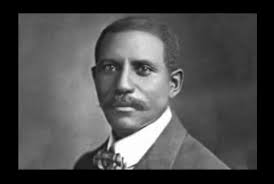
- The Inventor (William B. Purvis): William B. Purvis (1838–1914) was a prolific African-American inventor from Pennsylvania, holding nearly three dozen patents. His inventions covered diverse fields, including paper bags, electric railways, and mechanical safety devices. Like his contemporaries Loudin and Murray, Purvis was a key figure who pursued practical, marketable engineering solutions, particularly those involving innovative applications of magnetism and mechanics.
Relation to Current Items
Purvis’s invention is a fundamental conceptual predecessor to modern inductive and contact-based power systems in transit:
- Sectional Third-Rail Systems: The core principle of sectioning the power conductor so that only the segment under the vehicle is live is used in some modern subway and light-rail systems with third-rail power. This system of switching power is usually done with sophisticated electronics rather than simple mechanical attraction.
- Wireless Charging in Transit (Inductive Power): Purvis’s electromagnetic lifting system is conceptually similar to modern wireless charging systems for electric buses or autonomous vehicles
(using inductive loops embedded in the road). In both cases, the vehicle itself activates the power transfer mechanism, ensuring the road surface is not energized and eliminating the need for constant, exposed contact lines.
- Magnetic Actuation: The reliance on an on-board electromagnet to physically actuate a wayside component (lifting the conductor) demonstrates a clever use of electromagnetism for mechanical work, a principle fundamental to solenoids, magnetic levitation (Maglev) control, and electronic switching in modern infrastructure.
