
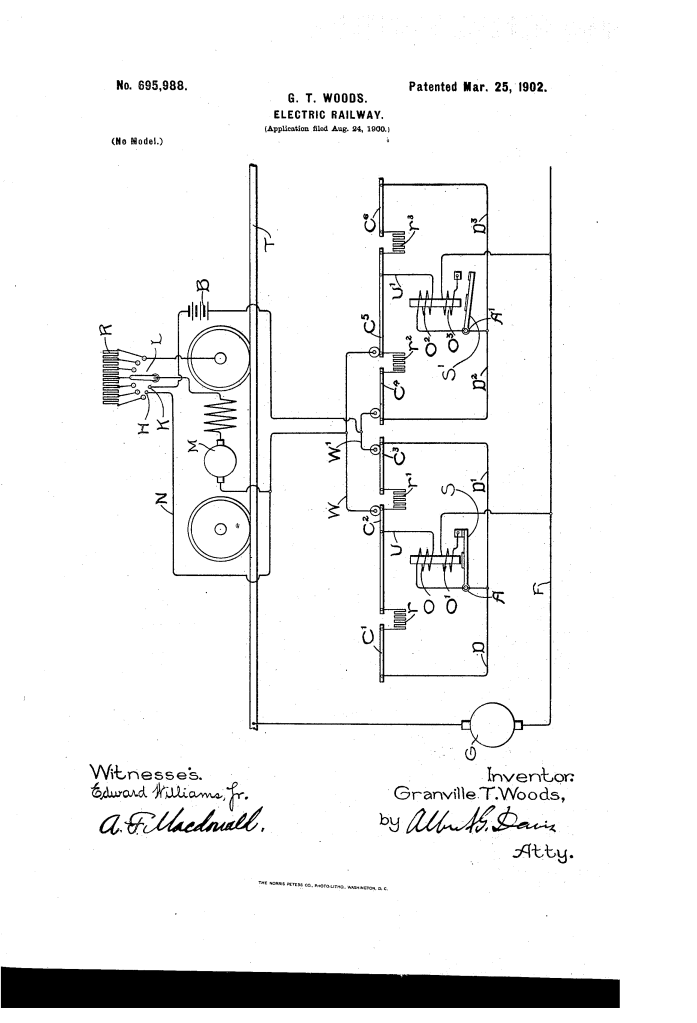
The patent by Granville T. Woods of New York, N.Y., describes certain new and useful Improvements in Electric Railways (Patent No. 695,988, 1902). The invention relates to sectional-conductor electric railways and provides novel means for successively energizing the conductor-sections as the car advances.
Inventor Background: Granville T. Woods
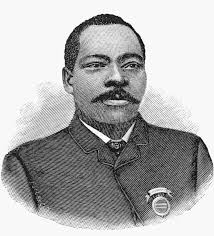
Granville T. Woods (1856–1910) was an incredibly prolific and important African-American inventor known as the “Black Edison.” His work in this area was critical to solving the major safety and efficiency problems of early electric railways, where exposed power rails were hazardous. This patent refines the sectional conductor system to ensure smooth, sequential power-up of track segments.
Invention and Mechanism (Simplified)
The system uses the car’s own power to “wake up” the section of track immediately ahead of it, ensuring that current is always available but only in the necessary segments.
- Sectional Track Power: The track is divided into conductor-sections (C), which are normally dead (not connected to the main feeder F).
- Sets and Resistances: The sections are grouped into “sets” (e.g., three sections per set) and connected internally by resistances ($r$ ).
- Actuation: Gravity-switches (S, S’) are adapted to connect the sections of each set to the main feeder (F) when the car approaches.
- Two Car Contacts: The car carries two specialized contacts:
- Motor-Collector (V): The main shoe that collects current for the motor (M).
- Switch-Energizing Contact (W): A separate contact used to “wake up” the switch in advance. It is connected to a small battery (B) or other power source on the car.
- Sequential Energizing (Key Innovation):
- Shunted Current: As the car moves over a live set of sections, the resistances ($r$) connecting the sections are calculated to shunt (divert) a portion of the current from the main motor circuit through the switch-energizing contact (W).
- Advance Activation: This shunted current flows forward to the next succeeding (advance) set of sections and through the magnet coil ($O$) of the switch ($S’$) controlling that advance set.
- Result: This small, shunted current energizes the magnet, closing the switch ($S’$) and activating the next set of sections before the main motor collector (V) reaches them.
- Discharge Loop (Efficiency): When the rear motor collector leaves a section, the circuit of the series-coil ($O$) is broken. However, a closed loop is formed by the sections and resistances, which allows the magnet coil ($O$) to safely discharge its secondary energy without waste.
Concepts Influenced by This Invention
Woods’s sectional railway influenced modern power distribution and safety systems by pioneering predictive, self-activating power transfer using the vehicle itself.
- Predictive/Advance Power Activation: The core concept of using shunted current from a preceding track section to “predictively” activate the switch of the next section influenced the design of automated power grids and track-switching systems that rely on sensing the approaching load to prepare the next segment.
- Sectionalized Power for Safety: This patent advanced the critical principle of sectional power delivery, ensuring that vast lengths of track remain de-energized and safe until a vehicle is actively drawing power from that specific segment.
- On-Board/On-Site Power Management: The use of resistances (r) within the track itself to manage current flow and the magnet-coils’ secondary discharge influenced the design of distributed control systems where intelligent components are built into the infrastructure to manage power locally.
- Energy Recirculation (Discharge Loop): The use of a closed loop to handle the secondary discharge of the electromagnet-coils (instead of wasting the energy) influenced modern electrical system design, where discharge suppression and energy recovery are prioritized for efficiency and component longevity.
