
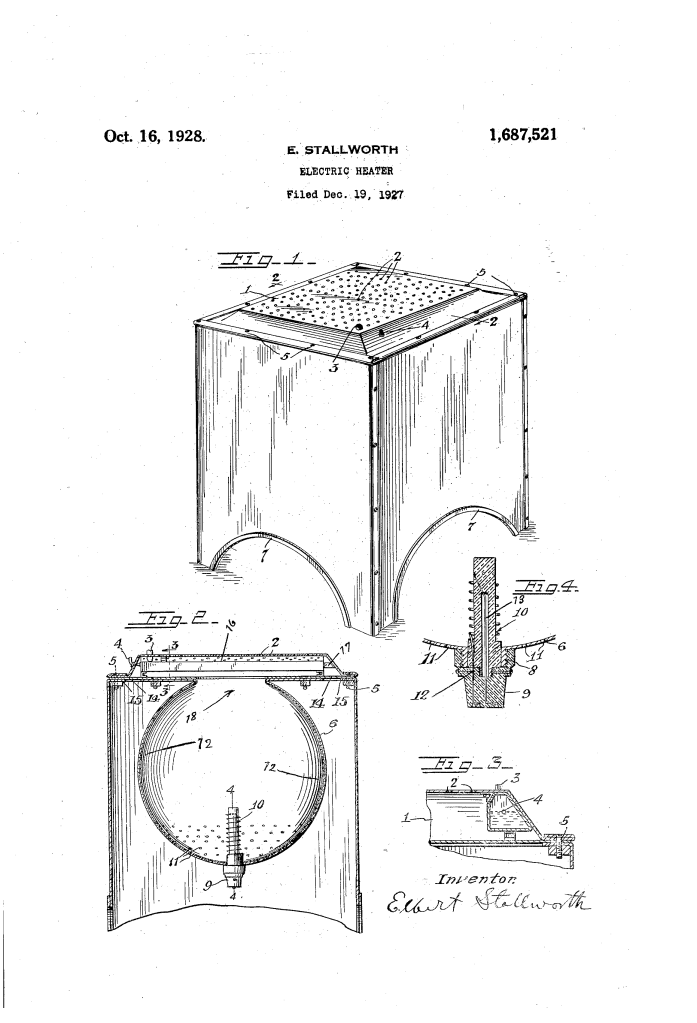
Electric Heater (Elbert Stallworth, No. 1,687,639)
The patent by Elbert Stallworth of Americus, Georgia, describes an improved Electric Heater (Patent No. 1,687,639, 1928). This invention is a portable space heater designed to provide both radiant heat and humidified convection. Stallworth’s primary objective was to solve the “dry air” problem associated with early electric heaters, which often caused discomfort to the respiratory system. His innovation features a concave reflector to focus radiant heat and an integrated humidifier located directly in the hot air’s path, ensuring that the air exiting the heater is comfortably moist.
Inventor Background: Elbert Stallworth
Elbert Stallworth was an African American inventor based in Georgia during the late 1920s. His 1928 patent reflects a sophisticated understanding of thermodynamics and home comfort. At a time when electric heating was a luxury, Stallworth focused on the “quality” of heat, recognizing that temperature alone does not create a healthy indoor environment. His design for a “spherical heating chamber” with built-in moisture control was an advanced piece of domestic engineering, positioning him as a pioneer in the field of environmental control systems.
Key Mechanical & Thermal Systems
The heater functions through a combination of radiant energy and a natural “chimney effect” for airflow.
1. The Radiant Heating Element (10, 13)
- Construction: The element consists of a porcelain tube (10) with an electric heating wire (13) coiled spirally around its exterior.
- Terminal Block (9): The tube fits into a socketed terminal block protected by a threaded cover.
- Function: This design allows for high heat generation while maintaining electrical insulation. The spiral arrangement of the wire maximizes the surface area exposed to the air, increasing the rate of heat transfer.
2. The Spherical Reflector and Cold Air Inlet (6, 18)
- The Reflector (6): A concave or spherical reflector is suspended within the heater casing.
- Cold Air Perforations: The bottom of the heating chamber is perforated around the heating unit.
- Action: Radiant heat from the wire hits the reflector and is projected forward/upward. Simultaneously, cold air is drawn in through the bottom perforations, heated by the porcelain tube, and directed upward through the circular air passage (18) at the top of the reflector.
3. The Integrated Humidifier (3, 4, 16) (Key Innovation)
- The Receptacle (16): A water tank is mounted directly under the heater’s top plate (1).
- The Sight Glass (4): A water gauge tube (4) allows the user to monitor the water level.
- The Vapor Outlet: The humidifier has beveled sides with perforated outlets near the top.
- Function: As hot air rises from the reflector, it passes over the humidifier. The heat causes the water to evaporate, and the resulting vapor mixes with the hot air before it exits through the top outlet (2). This ensures the room is heated and humidified simultaneously.
Improvements Over Standard 1920s Heaters
| Feature | Standard Electric Heaters | Stallworth’s Humidified Heater |
| Air Quality | Produced “burnt,” dry air. | Integrated humidifier (16) maintains healthy moisture levels. |
| Heat Efficiency | Heat was scattered and lost. | Concave reflector (6) focuses radiant heat for better range. |
| User Awareness | No way to know if water was needed. | Visible water gauge (4) for easy maintenance. |
| Safety | Exposed wires were a fire hazard. | Porcelain tube (10) provides a rigid, insulated support. |
Significance to HVAC and Domestic Engineering
Elbert Stallworth’s electric heater influenced the development of integrated climate control and radiant-convection hybrids.
- Psychrometric Awareness: By incorporating a humidifier, Stallworth demonstrated a mastery of psychrometrics—the study of gas-vapor mixtures—long before “indoor air quality” became a standard engineering term.
- Reflector Optimization: The use of a spherical chamber to project heat while creating a central “vacuum” for airflow is a foundational principle in modern space heater design, where focused radiance is combined with fan-forced or natural convection.
- Modular Safety Components: His threaded terminal block cover (9) and porcelain tube assembly anticipated the modular heating elements used in modern household appliances like water heaters and ovens.
- User-Centric Design: Including a “sight glass” or gauge for water level shows an early commitment to ergonomics and user experience (UX) in hardware design.
