
Self-Feeding Attachment for Furnaces (Firmin Charles Brown, No. 1,719,534)
The patent by Firmin Charles Brown of Chicago, Illinois, describes a Self-Feeding Attachment for Furnaces (Patent No. 1,719,534, 1929). This invention is a mechanical hopper and chute system designed to automate the fueling of standard domestic heating furnaces. Brown’s primary objective was to eliminate the need for constant manual stoking by providing a continuous, gravity-fed supply of coal or fuel. His innovation features a track-mounted mobile hopper and a specialized agitator system that prevents fuel from clogging, ensuring a steady burn throughout the day or night.
Inventor Background: Firmin Charles Brown
Firmin Charles Brown was an African American inventor and engineer active in Chicago during the mid-1920s. His 1929 patent addressed a universal challenge of the era: the labor-intensive nature of coal-fired home heating. Before the widespread adoption of gas and oil heating, homeowners had to manually shovel coal into furnaces several times a day. Brown’s work demonstrates a sophisticated understanding of gravity-flow dynamics and remote mechanical actuation, allowing residents to manage their furnace’s performance from the upper floors of their homes.
Key Mechanical & Feeding Systems
The attachment functions as a bridge between the coal bin and the firebox, utilizing gravity and mechanical vibration to move fuel.
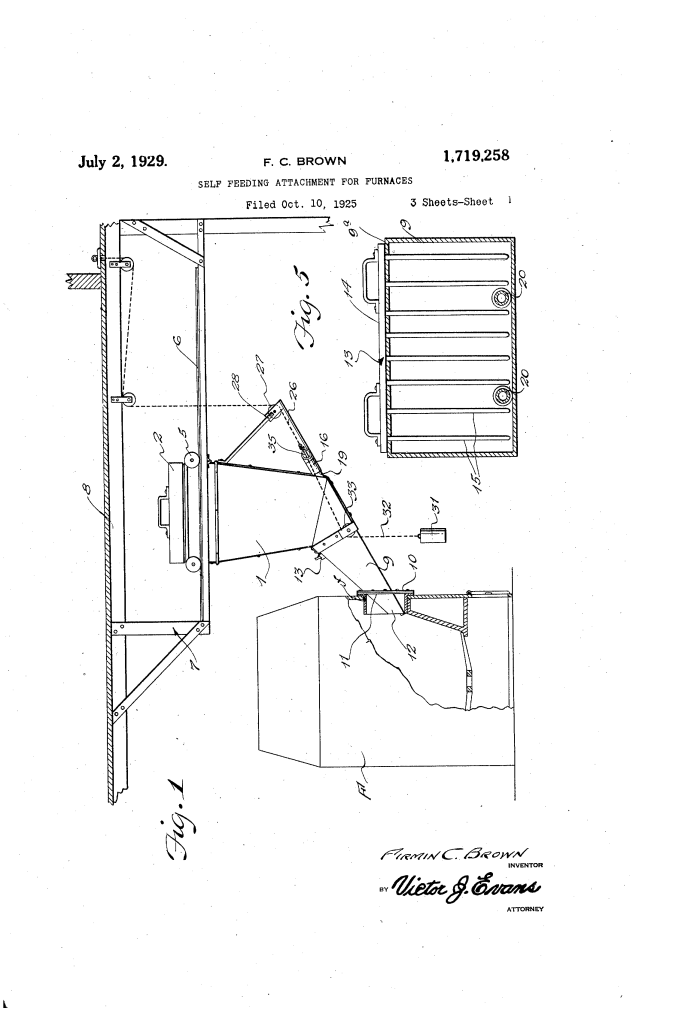
1. The Track-Mounted Hopper (1, 5, 6, 7)
- Mobility: The hopper (1) is mounted on grooved wheels (5) that travel along a track (6) supported by a structural frame (7).
- Operation: The track extends from the furnace (F) to the coal storage bin.
- Function: This allows the user to easily slide the hopper to the coal bin for refilling, then roll it back to the furnace where the nozzle (12) fits into the door opening. This eliminates the heavy lifting and mess associated with carrying coal across a basement.
2. The Regulating Gate (13, 14, 15)
- Construction: A gate (13) consisting of a head (14) and multiple parallel rods (15) extends through the top of the chute.
- Action: This gate acts as a “dam.” When filling the hopper, the rods are lowered to block the flow. Once the nozzle is in the furnace, the gate is raised to allow fuel to slide down. It can also be used to partially restrict the flow to control the thickness of the fuel bed.
3. The Reciprocating Agitator System (20, 22, 26) (Key Innovation)
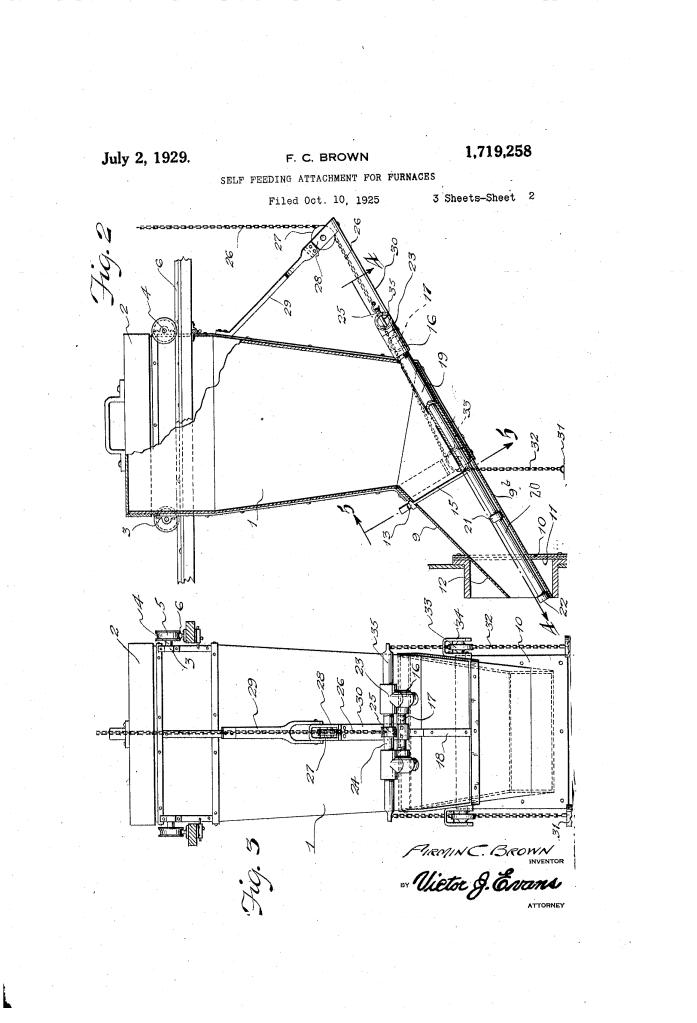
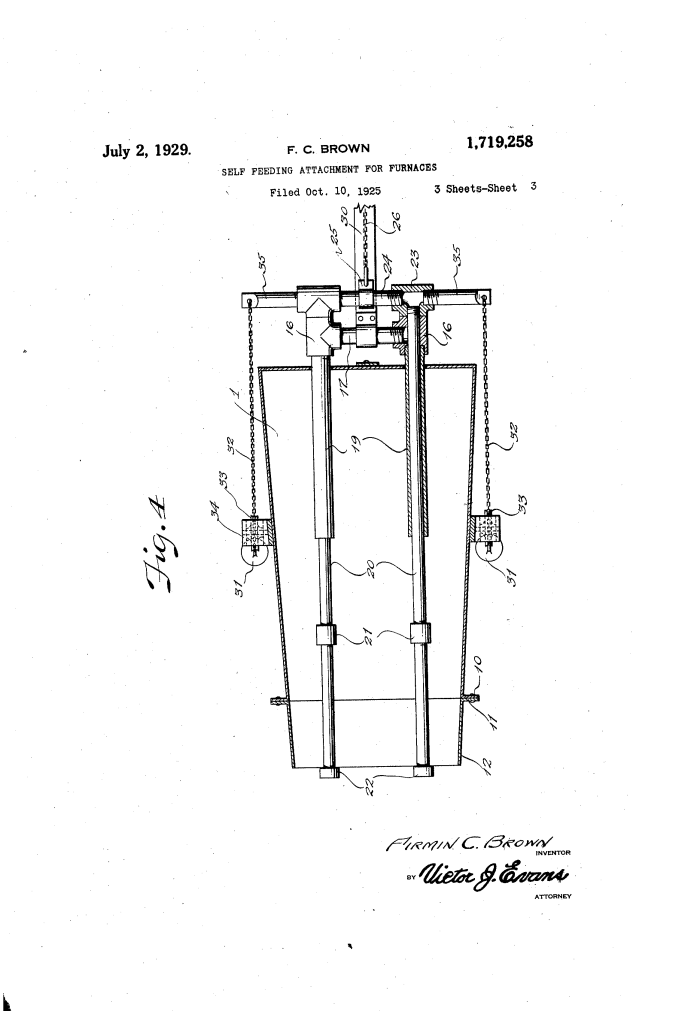
- Agitator Bars (20): Two metal bars with caps (22) at their ends slide along the bottom of the chute.
- Remote Chain (26): The bars are connected to a chain (26) that can be led through the floor to the living quarters above.
- Weights (31): Counterweights pull the bars back into their “rest” position.
- Function: If the coal becomes lodged, the resident can pull the chain from upstairs. This moves the agitator bars back and forth, breaking up “clogged” coal and pushing a fresh supply over the fire bed without a trip to the cellar.
4. The Sealing Nozzle (10, 11, 12)
- Snug Fit: The nozzle (12) is equipped with a large flange (11).
- Function: When the attachment is rolled into place, the flange seats tightly against the furnace’s door frame. This prevents smoke and toxic fumes from leaking into the basement while the self-feeder is in operation.
Improvements Over Manual Furnace Stoking
| Feature | Manual Shoveling | Brown’s Self-Feeding Attachment |
| Labor | Heavy, frequent manual labor. | Gravity-fed; only requires periodic refills. |
| Consistency | Uneven heat; fire can go out. | Continuous supply maintains steady temperature. |
| Cleanliness | Dust and coal spills in the cellar. | Closed system; hopper moves directly to the bin. |
| Control | Requires trips to the basement. | Remote chain (26) allows for control from upstairs. |
Significance to Engineering and Home Automation
Firmin Charles Brown’s self-feeding attachment influenced the development of automatic stokers and residential climate control.
- The Precursor to the Modern Stoker: The logic of using a mechanical agitator to manage solid fuel flow is a direct mechanical ancestor to the screw-fed pellet stoves and automated coal stokers used in industrial boilers today.
- Remote User Interface: By extending the control chain to the “living quarters,” Brown practiced early home automation engineering, recognizing that the interface for a machine should be located where the user actually spends their time.
- Material Logistics: His use of a trackway to connect storage (the bin) to the point of use (the furnace) is a foundational principle in industrial material handling.
- Safety and Environmental Health: The flanged nozzle system was a critical early contribution to indoor air quality, acknowledging that automated systems must not compromise the safety of the building’s atmosphere.
