
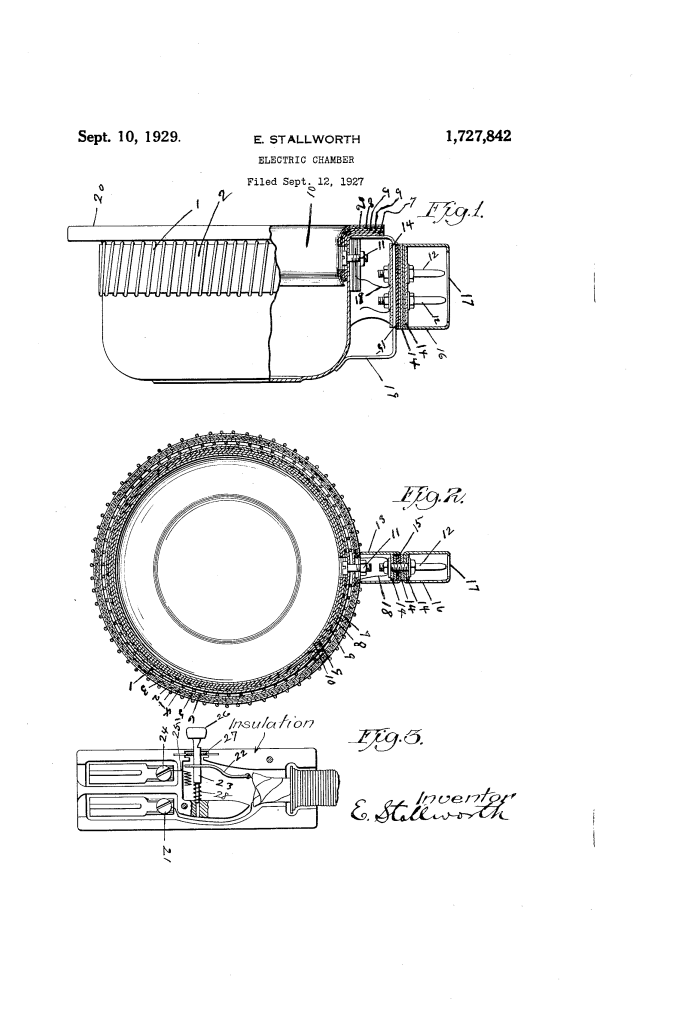
Electric Chamber (Elbert Stallworth, No. 1,727,845)
The patent by Elbert Stallworth of Americus, Georgia, describes an Electric Chamber (Patent No. 1,727,845, 1929). This invention is an electrically heated chamber pot designed to provide comfort and warmth for children or sensitive individuals using the vessel during cold weather, particularly at night. Stallworth’s primary objective was to eliminate the shock of a cold seat and to maintain a comfortable temperature within the vessel. His innovation features a multi-layered insulated seat and a rapid-heating resistance wire system that can warm the device in under a minute.
Inventor Background: Elbert Stallworth
Elbert Stallworth was an African American inventor based in Americus, Georgia. This 1929 patent is a testament to his focus on domestic comfort and specialized engineering. At a time when indoor plumbing was not yet universal—especially in rural areas—the chamber pot remained a common household necessity. Stallworth applied the principles of electrical resistance heating and thermal insulation to a basic utility item, demonstrating a keen eye for improving the “lived experience” of everyday life. His design prioritized safety, specifically targeting the protection of children from burns.
Key Mechanical & Thermal Systems
The device transforms a standard vessel into a heated appliance through a specialized rim-mounted heating unit.
1. The Resistance Heating Unit (2, 3, 4, 6)
- Heating Element: The unit consists of electric heating wire (4) coiled between strips of mica (3, 5).
- Metallic Bands: This assembly is enclosed by two metallic bands (2 and 6) that are riveted together and bolted to the upper edge of the vessel.
- Safety Guard (1): A wire guard extends around the heating bands.
- Function: The mica provides electrical insulation while allowing heat to pass through to the bands. The wire guard acts as a physical barrier to ensure the user’s skin never makes direct contact with the hot metallic bands.
2. The Triple-Layer Insulated Seat (8, 9, 20) (Key Innovation)
- Asbestos Layer (8): Placed closest to the metal body to prevent scorching and to retain heat after the current is switched off.
- Rubber Strips (9): Two layers of rubber are placed over the asbestos.
- Seat Covering (20): A final layer that forms the actual seating surface.
- Function: This “sandwich” construction is a sophisticated thermal management system. The asbestos retains heat so several children can use the device in succession without reheating. The rubber “mortifies” or tempers the heat, ensuring the seat gets warm but never uncomfortably hot for the user.
3. The Push-Button Plug Mechanism (21-28)
- The Controller: The device is operated by a specialized push-button plug.
- Contact Lever (22): Pressing the button (26) moves a lever into contact with the electrical terminals.
- Spring Return (28): A spring and notch system allows the user to lock the heat on or release it with a slight forward press.
- Action: Stallworth designed the system for extreme efficiency; the current only needs to be active for 25 to 45 seconds to bring the seat to the desired temperature.
Improvements Over Standard Chamber Pots
| Feature | Standard 1920s Vessels | Stallworth’s Electric Chamber |
| Comfort | Extremely cold to the touch in winter. | Pre-heated seat provides immediate warmth. |
| Heat Retention | Lost heat instantly. | Asbestos padding (8) keeps the seat warm for multiple uses. |
| Safety | No protection if used near heat sources. | Wire guard (1) and rubber layers prevent skin burns. |
| Efficiency | Required external warming (e.g., water). | Integrated electric unit heats in under 60 seconds. |
Significance to Domestic Engineering
Elbert Stallworth’s electric chamber influenced the development of heated household appliances and thermal safety standards.
- Localized Thermal Comfort: Stallworth’s invention is a direct precursor to modern heated toilet seats and personal warming devices, utilizing the same core concept of rim-based resistance heating.
- Composite Material Engineering: The use of asbestos for heat retention and rubber for temperature regulation demonstrates an early mastery of material properties to solve ergonomic problems.
- Safety-First UI: The inclusion of a wire guard and a specific “timed” heating instruction (45 seconds) shows an early commitment to consumer safety and user education in the electrical appliance industry.
- Rural Innovation: This device served as a “bridge technology,” bringing the comforts of modern electricity to traditional household items during the electrification of the American South.
