
Electric Cell (1966)
U.S. Patent No. 3,255,045, granted on June 7, 1966, to Robert A. Powers, Douglas R. Allenson, and Albert C. Stewart, describes a novel electrochemical cell engineered to generate electric power using an electrolyte-soluble depolarizer without requiring conventional, high-resistance physical separators.
Prior to this invention, wet cells relying on soluble chemical redox systems—such as the classic Daniell cell—depended on gravity separation to keep the anolyte and catholyte phases apart. Because physical agitation or shaking destroyed that delicate fluid boundary, those earlier systems were impractical for modern, dynamic industrial applications. Powers, Allenson, and Stewart solved this limitation by designing a homogeneous, single-electrolyte system that operates continuously even when vigorously stirred or shaken.
The Innovation: Differential Overvoltage Electrochemistry
Rather than physically walling off the chemical components with a porous ceramic cup or fragile membrane, the inventors relied on the deliberate catalytic properties of the two electrodes to control the reaction.
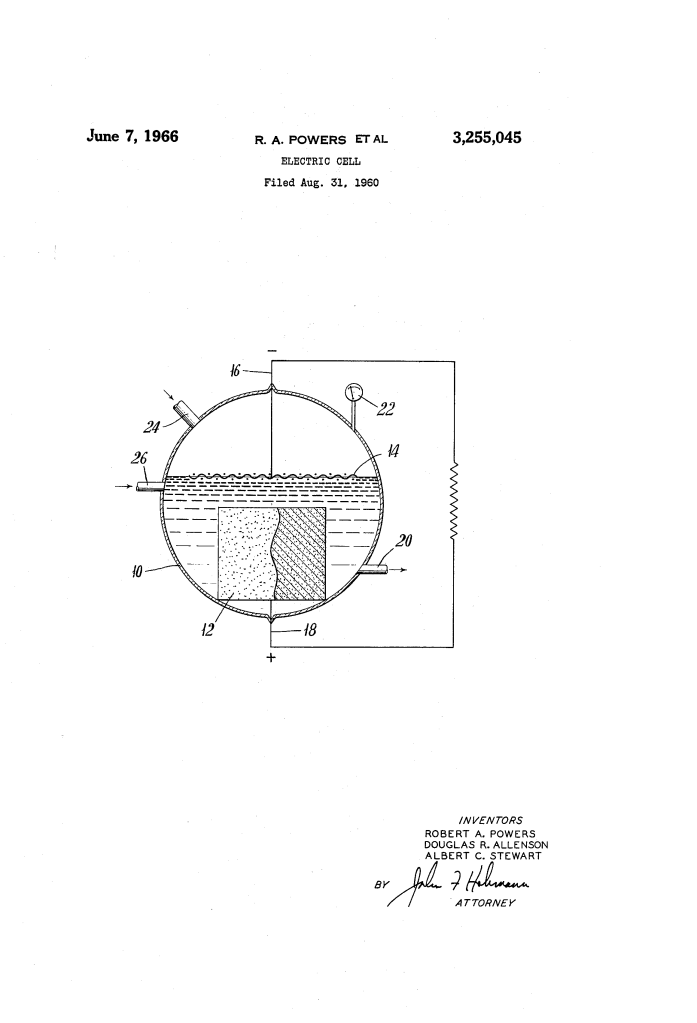
- Inert Anode (14): Positioned directly at the liquid-gas interface. It features a hydrogen ionization catalyst (finely divided platinum black on platinized platinum) with a very low overvoltage for the hydrogen reaction (H to H+). Its upper side stays in contact with hydrogen gas, while its lower face contacts the fluid electrolyte.
- Porous Cathode (12): Fully submerged in the bottom of the cell. Fabricated from porous carbon, it possesses an intentionally high overvoltage for the hydrogen reaction, preventing unwanted side reactions while directing the reduction of the soluble depolarizer.
Because the system relies on these opposing kinetic properties rather than spatial isolation, the cell dispenses entirely with internal mechanical dividers.
Key Technical Components
| Component | Function |
| Vessel (10) | Sealed outer casing made from non-reactive material (graphite, glass, or metal) to house the chemical reaction. |
| Porous Cathode (12) | Submerged carbon cathode exhibiting high hydrogen overvoltage; reduces the dissolved depolarizer ions. |
| Catalytic Anode (14) | Platinized platinum electrode positioned at the electrolyte interface to oxidize incoming hydrogen gas. |
| Hydrogen Gas Inlet (24) | Feeds gaseous hydrogen into the sealed headspace above the anode to maintain the fuel supply. |
| Depolarizer/Electrolyte Ports (20, 26) | Dedicated entry and exit ports allowing addition, testing, and continuous circulation of the electrolyte solution. |
| Pressure Gauge (22) | Monitors internal operating pressure within the sealed gas space above the fluid interface. |
Performance and Operational Metrics
The patent details experimental testing demonstrating reliable current production from a single homogeneous bath:
- Electrolyte/Depolarizer Solution: 0.01 M ferric sulfate (Fe2(SO4)3) dissolved in 0.8 N sulfuric acid (H2SO4).
- Fuel Source: Gaseous hydrogen introduced directly into the sealed upper headspace.
- Open-Circuit Voltage: The cell established an operating potential of 0.764 volts.
- Current Delivery: Delivered a steady current of 1 milliampere through an external electrical load.
The cell supports various alternative reducible ions placed below hydrogen in the electromotive series, including selenate, arsenate, and uranyl ions.
Historical and Scientific Impact
The mid-1960s marked an era of rapid expansion in fuel cell and battery research, driven by the demands of aerospace exploration, remote telemetry, and portable power systems.
- Elimination of Internal Resistance: Standard mechanical separators introduced internal electrical resistance that degraded output efficiency. Eliminating the separator lowered resistance while simplifying internal geometry.
- Mechanical Ruggedness: Moving away from gravity-layered solutions allowed electrochemical cells to tolerate movement, transport, and mechanical vibrations without shorting or losing output.
- Continuous Flow Potential: By utilizing fully dissolved depolarizers and external gas ports, the design laid practical groundwork for regenerative, closed-loop fuel cells.
About the Inventors
The patent was developed by a team of research chemists that included Dr. Albert Clifton Stewart, a pioneering African American chemist. Stewart earned his Ph.D. in physical chemistry from St. Louis University in 1951, conducting critical research in radiation chemistry, nuclear energy applications, and advanced power sources during his career with Union Carbide and national energy initiatives. Alongside colleagues Robert A. Powers and Douglas R. Allenson, Stewart’s contributions in electrochemical power generation helped advance twentieth-century industrial energy storage and fuel cell engineering.
Summary of Claims
The patent explicitly claims:
- An electric power generation device featuring an inert cathode submerged in electrolyte and an inert catalytic anode positioned at the liquid-gas interface.
- The deliberate pairing of a low-overvoltage catalytic anode with a high-overvoltage cathode for the hydrogen ionization reaction.
- An electrochemical design operating with an oxidized, soluble depolarizer in a single homogeneous electrolyte without requiring an intervening mechanical separator.
