
Effective Temperature Thermostat: David N. Crosthwait, Jr. (Patent No. 2,095,065)
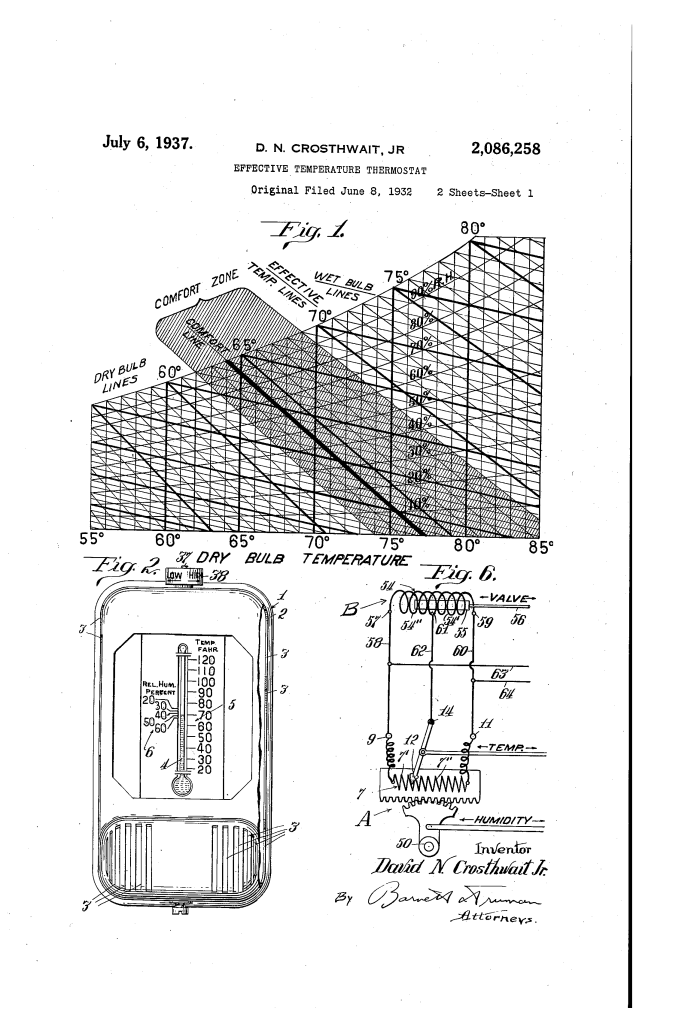
The patent by David N. Crosthwait, Jr. of Marshalltown, Iowa, describes an Effective Temperature Thermostat (Patent No. 2,095,065), granted on July 6, 1937. This invention is a sophisticated climate control system that does not merely measure heat (dry-bulb temperature) but calculates “human comfort” by factoring in relative humidity. By mechanically combining these two variables, Crosthwait created a device capable of maintaining a constant “effective temperature,” ensuring a building feels comfortable regardless of whether the air is dry or damp.
The “Why”
In the early 20th century, thermostats were simple “on/off” switches triggered by heat alone. Crosthwait identified a major “pain point” in indoor environments: sensory discomfort despite consistent temperatures. A room at 70°F feels chilly when the air is dry and stifling when it is humid. Standard systems forced users to manually adjust dials to compensate for the weather. Crosthwait’s mission was to automate this “feel,” providing a steady rate of heat dissipation from the human skin to maintain perfect equilibrium.
Inventor Section: David N. Crosthwait, Jr.
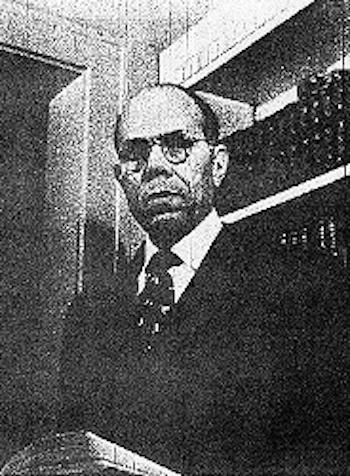
David Nelson Crosthwait, Jr. was a pioneering African American mechanical engineer and a Fellow of the American Society of Heating, Refrigerating and Air-Conditioning Engineers (ASHRAE). His engineering philosophy was rooted in precision fluid dynamics and human-centric automation. During an era of restricted opportunities for Black professionals, Crosthwait became a leading expert in vacuum heating systems. This patent is a testament to his ability to translate complex physiological “comfort” into a tangible, mechanical logic gate.
Key Systems Section
1. The Volumetric Bellows Actuator
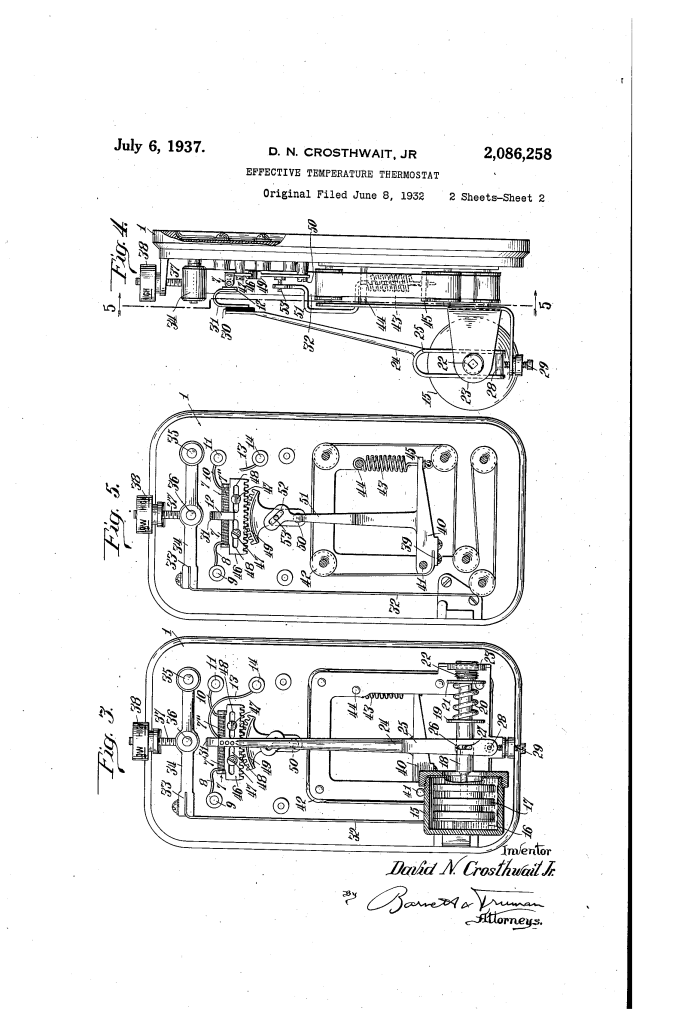
The temperature-sensing element is a hermetically sealed casing (15) filled with a heat-responsive fluid (16).
- Modern Term: Fluid-Expansion Thermal Sensor.
- As the room warms, the fluid expands, pushing a flexible bellows (17) and an operating stem (18) to move a contact arm.
2. The Differential Resistance Bridge
The heart of the control logic is a resistance coil (7) divided into two sections by a sliding contact (12).
- Modern Term: Potentiometric Voltage Divider.
- The contact (12) moves in response to temperature, while the entire coil frame (7) moves in response to humidity. The relative position of the two determines the electrical signal sent to the heating valve.
3. Hygroscopic Membrane Linkage
To measure humidity, Crosthwait utilized a long “hygroscopic strip” (32) looped around direction pulleys (42) to maximize sensitivity.
- Modern Term: Mechanical Humidity Transducer.
- This membrane expands or contracts based on moisture. This motion is transferred through a gear sector (49) and a rack (46) to bodily shift the resistance coil mentioned above.
4. The Proportional Solenoid Motor
The electrical output drives a solenoid coil (54) with a movable core (55).
- Modern Term: Proportional Control Actuator.
- Unlike an “all or nothing” switch, this system adjusts the steam valve to a specific percentage of openness, allowing for a continuous, modulated flow of heat rather than intermittent blasts.
Comparison Table
| Feature | Standard Thermostats (1930s) | Crosthwait’s Innovation |
| Control Variable | Dry-bulb temperature only. | “Effective Temperature” (Heat + Humidity). |
| Switching Logic | Binary (Full On / Full Off). | Proportional (Modulated flow). |
| Mechanism | Static sensor. | Dynamic “floating” resistance bridge. |
| Comfort Result | Periodic “chilly” or “stuffy” spells. | Constant sensory comfort. |
Significance Section
- Foundation of Modern HVAC: This invention is a direct ancestor to modern “Smart” thermostats that use algorithms to calculate “Feels Like” temperatures.
- Sub-Atmospheric Heating: Designed to work with vacuum steam systems, it allowed for precise heating at temperatures below 212°F (100°C), preventing the “scorched air” feel of older radiators.
- Integrated Diagnostics: The device included a dual-scale thermometer that allowed users to read both temperature and relative humidity simultaneously—an early example of a multi-variable dashboard.
- Engineering Equity: Crosthwait’s work on this system helped standardize the “Comfort Zone” charts still used by engineers today to design office and residential buildings.
