
Effective Temperature Control Apparatus: Dunham & Crosthwait (Patent No. 2,094,733)
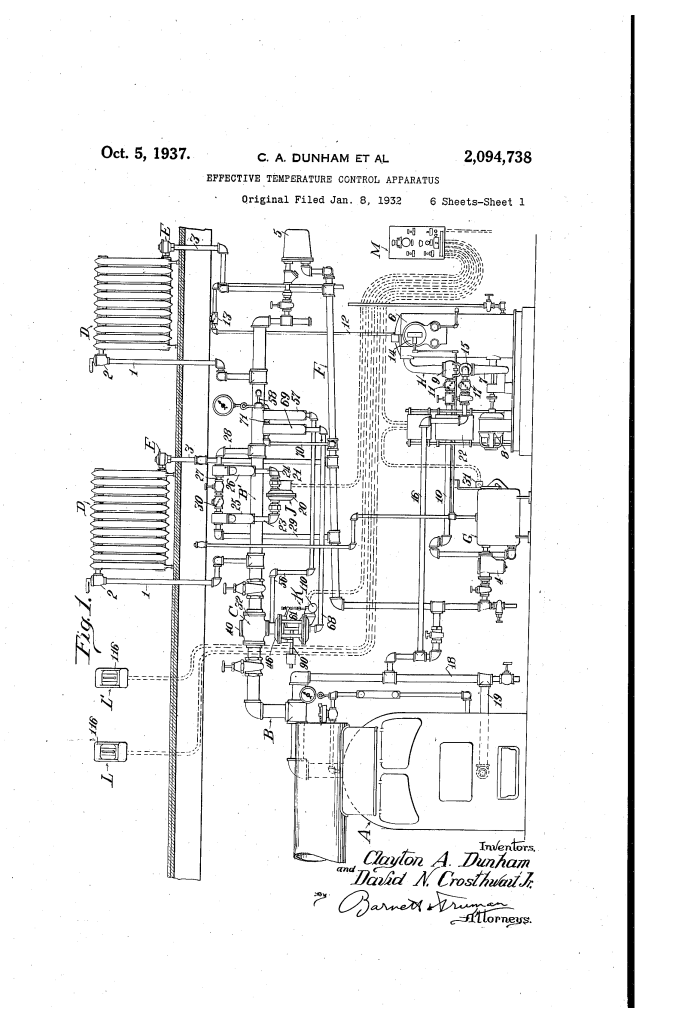
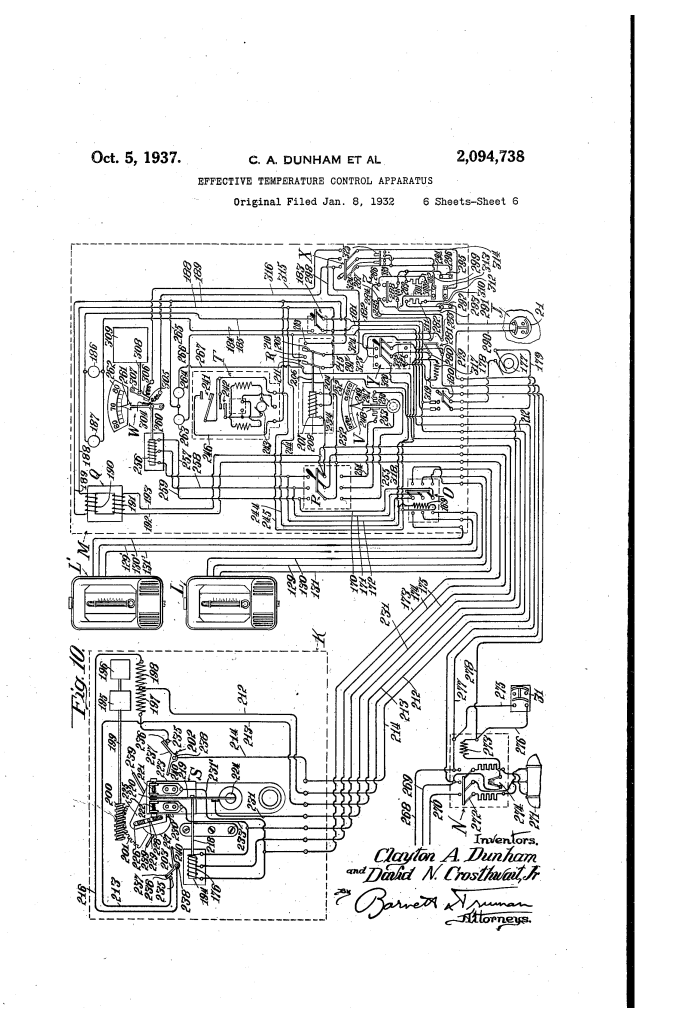
The patent by Clayton A. Dunham of Glencoe, Illinois, and David N. Crosthwait, Jr. of Marshalltown, Iowa, describes an Effective Temperature Control Apparatus (Patent No. 2,094,733), granted on October 5, 1937. This invention is a comprehensive, centralized control system for sub-atmospheric steam heating. It represents the pinnacle of early 20th-century climate engineering by integrating differential pressure sensing, thermostatic heat regulation, and hygroscopic humidity adjustment into a single, automated logic loop managed by a master control panel.
The “Why”
In the 1930s, heating systems often suffered from “stratification” (hot ceilings and cold floors) and “intermittent blasts” of steam that caused discomfort. The inventors identified a critical “pain point”: the disconnect between steam production and human sensation. They realized that true comfort—”Effective Temperature”—requires a continuous, modulated flow of heat that adjusts not just for cold air, but for the air’s moisture content. This system was designed to provide a “steady state” of comfort, ensuring heat is replaced exactly as fast as the building loses it.
Inventor Section: Dunham & Crosthwait
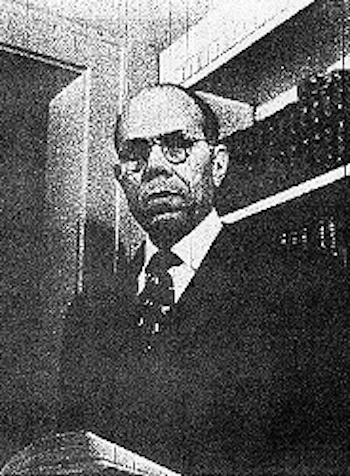
This partnership combined Clayton Dunham’s expertise in fluid management with David N. Crosthwait, Jr.’s visionary work in heat transfer and automation. Crosthwait, a preeminent Black engineer, pioneered the use of “sub-atmospheric” steam—steam kept at pressures lower than the outside air, allowing it to circulate at much lower, gentler temperatures. Their joint engineering philosophy was holistic synchronization: every pump, valve, and sensor must work as a single “nervous system” for the building.
Key Systems Section
1. The Sub-Atmospheric Differential Controller (J)
This system maintains a precise pressure gap between the steam supply and the return lines.
- Modern Term: Differential Pressure Transducer / Vacuum Control.
- By keeping the return side at a lower pressure than the supply side, steam is “pulled” through the radiators even at very low temperatures, preventing the “clanking” and “scorching” common in high-pressure systems.
2. The Master Control Panel (M)
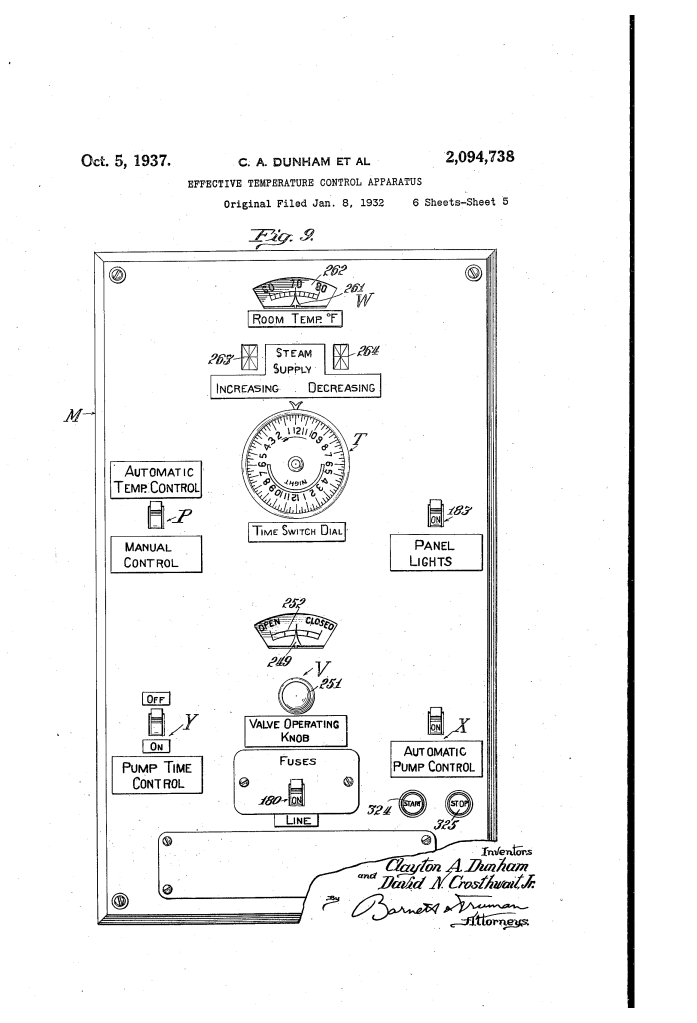
The system features a centralized “brain” where an operator (or the clock mechanism) can monitor and adjust the entire building’s climate.
- Modern Term: BMS (Building Management System) Interface.
- It includes signal lights (263, 264) to show if the steam supply is “Increasing” or “Decreasing” and switches to toggle between Day/Night thermostats and Manual/Automatic modes.
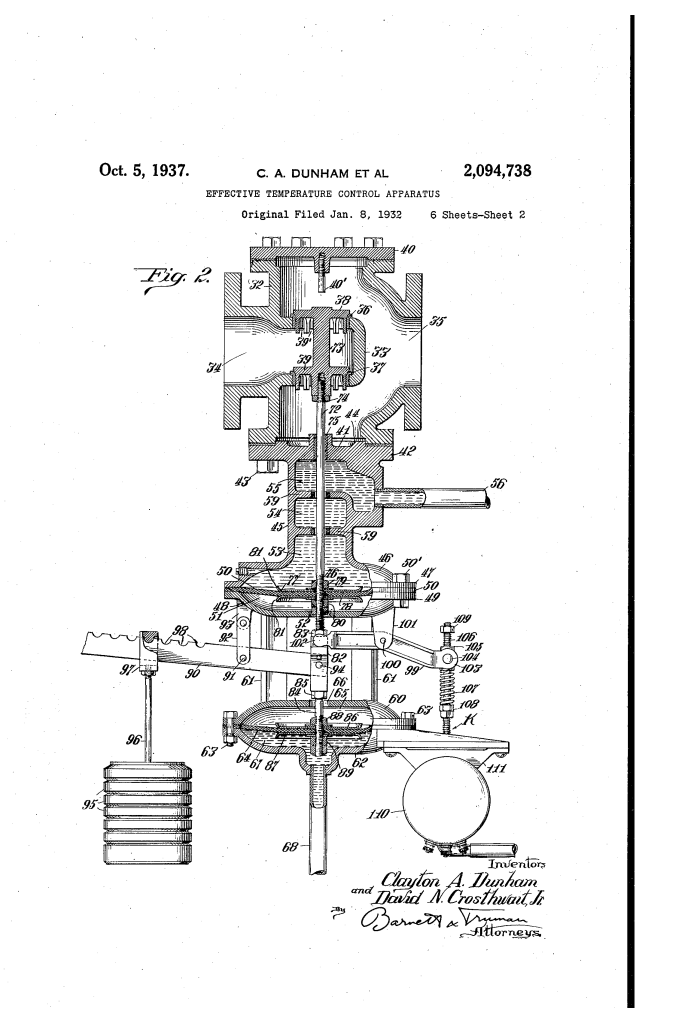
3. Proportional Solenoid Valve Actuator (K)
The steam valve (C) is adjusted by a motor mechanism that moves the valve by increments rather than simple “On/Off.”
- Modern Term: Modulating Control Valve.
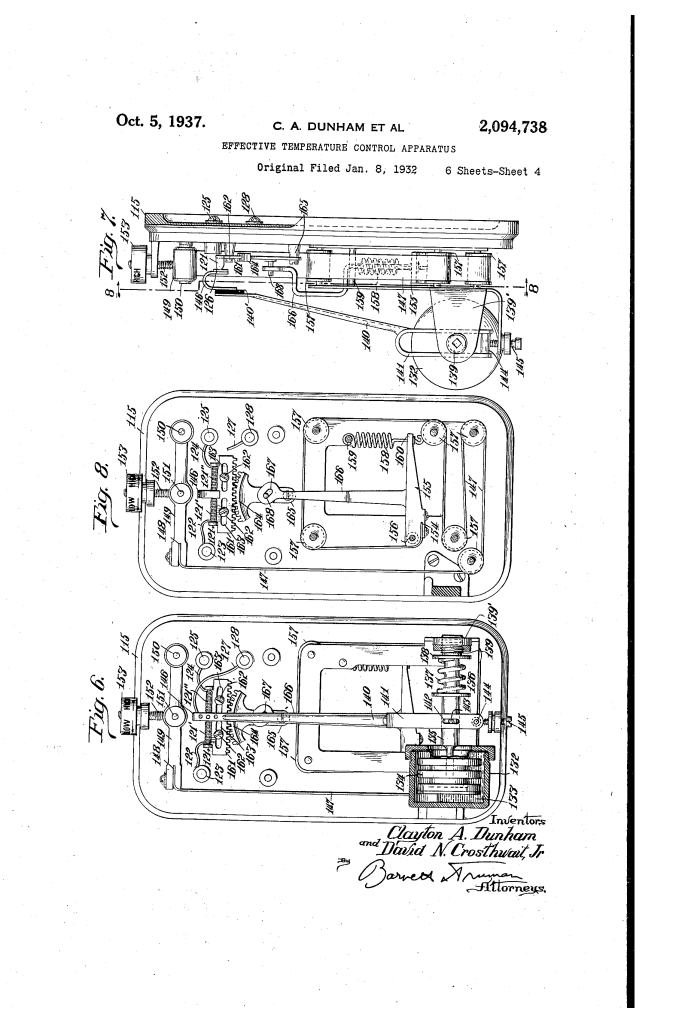
- A balanced solenoid (176) moves a core (194) based on signals from the thermostats. This ensures the valve is opened just wide enough to maintain the “comfort line.”
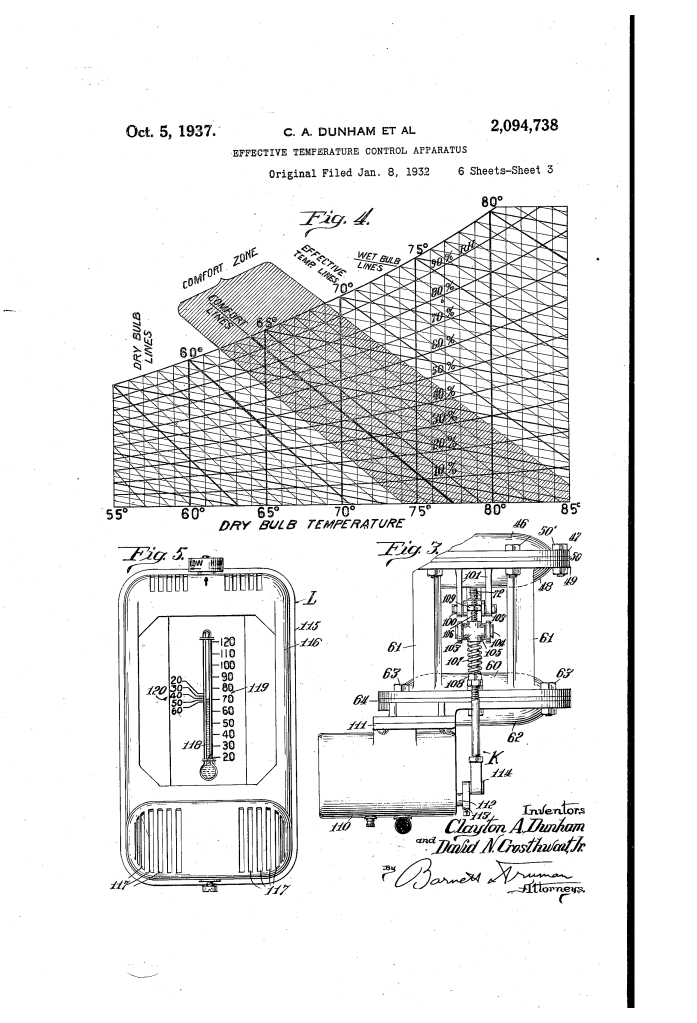
4. The Effective Temperature Logic
The system uses the “Crosthwait Thermostat” (which factors in humidity) to move a resistance bridge.
- Modern Term: Multi-Variable Feedback Loop.
- If humidity drops, the “Hygroscopic Membrane” contracts, shifting the electrical resistance to demand more heat, even if the thermometer shows a steady 70°F.
Comparison Table
| Feature | Conventional Heating (1930s) | Dunham & Crosthwait System |
| Heat Distribution | Intermittent “slugs” of high-heat steam. | Continuous flow of low-temperature steam. |
| Control Logic | Single-variable (Temperature only). | Multi-variable (Temp + Humidity + Pressure). |
| Operator Visibility | Gauges scattered throughout the boiler room. | Centralized dashboard with status lights. |
| Fuel Efficiency | Wasted heat via overheating/venting. | Precision modulation to match heat loss. |
Significance Section
- The “Feels Like” Pioneer: This system is the mechanical grandfather of modern algorithms that calculate the “Heat Index” or “Wind Chill” for smart home automation.
- Commercial Scalability: Designed for large buildings (skyscrapers and hospitals), it allowed for a uniform climate across hundreds of rooms.
- Vacuum Pump Optimization: The system includes logic to shut down the vacuum pump (7) when the building has reached its “Effective Temperature,” significantly extending equipment life.
- Legacy of Excellence: David Crosthwait’s contributions to this patent solidified his status as a master of Industrial Ergonomics, proving that engineering is as much about human biology as it is about iron and steam.
