
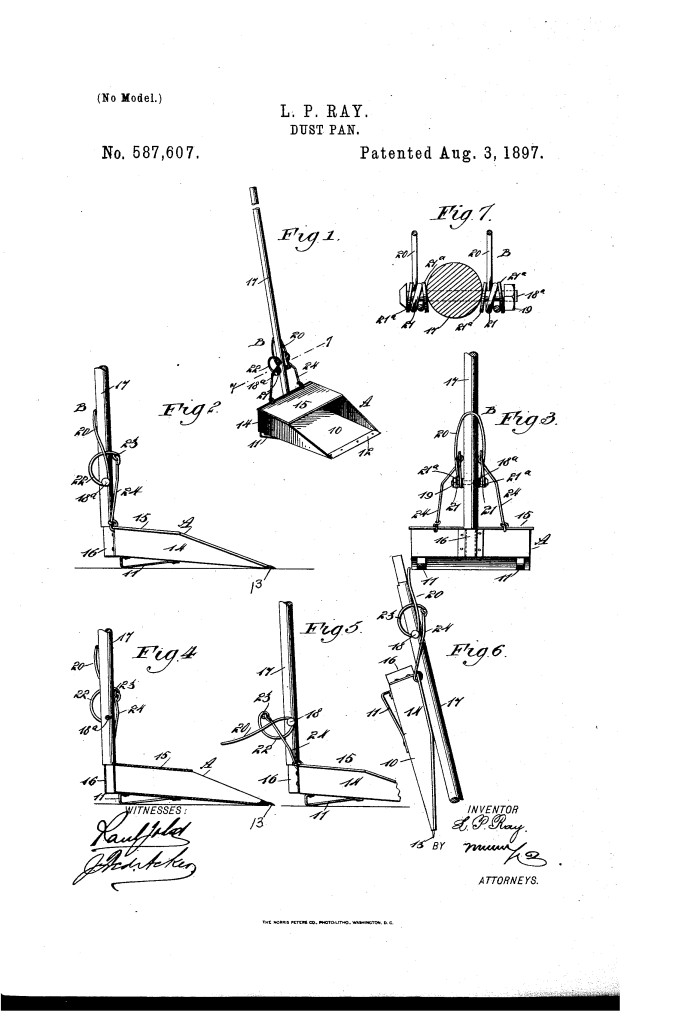
Improved Dust-Pan (1897)
U.S. Patent No. 587,607, granted on August 3, 1897, to Lloyd P. Ray, presents an improved mechanical dustpan designed to address two common household frustrations: poor surface contact during sweeping and cumbersome storage. Lloyd P. Ray, an inventor based in Seattle, Washington, engineered an ergonomic, reinforced dustpan that ensured efficient dust collection while integrating a multi-functional spring-latching handle.
Traditional dustpans of the late 19th century frequently suffered from weak lip edges that bent out of shape, allowing dirt to sweep underneath rather than into the pan. Additionally, fixed rigid handles made them awkward to store in tight spaces. Ray solved both mechanical issues through structural reinforcement and a tensioned spring mechanism.
The Core Innovations: Edge Reinforcement and Spring Fastening
Ray’s design introduced two distinct mechanical improvements that enhanced both the utility and lifespan of the everyday dustpan.
- The Tapered Steel Receiving Edge (12)
- The front receiving lip is constructed from hardened steel, making it significantly more durable than the lighter metal used for the pan body (10).
- The steel plate tapers to a thin edge that is curved downward (13), creating flush contact with the floor.
- Rear elevating feet (11) tilt the bottom forward, ensuring sweepings stay inside the hood (15) and do not slide backward out of the pan.
- The Spring-Tension Handle Fastener (B)
- The handle (17) is completely detachable and fits into a rectangular rear socket (16).
- A specialized spring-wire assembly straddles the handle, featuring coiled wire sections (21) seated on lateral pins or bolts (18) and angled washers (21).
- Upward tension links (24) pivotally anchor the spring assembly directly to the pan body on either side of the socket.
How the Mechanism Functions
The spring-loaded handle system provides three distinct functional configurations:
| Position | Mechanical Action | Practical Utility |
| 1. Locked / In-Use | The spring loop (20) is snapped upward against the rear face of the handle. | Contracts the wire coils (21) and forces washers to converge, locking the handle firmly at an upright working angle. |
| 2. Unlocked / Removal | The spring loop is swung downward laterally away from the handle body. | Releases tension on the links (24) and allows the rectangular handle to slide freely out of socket 16. |
| 3. Storage / Suspension | The handle is removed from the socket, laid flat across the top of the hood (15), and the loop (20) is extended upward. | Converts the spring latch into a sturdy suspension hook to hang the entire unit flat against a wall or peg. |
Technical Components
- Dust-Pan Body (A): Sheet-metal container featuring raised sides (14), rear elevating feet (11), and an integrated upper hood (15) to trap swept debris.
- Receiving Plate (12): Hardened steel edge with downward curve 13, designed to resist blunting and prevent dust from escaping beneath the pan.
- Rectangular Socket (16): Centrally mounted rear receptacle preventing axial rotation of the inserted handle.
- Spring Fastening Device (B): Formed spring-wire assembly comprising retention loop 20, tension coils 21, and terminal eyes 23.
- Connecting Links (24): Lateral pivot arms linking the spring eyes (23) directly to the rear upper rim of the pan body.
Historical and Practical Impact
Ray’s patent represents a practical late-19th-century advance in domestic ergonomics and modular mechanical design.
- Durability: By reinforcing solely the high-wear contact zone with steel while keeping the main body lightweight, the design maximized longevity without adding unnecessary weight.
- Dual-Function Hardware: The spring-wire mechanism eliminated the need for separate assembly fasteners and hanging brackets, using one continuous mechanical loop for both locking tension and wall storage.
- Compact Storage: Collapsing the handle parallel across the hood allowed for flat packing, easing commercial shipment and domestic storage.
About the Inventor: Lloyd P. Ray
Lloyd P. Ray was an African American inventor operating in Seattle, Washington, during the late 19th century. His 1897 dustpan design remains one of the most widely referenced early patents in household sanitation improvements, illustrating how deliberate mechanical engineering could transform standard domestic tools into durable, versatile devices.
Summary of Claims
The patent explicitly claims:
- A dustpan body featuring a receiving lip made of a material harder than the main container and curved downward to contact the floor.
- A removable handle seated in a rear socket, equipped with lateral pins, coiled spring arms, and pivoting connecting links.
- A snap-action spring loop arranged to lock under tension against the handle during operation and swing free to act as a hanging suspension device for storage.
