
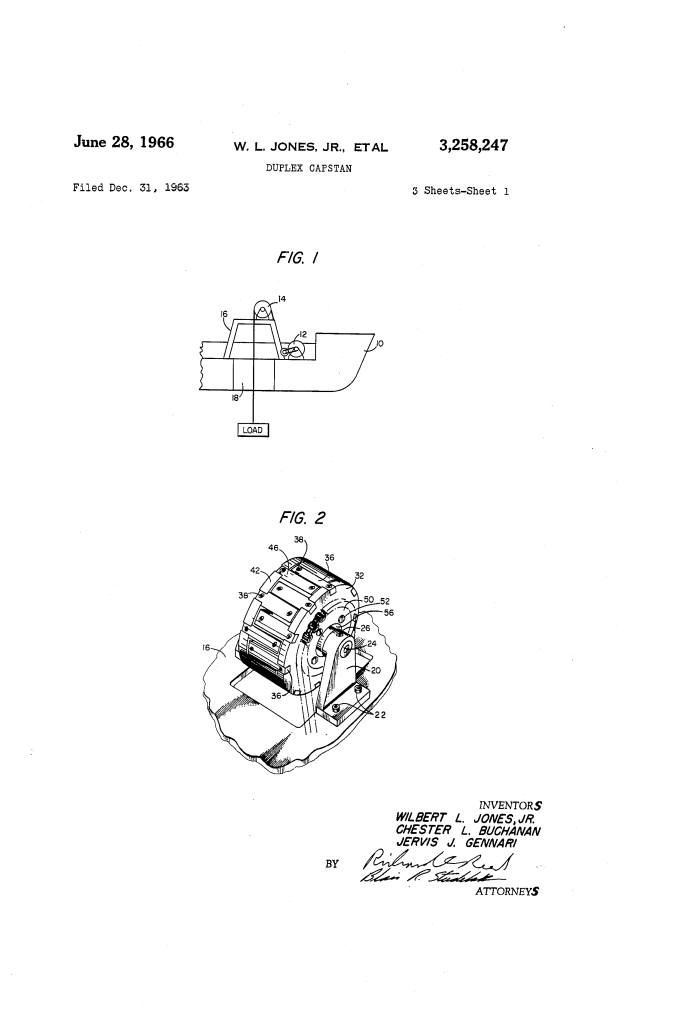
Duplex Capstan (1966)
U.S. Patent No. 3,258,247, granted on June 28, 1966, to Wilbert L. Jones, Jr., Chester L. Buchanan, and Jervis J. Gennari (assigned to the United States of America as represented by the Secretary of the Navy), addresses a major engineering barrier in deep-sea recovery and oceanographic research: managing extreme cable tension and spooling wear during heavy deep-sea hoisting.
When hoisting massive payloads from the ocean floor, winding thousands of feet of heavily loaded cable directly onto a single storage drum creates crushing compressive loads on the drum core and extreme outward shear forces against the flanges. While using a separate hauling capstan and low-tension storage reel mitigated this issue, traditional dual-drum hauling systems were bulky, heavy, and caused severe cable wear through friction and turn-to-turn contact. The inventors designed a compact, high-capacity duplex capstan that continuously hauls and laterally advances heavy cable with pure rolling motion, entirely eliminating inter-turn rubbing and cable slippage within a single shared operational envelope.
The Innovation: Intermeshed, Canted “Squirrel-Cage” Drums
Rather than placing two separate grooved drums side-by-side, this design intermeshes two slotted “squirrel-cage” drums (30 and 40) so they rotate through substantially the same physical space on a single stationary shaft (24).
The breakthrough lies in mounting the drums on eccentric journals that are both canted (angled) and offset relative to one another:
- Offset Motion: Causes the cable to touch only one drum’s crossbars at a time, carrying the load on each drum for exactly half a revolution (180 degrees) before transferring it cleanly to the other drum.
- Canted Axes: The slight angular tilt between the two drums causes the cable to automatically advance laterally in a precise, non-contacting helical path across the face of the unit without needing mechanical guides or fleet angles.
- Full Dual-End Support: Unlike earlier cantilevered textile winding reels that were far too weak for marine loads, both ends of every bar member (36, 46) are rigidly anchored to structural end discs, creating a bridge-like frame capable of supporting extreme deep-sea loads.
How the Hauling Cycle Functions
As the capstan turns, cable transfers seamlessly between the two drum cages every 180 degrees:
| Step | Action | Mechanical & Cable-Safety Purpose |
| 1. Initial Intake | Cable enters perpendicularly at point a, engaging the bars of the first drum. | Prevents side-load stresses and initiates stable rolling contact. |
| 2. First Half-Turn | The first drum rotates 180 degrees, pulling the cable laterally due to its cant angle. | Advances the cable along the axis without allowing turns to bunch up or touch. |
| 3. Mid-Point Transfer | At the horizontal boundary (point d), the bars of the second drum rotate past the periphery of the first. | Lifts the cable free from the first set of bars without sliding friction. |
| 4. Second Half-Turn | The second drum carries the cable through the remaining 180 degrees, continuing lateral movement. | Maintains identical speed and direction of lateral travel across the entire cycle. |
| 5. Discharge to Reel | Cable leaves the capstan (e.g., toward storage unit 12) at substantially relaxed tension. | Protects the dedicated storage spool from high crushing pressures. |
Technical Components
- Stationary Shaft (24): A rigid structural axle locked between upright support members (20) by cap screws (26).
- Eccentric Journals (33, 35, 43, 45): Keyed directly to the central shaft via key 28. Their geometry fixes the exact offset distance and cant angle (2a) necessary to advance the cable by at least one cable diameter per revolution.
- Intermeshed Cross Bars (36, 46): Rigid load-bearing bars spanning the end discs (32, 34 and 42, 44). The outer contact faces are contoured to a specific transition radius (r) to prevent sharp cable bending over the unsupported gaps between bars.
- Dual Drive Sprockets (50): Mounted to the outer drive discs via spacers (54) to apply balanced torque to both drums simultaneously, eliminating drive strain across the intermeshed bars.
Historical and Operational Impact
Developed directly for naval ocean engineering and research vessels:
- Massive Size and Weight Reductions: Replacing two separated grooved drums with an intermeshed single-footprint unit drastically minimized machinery platform requirements on research ships.
- Extended Cable Life: The rolling hand-off completely eliminated the abrasive turn-to-turn friction and axial sliding typical of conventional capstans.
- Full Reversibility: The symmetrical canted geometry functions identically in reverse, enabling safe, controlled lowering of sensitive deep-submergence equipment under full load.
About the Inventors
Wilbert L. Jones, Jr., Chester L. Buchanan, and Jervis J. Gennari were prominent research engineers and ocean technologists with the U.S. Naval Research Laboratory (NRL) in Washington, D.C. Chester Buchanan led the NRL’s Ocean Engineering Branch, famously directing the deep-sea search systems that located the sunken submarine USS Thresher in 1963 and the lost hydrogen bomb off Palomares, Spain, in 1966. Their work on heavy-tether management hardware laid the foundation for modern deep-ocean search, salvage, and bathymetric mapping operations.
Summary of Claims
The patent explicitly claims:
- A heavy-duty hauling capstan featuring a rigid fixed shaft mounted between upright structural supports.
- Four eccentric journals keyed to the shaft, supporting four rotating disc members.
- A plurality of crossbars spanning the end discs to form two intermeshed, axially slotted drums that are both canted and axially offset relative to one another.
- A drive arrangement imparting synchronized rotary motion to provide continuous hauling with built-in lateral cable displacement.
