
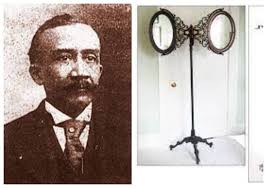
Inventor: Samuel R. Scottron
Patent Number: 76,253 (US-0076253-A)
Date of Patent: March 31, 1868
Invention: Improved Mirror (often referred to as an “Adjustable Mirror” or “Dual-Adjustable Mirror” due to its functionality)
Detailed Description of the Invention: Samuel R. Scottron’s 1868 patent for an “Improved Mirror” was a clever solution to a common problem, particularly relevant in barbershops and for personal grooming. The invention aimed to allow an individual to see all sides of their head or themselves from multiple angles simultaneously, famously described by Scottron as enabling one to “see ourselves as others see us.”
Based on the patent document and historical accounts, the key features of his mirror design included:
- Multi-Mirror Arrangement: The core of the invention was the strategic arrangement of multiple mirror surfaces. This typically involved:
- A main mirror (likely stationary or the primary viewing mirror).
- Two “wings” (C and D): These were additional mirrors, often in frames, hinged to a central adjustable rod. They could be moved separately or together.
- Adjustable Stand and Rod (A, B): The entire mirror assembly was mounted on a stand (A) with an adjustable rod (B). This allowed the mirrors to be raised or lowered to suit the height of the user.
- Hinged and Pivoting Mirrors:
- The “wings” (C and D) were hinged together upon the adjustable rod (B), allowing them to be set at various angles to each other. The rod acted as the apex of these angles.
- Within these wings, the individual mirror panes (b, c) were placed in frames (d, e, f, etc.) that were pivoted at their centers. This allowed these individual mirrors to also be adjusted at different angles.
- To further increase versatility, one mirror’s frame (e) might be set into another frame (f) that worked on horizontal axes (g), while the mirror within that frame pivoted vertically. This multi-axis adjustability allowed the mirrors to be turned up, down, or angled to achieve a variety of reflections.
- Clamping Mechanism: A set-nut (E) on the adjustable rod (B) and a set-screw (F) were used to clamp the rod in the stand, firmly fixing the mirrors at the desired position after adjustment.
How it worked: By adjusting the angles of the hinged and pivoting mirrors, a user could manipulate the reflections to capture views of their head’s sides, back, and top, which would normally be out of sight in a single mirror. This was incredibly useful for barbers ensuring a precise cut, or for individuals performing their own detailed grooming.
Personal Significance (Samuel R. Scottron): Samuel R. Scottron (1841-1908) was a remarkable African American inventor, entrepreneur, and community leader from New York. Born free in Philadelphia, he gained practical experience as a sutler during the Civil War, serving African American troops. This experience, combined with his natural “inventive genius” (a term he used himself), led him to pursue formal education at Cooper Union later in life.
Scottron’s decision to open a barbershop in Springfield, Massachusetts, directly inspired his invention of the adjustable mirror. He observed the practical need of his customers to see all angles of their haircut. Beyond his inventions, Scottron was a tireless advocate for civil rights, co-founding the Cuban Anti-Slavery Society and becoming the first African American member of Brooklyn’s Board of Education. His ability to succeed as an inventor and businessman despite profound racial discrimination showcases his extraordinary resilience, intellect, and dedication to improving society.
Historical Significance: Samuel R. Scottron’s “Improved Mirror” (Patent 76,253) holds significant historical importance:
- Revolutionizing Barbershop Services: The invention directly addressed a major limitation in barbershops of the era. It provided unprecedented visual feedback to customers, enhancing their satisfaction and becoming a highly sought-after feature. This made barbershops more professional and client-focused.
- Advancement in Personal Grooming Aids: It represented a significant step forward in tools for personal grooming, enabling a level of self-inspection previously difficult or impossible. This reflected a growing emphasis on personal appearance and detailed grooming.
- African American Contribution to Consumer Products: This patent is a prime example of an African American inventor creating a widely popular and commercially successful consumer product. Scottron’s mirrors were sold and became well-known, demonstrating the impact of Black ingenuity on daily life and the broader economy, often despite systemic barriers.
- Entrepreneurial Success: The success of the “Scottron Mirror” allowed him to take on a white partner (Pitkin and Scottron) and expand his ventures, illustrating a path of entrepreneurial success for an African American in a challenging post-Civil War landscape.
- Legacy of Practical Innovation: The principles of multi-angled reflection for comprehensive viewing, which Scottron patented, are still evident in various applications today, from specialized mirrors to imaging technologies.
