
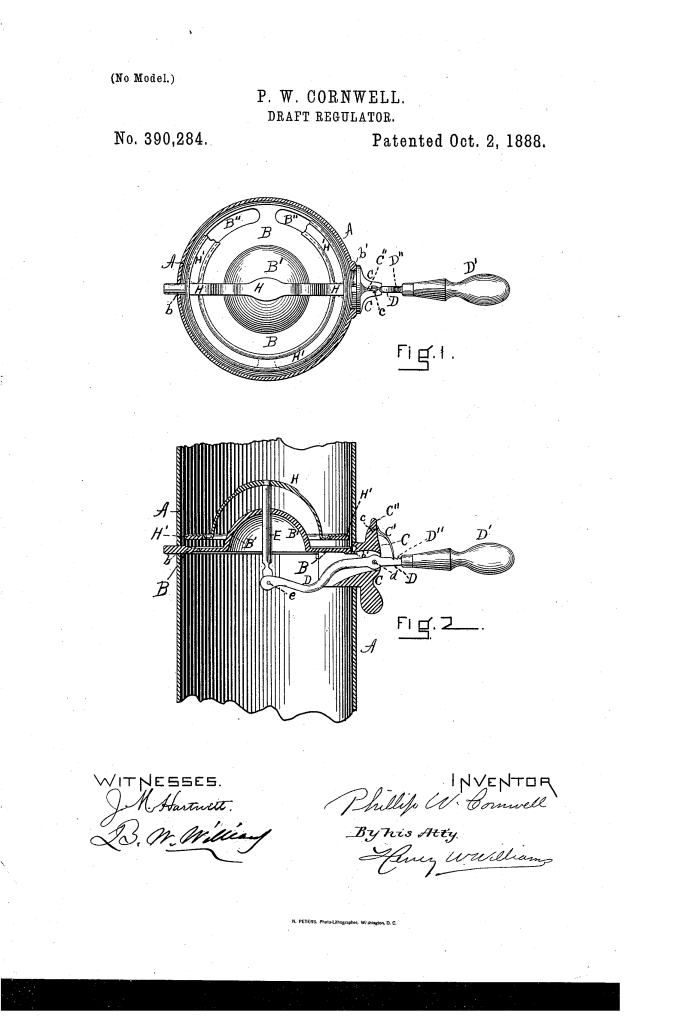
Draft-Regulator (Phillip W. Cornwell, No. 390,284)
The patent by Phillip W. Cornwell of Brockton, Massachusetts, describes an improved Draft-Regulator (Patent No. 390,284, 1888). This invention is a specialized mechanical control system for stove-pipes and furnace flues. Cornwell’s primary objective was to provide a means of regulating heat with greater accuracy than standard dampers, allowing for the efficient escape of coal gases while ensuring the economic combustion of fuel. His innovation centers on a dual-damper system where a secondary “ring” damper can be finely adjusted relative to a slotted main damper without needing to rotate the entire assembly.
Inventor Background: Phillip W. Cornwell
Phillip W. Cornwell was an African American inventor based in Massachusetts during the late 19th century. His 1888 patent addressed a critical safety and efficiency issue in Victorian-era homes: the management of coal smoke and “coal gas” (carbon monoxide). Standard dampers of the time were often “all or nothing”—either fully open or fully closed—which led to wasted fuel or dangerous gas leaks. Cornwell, applying a keen sense of mechanical precision, designed a system that allowed for “micro-adjustments,” reflecting the sophisticated engineering talent present in Black communities during the post-Reconstruction industrial boom.
Key Mechanical & Regulating Systems
The regulator functions as a “valve within a valve,” providing two distinct methods of controlling airflow.
1. The Main Damper and Dome (B, B’)
- Construction: The main damper (B) is pivoted at one side (b) of the flue (A). It features a central concave-convex dome (B’).
- Curved Slots (B”): Near its outer edge, the main damper is perforated with curved slots (B”).
- Function: The slots provide a dedicated pathway for gases to escape even when the main damper is in the “closed” position, preventing the buildup of dangerous pressure or fumes within the stove.
2. The Supplemental Ring Damper (H, H’) (Key Innovation)
- The Ring (H’): A flat, annular piece of metal is supported by a curved bail (H).
- Alignment: This ring is positioned directly above the curved slots (B”) of the main damper.
- Action: By moving this ring toward or away from the main damper, the user can precisely “choke” or open the air passage through the slots. This allows for fine-tuning the fire’s intensity without disturbing the overall position of the main flue plate.
3. The Lever and Ratchet Mechanism (D, C’)
- Lever (D): A rod extends through a hollow thimble (O) in the side of the flue to an external handle (D’).
- Pawl and Teeth (C’, D”): The upper edge of the lever features a series of teeth that engage with a pivoted pawl (C’).
- Function: This provides a ratchet-and-pawl locking system. The user can lift or depress the handle to set the draft at a specific level, and the pawl will automatically hold the supplemental damper in that exact position, ensuring a steady, regulated burn.
4. Dual-Mode Operation
- Standard Draft: For building a fire, the entire assembly (B and H) can be rotated on the pivot (b) like a traditional damper to allow maximum airflow.
- Precision Regulation: Once the fire is established, the main damper is closed, and the user regulates the “cruising” temperature by moving the handle (D’) to adjust the gap between the ring (H’) and the slots (B”).
Improvements Over Standard Flue Dampers
| Feature | Standard 1880s Dampers | Cornwell’s Draft-Regulator |
| Adjustment | Coarse; limited by the rotation of the plate. | Precision “micrometer” style vertical adjustment. |
| Gas Safety | Closed dampers could trap toxic coal gas. | Curved slots (B”) ensure a constant safety vent. |
| Stability | Often slipped due to heat/vibration. | Pawl and Ratchet (C’, D”) locks the setting in place. |
| Economy | High fuel waste due to poor draft control. | Optimized combustion through fine air regulation. |
Significance to Mechanical and HVAC Engineering
Phillip W. Cornwell’s draft regulator influenced the development of precision air-handling controls and safety-venting hardware.
- The Foundations of Proportional Control: Cornwell’s idea of using a secondary, adjustable surface to vary the effective area of a vent is a foundational principle in modern HVAC dampers and butterfly valves.
- Safety-First Design: By integrating a “permanent” vent (the slots) that can be partially obscured, he anticipated the failsafe venting requirements now standard in modern furnaces and water heaters.
- Ergonomic Feedback: The use of a ratchet system provided the operator with “tactile feedback,” a core concept in human-machine interface design, allowing settings to be replicated accurately every time.
- Industrial Durability: By mounting the lever through a protective thimble (O), Cornwell ensured that the mechanical pivot was shielded from direct heat and soot, increasing the operational longevity of the device.
