
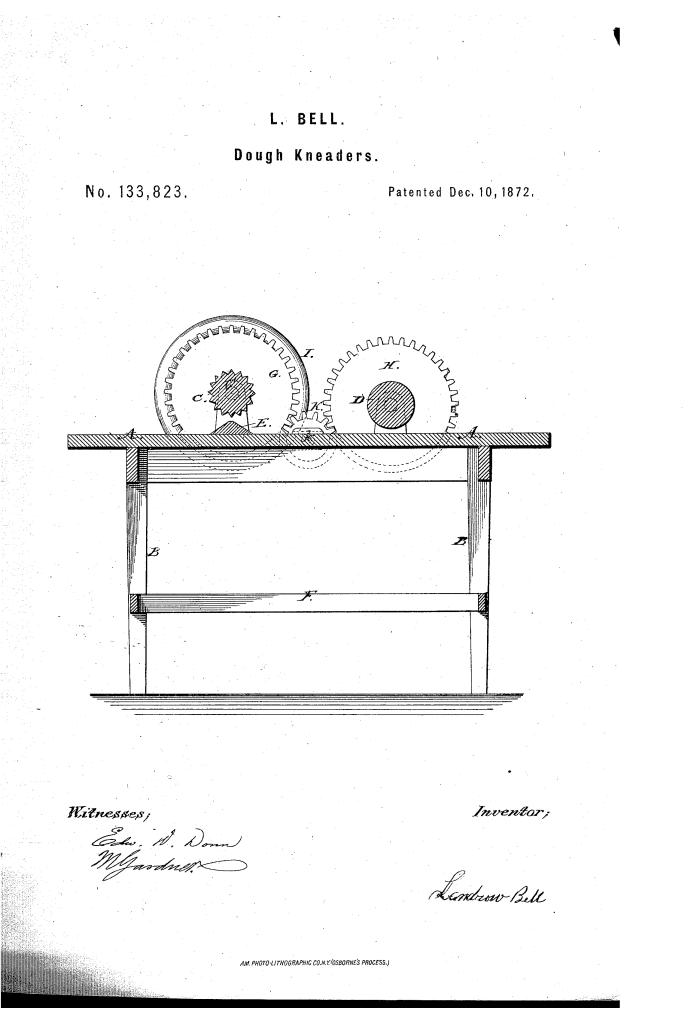
Landrow Bell, the same inventor who patented the locomotive smoke stack, also patented a “Dough Kneader.”
Inventor: Landrow Bell Patent Number: 133,823 Date of Patent: December 10, 1872 Invention: Improvement in Dough-Kneaders
Description of the Invention: Landrow Bell’s dough kneader was designed to mechanize the arduous task of kneading dough, an operation traditionally performed by hand. The invention featured a table with a “bridge” or double-inclined board, over which a fluted roller (C) was positioned. A short distance in front of this, a smooth roller (D) was arranged in a lower plane. The dough, mixed in the usual manner, would be placed on the table in front of the fluted roller. By turning a crank (not shown), the operator would set a series of gears (G, K, H) in motion, causing the rollers to turn. The dough would pass up the incline and between the fluted roller and the bridge, being “cut and pressed” in the process. It would then pass to the smooth roller for further pressing and rolling. The process could be repeated by reversing the rollers’ movement. Bell claimed this machine could thoroughly knead dough in “five to ten minutes,” significantly reducing the time and labor compared to hand kneading.
Personal Significance (Landrow Bell): While specific biographical details about Landrow Bell are limited, patent records indicate he was a resident of Washington, D.C. and also held another patent for an “Improvement in Smoke Stacks for Locomotives” (Patent No. 115,153, granted May 23, 1871). The fact that he held patents for inventions in seemingly disparate fields (locomotive smoke stacks and dough kneaders) suggests a versatile and inventive mind. Furthermore, Landrow Bell is recognized as an African American inventor, making his contributions particularly significant given the historical context of the post-Civil War era. African American inventors faced substantial hurdles in getting their inventions recognized and patented, making Bell’s achievements all the more remarkable. His work, alongside other Black inventors, contributed to the technological advancements of the time and challenged racial barriers.
Historical Significance: Landrow Bell’s dough kneader, Patent No. 133,823, represents an important step in the mechanization of food preparation. Before such inventions, baking was an extremely labor-intensive process, especially for large quantities of dough. This patent, and similar ones, contributed to a broader trend of industrialization that transformed domestic and commercial kitchens. By making dough kneading more efficient, Bell’s invention would have saved significant time and effort for bakers, whether in homes, bakeries, or other food production settings. This efficiency would have allowed for greater output and potentially contributed to the wider availability and affordability of baked goods. The invention also reflects the spirit of innovation prevalent in the late 19th century, where inventors sought to simplify and improve everyday tasks through mechanical means.
