

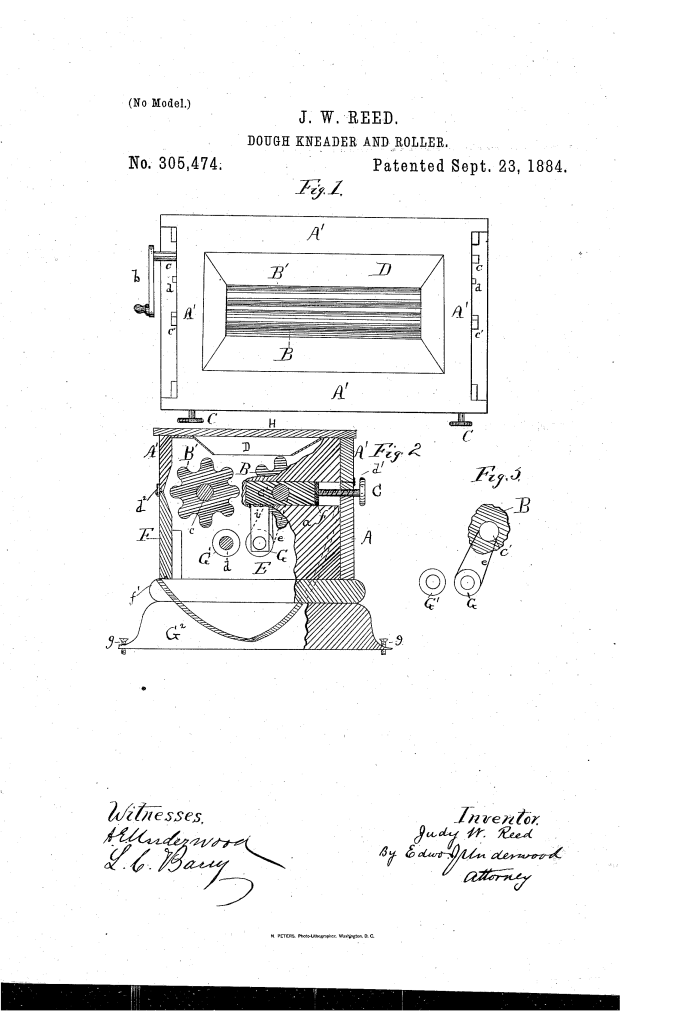
Judy W. Reed received U.S. Patent No. 305,474 for a Dough Kneader and Roller on September 23, 1884. This invention was designed to automate and improve the labor-intensive process of kneading and rolling dough, which was traditionally done by hand in kitchens and bakeries.
Key features of her invention, as described in the patent included:
- Corrugated Intermeshing Rollers: The central element of her invention consists of a pair of corrugated rollers or cylinders (referred to as “B” and “B’” in the patent) that intermesh. These corrugations are essential for the kneading action, as they “subject the mass of dough to a thorough and equable mixing and working.”
- Adjustable Rollers: One of the corrugated rollers (B’) is designed to be movable. It can “approach or recede from” the other fixed corrugated roller (B) through the agency of regulating-screws (C C). This adjustability allows the operator to control the pressure applied to the dough, increasing or diminishing it as desired, depending on the consistency and type of dough.
- Plain Rollers for Rolling: After passing through the corrugated kneading rollers, the dough then passes between a separate pair of plain rollers (G and G’). These rollers are responsible for rolling the dough into a “continuous sheet or ribbon.”
- Covered Receiver/Hopper (D): The machine features a hopper-shaped receiver or trough (D) at the top. This part is designed to receive the dough before it enters the rollers. Crucially, this receiver is covered, preferably with a tightly-fitting cover (H), to protect the dough from “dust and other particles in the air,” ensuring hygiene. This receiver is hinged (d) to the main case, allowing it to be swung open for cleaning or to separate/remove the rollers.
- Receptacle for Kneaded Dough (E): Below the rollers, there is a receptacle (E) designed to collect the kneaded and rolled dough. This receptacle is also covered and features a door (F) on the front to allow for easy removal of the processed dough while preventing dust entry. Like the receiver, it’s preferably lined with thin metal (like tin) to prevent any taste from the wood or other case material from being imparted to the dough.
- Crank Operation: One of the corrugated rollers (B) is fixed laterally and provided with a crank to actuate the entire device. As this crank is turned, motion is imparted to the other rollers via meshing and a belt (e) connecting the plain rollers to the corrugated ones.
- Case Construction: The entire mechanism is housed within a wooden case or box (A). The case is divided into two parts along the axial line of the rolls. The upper part, containing the receiver, can be opened for cleaning and access to the rollers.
- Support: The machine is designed to be supported on “rests or feet” (G’), which can stand on a table or be attached to it.
About Judy W. Reed
Judy W. Reed is notably one of the earliest documented African American women to receive a U.S. patent. While precise biographical details about her life (such as birth and death dates, or extensive personal history) are scarce, her patent is a significant historical marker. She was from Washington D.C., and her invention highlights the ingenuity and practical contributions of African American women, even amidst the severe social and economic limitations of the post-Reconstruction era. Her achievement underscores the fact that innovation was not limited by race or gender, despite the systemic barriers in place.
Personal and Historical Significance of the Invention
Personal Significance for Judy W. Reed:
- Pioneer for African American Women Inventors: Securing this patent placed Judy W. Reed in a unique position as one of the first African American women officially recognized for her inventive contribution. This was an extraordinary feat given the era’s racial and gender discrimination.
- Validation of Ingenuity: The patent served as official recognition of her inventive skill and problem-solving ability, providing personal validation in a society that often denied such recognition to Black women.
- Potential for Empowerment: While the commercial success of her invention is not widely documented, obtaining a patent could have opened avenues for economic empowerment, either through manufacturing, licensing, or selling her invention.
Historical Significance of the Invention:
- Advancement in Household/Kitchen Technology: Dough kneading and rolling were time-consuming and physically demanding tasks. Reed’s invention aimed to mechanize this process, making food preparation easier and more efficient for households and small bakeries. This contributed to the broader trend of developing labor-saving devices for the home.
- Highlighting African American Women’s Contributions: Judy W. Reed’s patent is crucial for understanding the full scope of American innovation. It demonstrates that African American women, despite facing immense societal barriers, were actively involved in inventing and improving technologies that impacted daily life. Her patent helps to fill gaps in historical narratives that often overlook the contributions of marginalized groups.
- Precursor to Modern Kitchen Appliances: Her invention can be seen as an early step in the mechanization of kitchen tasks, foreshadowing the development of modern kitchen appliances like stand mixers and food processors, which have revolutionized food preparation.
- Symbol of Perseverance: Her achievement stands as a powerful symbol of perseverance and ingenuity in the face of adversity, inspiring future generations and providing a tangible example of African American women’s often-unrecognized roles in shaping technological progress.

