
Dope-Cup Lubricator (1891)
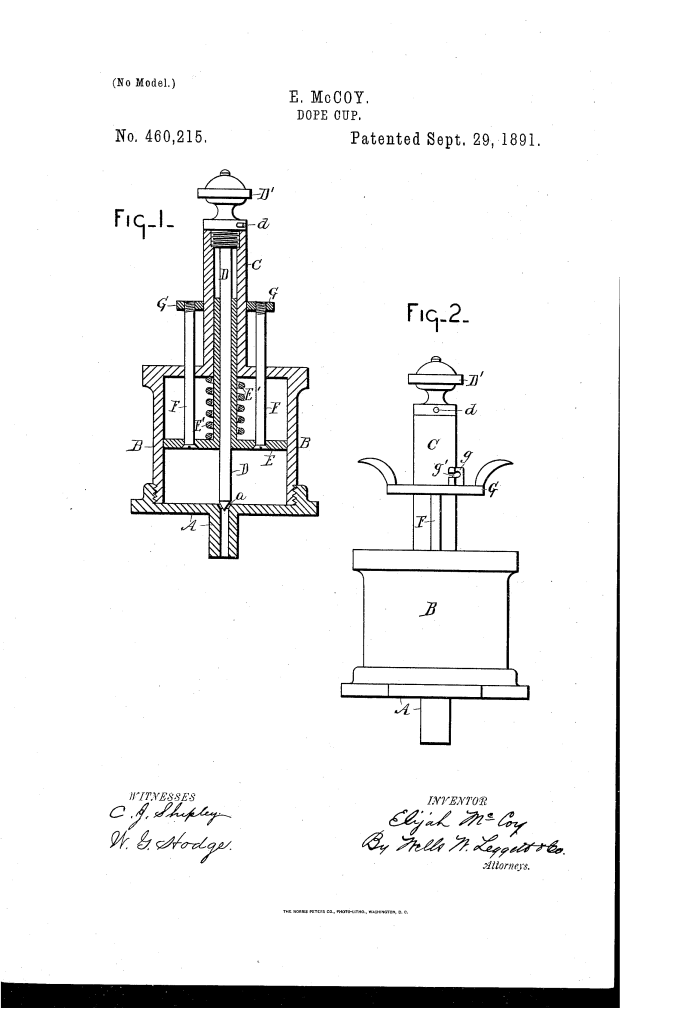
U.S. Patent No. 460,215, granted on September 29, 1891, to Elijah McCoy, introduces an improved “dope-cup” designed for the efficient lubrication of heavy machinery. While McCoy is most famous for his “automatic lubricator” for steam engines, this patent focuses on a specialized device for “dope”—a term used in the 19th century for heavy, viscous grease that was often difficult to regulate.
This invention solved a messy and wasteful industrial problem: how to store thick grease under pressure, regulate its flow precisely, and refill the container without the pressurized piston getting in the way or causing a “blowout” of lubricant.
The Innovation: The “Lock-and-Load” Piston
The brilliance of McCoy’s 1891 design lies in the mechanical link between the piston (which pushes the grease out) and the spindle (which acts as the shut-off valve). Before this, grease cups were often difficult to refill because the spring-loaded piston would constantly push against the user.
1. The Integrated Shut-Off System
McCoy designed a central spindle (D) that runs the entire length of the cup. By turning the thumb-piece (D’) at the top, the operator can screw the spindle down to perfectly plug the outlet orifice (a) at the bottom.
2. The Pin-and-Notch Locking Mechanism
To make refilling easy, McCoy added a collar (G) connected to the piston by guide-rods (F).
- The Lock: When the piston is pulled up to the top, a pin (d) on the thumb-piece can be rotated into a notch (g) on the collar.
- The Safety: The spindle is measured so that to lock the piston in the “up” position, the operator must screw the spindle down, which automatically closes the grease outlet. This prevents grease from leaking out while the device is being serviced.
Key Mechanical Components
The device is a symphony of 19th-century mechanical engineering where every part serves a dual purpose:
| Component | Function |
| Body (B) & Base (A) | The reservoir for the “dope” (grease). The base screws directly onto the machinery boxing. |
| Spring-Actuated Piston (E) | Provides constant downward pressure to ensure grease is forced into the moving parts. |
| Spindle (D) | A dual-purpose rod that acts as both the flow regulator and the locking pin for the piston. |
| Guide-Rods (F) | Stay the movement of the piston and connect it to the external collar for manual control. |
| Thumb-piece (D’) | The external interface that allows the operator to adjust the feed rate or lock the cup open. |
Operational Advantages
McCoy’s patent explicitly outlines why this design was superior to the standard grease cups of the era:
- Ease of Refilling: When the cup is empty, the operator pulls the piston up, locks it in place using the pin-and-notch, and unscrews the body from the base. They can then pack it with grease and screw it back on without fighting the tension of the spring.
- Precise Regulation: The feed rate cannot be adjusted until the piston is unlocked, ensuring the operator is intentional about when and how much lubrication is applied.
- Economy: By providing a “brilliant” seal at the bottom, it prevents the wasteful dripping of expensive lubricants when the machine is idle.
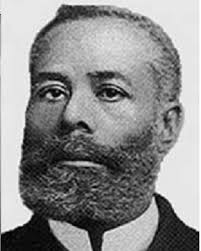
About the Inventor: Elijah McCoy
Elijah McCoy was a Canadian-born African American inventor whose name became synonymous with quality engineering.
- The “Real McCoy”: Legend suggests that engineers would ask if a machine had the “Real McCoy” system, wanting to ensure it wasn’t a cheap imitation of his superior lubrication patents.
- Education: Born to parents who escaped slavery via the Underground Railroad, McCoy traveled to Scotland at age 15 to study mechanical engineering, as professional opportunities for Black students were limited in the U.S. at the time.
- Legacy: He held over 50 patents. While he is best known for revolutionizing the railroad industry (allowing trains to be lubricated without stopping), his “dope-cup” patents brought that same efficiency to stationary factory equipment.
Summary of Claims
The patent explicitly protects:
- The combination of a lengthwise-adjustable spindle and an interior piston guided by external rods.
- The specific pin-and-notch connection that allows the piston to be locked in an elevated position.
- The safety feature where the spindle must close the outlet in order for the piston to be locked, preventing accidental spills during maintenance.
