
Direct-Acting Steam Engine: Frank Winn (Patent No. 394,047)
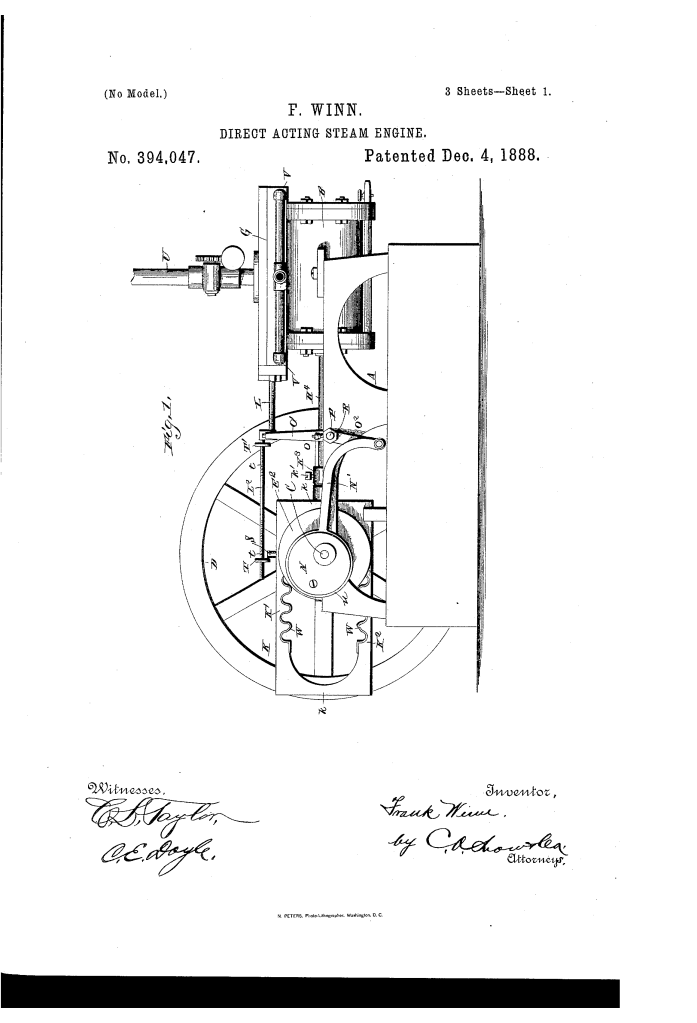
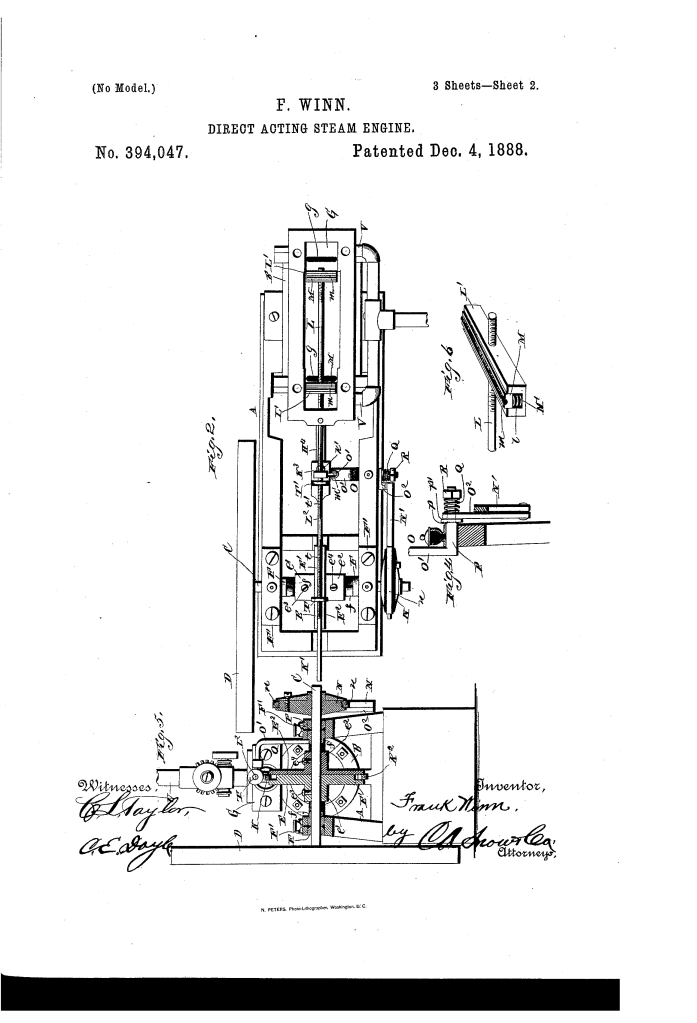
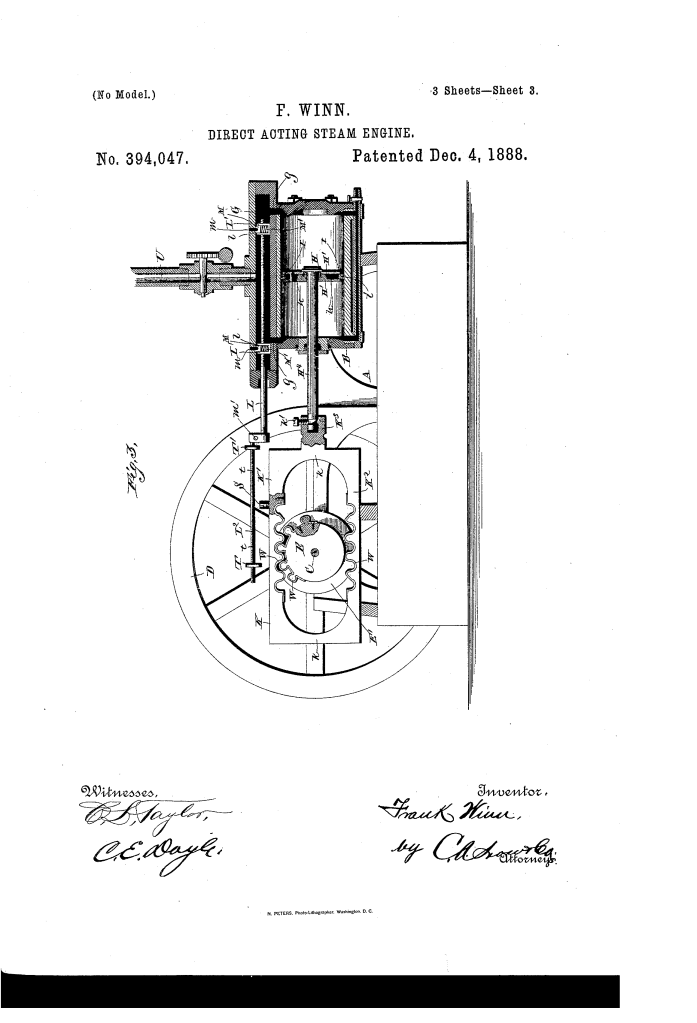
The patent by Frank Winn of Dallas, Texas, describes a Direct-Acting Steam Engine (Patent No. 394,047). This invention is an improved reciprocating steam engine designed to convert linear piston motion into rotary shaft motion with a specialized valve-timing mechanism to prevent mechanical shock and “hammering” at the end of each stroke.
The “Why”
In the late 19th century, direct-acting steam engines often suffered from a violent “knock” or mechanical hammer when the piston reached the end of its travel. Standard valve gears were frequently too slow to reverse the steam flow, leading to the piston striking the cylinder head or the rack-and-pinion gears jamming during the transition. Winn sought to solve this lack of synchronization by creating an “instantaneous cut-off” that uses a steam cushion to deaden the shock.
Inventor Section: Frank Winn
Frank Winn operated in Dallas, Texas, during the post-Reconstruction era, a period defined by the rapid expansion of the railroad and industrial manufacturing in the South. As a Black inventor in the 1880s, Winn faced a landscape dominated by Jim Crow restrictions, yet his engineering philosophy was one of precision and durability. He focused on “wear-reduction” (seen in his use of replaceable tooth shells and Babbitt metal bushings), reflecting a pragmatic approach to machine longevity in an era where replacement parts were not easily accessible to all.
Key Systems Section
1. Segmental Gear and Dual-Rack Transmission
Instead of a traditional connecting rod and crank, Winn uses a rack-and-pinion style interface.
- The Component: A gear wheel (E) with teeth covering only a portion of its circumference (segmental gear).
- Function: A rectangular rack frame attached to the piston rod has upper and lower teeth. As the piston moves forward, the upper rack drives the gear; on the return, the lower rack takes over.
- Modern Translation: This is a linear-to-rotary intermittent drive system.
2. The “Divided Lever” Friction Clutch
Winn’s most ingenious mechanical contribution is a split-arm lever (O) that connects the eccentric rod to the valve stem.
- The Component: Two independent arms held together by a heavy coiled tension spring.
- Function: Under normal conditions, friction allows the arms to move as one. However, if the valve stem is struck by the piston’s “finger,” the arms can slip/move independently.
- Modern Translation: A frictional override mechanism or mechanical torque limiter.
3. Automatic Steam Cushioning (The Finger & Stop)
To solve the “hammer” problem, Winn bypassed the slow eccentric timing at the critical moment of reversal.
- The Component: A vertical “finger” on the rack and adjustable “stops” on the valve stem.
- Function: Just before the piston hits the end of its stroke, the finger physically strikes the stop, instantly shifting the valve to admit steam to the opposite side.
- Modern Translation: An instantaneous mechanical feedback loop for terminal damping.
Comparison Table
| Feature | Standard Methods (1880s) | The Winn Innovation |
| Valve Actuation | Rigidly linked to the eccentric; slow reversal. | Dual-actuated: Eccentric for cycle, “Finger” for instant reversal. |
| Piston Deceleration | Physical braking or manual throttling. | Steam Cushioning: Counter-pressure admitted before stroke end. |
| Gear Wear | Permanent gear teeth; requires full replacement. | Replaceable Shells: Protective “veneers” on teeth for easy repair. |
| Transmission | Standard Crankshaft (high lateral stress). | Direct-Acting Rack; minimizes “dead center” stalls. |
Significance Section
- Precursor to Modern Actuators: The use of adjustable stops to trigger a state change is a direct mechanical ancestor to limit switches used in modern CNC machinery.
- Shock Absorption: The concept of “cushioning” a linear actuator with fluid (steam) pressure is the foundational logic behind pneumatic and hydraulic dampers.
- Modular Maintenance: Winn’s inclusion of replaceable “shells” for gear teeth predates the modern industrial focus on Modular Design and Life Cycle Management.
