
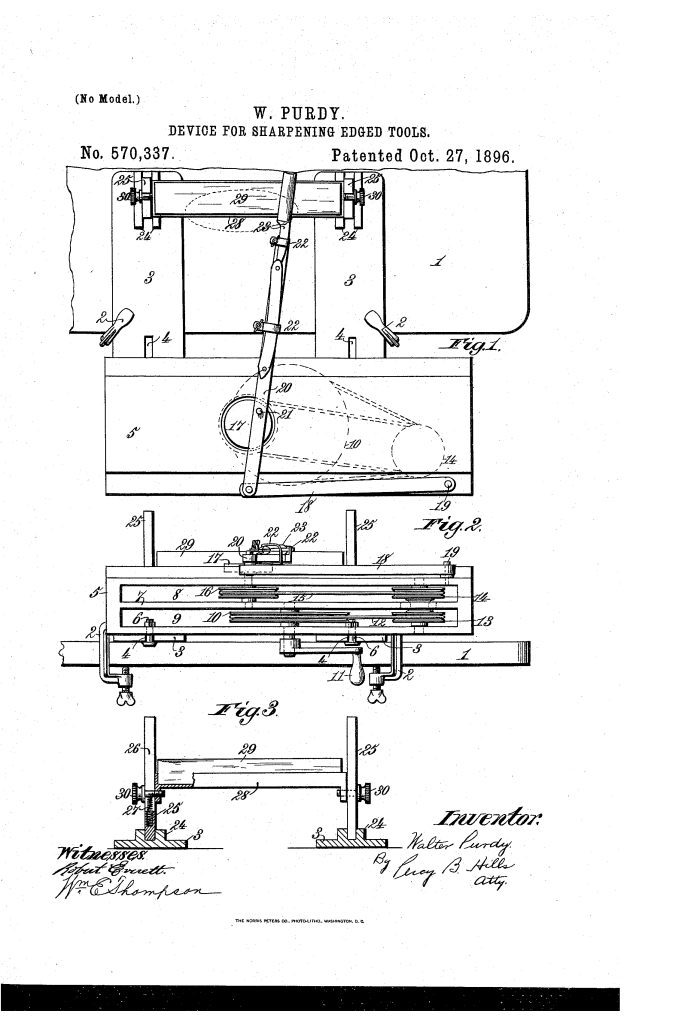
Device for Sharpening Edged Tools (1896)
U.S. Patent No. 570,337, granted on October 27, 1896, to Walter Purdy, describes an ingenious mechanical apparatus designed to automate and perfect the sharpening of razors and other fine-edged tools. Purdy, an inventor residing in Somerset, Pennsylvania, sought to replicate the precise, skilled hand motions of a professional barber using a mechanical linkage.
This invention solved a double-sided problem in tool maintenance: first, replicating the complex, elliptical “figure-eight” stroke required to hone a perfect edge without rounding the blade; and second, preventing the blade from chipping or wearing unevenly against a completely rigid sharpening stone.
The Innovation: The “Elliptical Linkage” & “Yielding Hone”
To sharpen a straight razor successfully by hand, a user must sweep the blade across a hone in an oval or elliptical path. A straight, linear motion back and forth simply will not produce the correct micro-geometry on the cutting edge.
Purdy’s breakthrough was a two-part mechanical system:
- The Elliptical Drive: A clever three-point mechanical linkage (a rotating wheel, a pivoting lever, and a floating carrier arm) that translates simple, circular hand-crank rotation into a perfect oval path of travel for the blade.
- The Spring-Loaded Bed: Instead of making the delicate razor blade flex to meet a hard stone, Purdy mounted the sharpening stone (hone) on vertical coil springs, allowing the stone itself to yield and maintain uniform, gentle pressure against the moving blade.
How the Mechanism Functions
The machine converts simple rotary motion into a complex, automated honing cycle:
| Step | Action | Mechanical Purpose |
| 1. Clamping | The razor (23) is secured into the clamps (22) at the end of the floating arm (20). | Holds the blade firmly at the correct angle relative to the sharpening surface. |
| 2. Geared Drive | The operator turns the large handle (11), which drives a series of internal belts and pulleys (10, 13, 14, 16). | Step-up gearing converts slow, comfortable hand-turning into rapid rotation of the drive wheel (17). |
| 3. Path Generation | The drive wheel (17) spins, pulling the eccentric arm (20) which is restricted at its other end by the pivoting lever (18). | Forces the razor-holding end of the arm to travel in a highly consistent, smooth oval/ellipse. |
| 4. Contact & Yield | As the razor sweeps across the hone (29), the stone’s spring-loaded support (28) compresses and rebounds. | Compensates for any structural rigidity, ensuring even pressure and preventing blade damage. |
Key Technical Components
The device is surprisingly compact and relies on a series of basic but highly coordinated mechanical parts:
- Drive Wheel (17): The main output wheel which features an eccentric mounting pin (21) off-center.
- Pivoted Lever (18): Anchored to the frame at one end (19), it acts as a swinging pendulum that restricts and guides the movement of the tool-carrying arm.
- Tool-Carrying Arm (20): The primary connecting rod. It links the eccentric pin on the drive wheel to the pivoted lever, terminating in clamps (22) that hold the tool.
- Slotted Uprights (25) & Springs (27): Vertical guides housing small coil springs that support the weight of the hone, acting as a suspension system for the sharpening stone.
- Clamping Base (3): Centrally slotted boards that allow the entire machine to be adjustably clamped to the edge of a standard work table.
Historical and Practical Impact
During the late 19th century, the straight razor was a daily necessity for men, and keeping it sharp was a highly valued, delicate skill.
- Democratizing the Perfect Edge: Purdy’s device allowed an unskilled operator—whether at home or in a busy barber shop—to achieve a professional-grade edge without years of practice.
- Blade Preservation: By utilizing a spring-loaded hone support, the machine drastically reduced human error, such as applying too much pressure and ruining an expensive hollow-ground steel blade.
- Portability: Designed to clamp directly onto the edge of any standard household table, the device was highly practical for domestic or traveling use.
About the Inventor: Walter Purdy
Walter Purdy was an American inventor from Somerset, Pennsylvania. Working during the height of the late-Victorian mechanical boom, Purdy focused his efforts on improving everyday utilitarian tasks through clever kinematics and linkage designs. His patent reflects the era’s transition from manual craft skills to accessible household mechanization.
Summary of Claims
The patent explicitly claims:
- The Kinematic Assembly: The combination of a frame, a fixed hone, a tool-carrying arm, and the mechanical linkage (eccentric wheel and lever) to generate an oval or elliptical sharpening path.
- Adjustability: A system where the drive frame and the hone are mounted on a supporting base and can be adjusted relative to one another to accommodate different blade sizes.
- The Yielding Hone Support: The specific use of slotted uprights, set-screws, and internal coil springs to provide a resilient, self-adjusting bed for the sharpening stone.
