
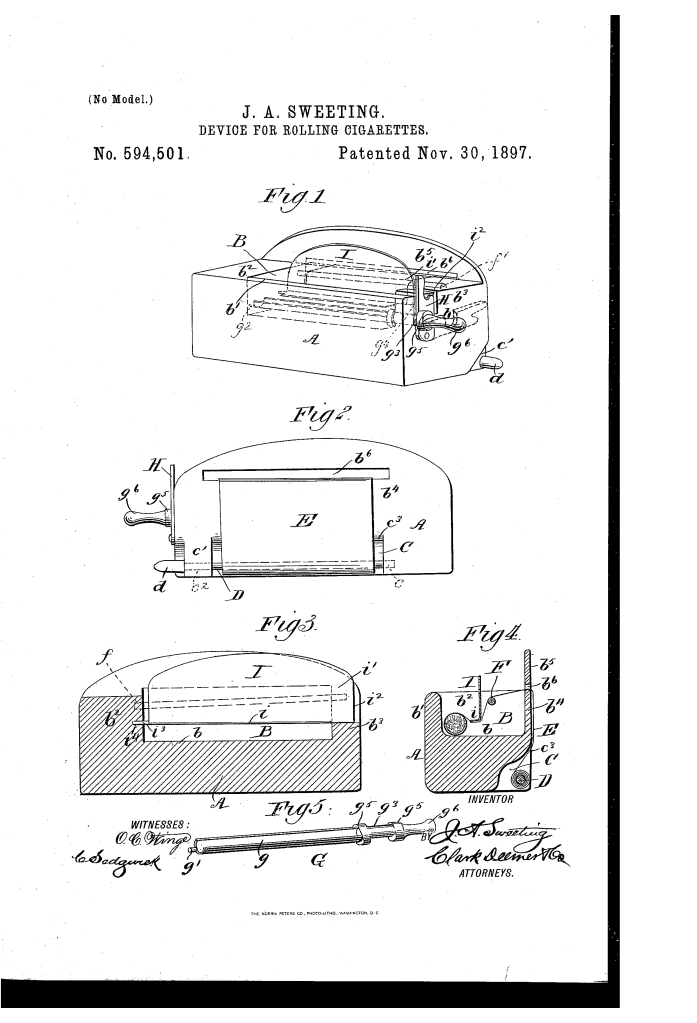
Device for Rolling Cigarettes (1897)
U.S. Patent No. 594,501, granted on November 30, 1897, to James A. Sweeting, addresses a common challenge for late 19th-century tobacco consumers: the difficulty and inconsistency of hand-rolling cigarettes.
James A. Sweeting, residing in New York City, developed a compact mechanical apparatus designed to let individual users roll cigarettes with ease, speed, and precision. Rather than requiring loose paper sheets and manual dexterity, Sweeting’s design integrated an onboard paper roll feed, a tensioned guiding mechanism, and a semi-cylindrical rotating mandrel to streamline the entire process from filling to sealing.
The Core Design: The Integrated Rolling Box
The Sweeting device is housed within a sturdy block or frame (A) containing a main chamber (B) where the rolling action occurs. The innovation centers on feeding continuous paper from an internal housing under a guiding plate and directly around a specialized tobacco holder.
- The Onboard Paper Supply (C, D, E)The back bottom of the main block contains a dedicated recess (C) that houses a roll of cigarette paper (E).The paper roll is mounted on a removable pin or shaft (D) equipped with an external head (d1) that allows the user to manually adjust tension and paper feed.Paper is drawn upward from the recess, passing through a longitudinal feed slot (b2) in the rear wall (b4) and over a top transverse guide-roller (F).
- The Guide-Plate and Flange (I)Positioned between the rear guide-roller (F) and the front rolling mandrel (G) is a vertical supplementary former or guide-plate (I).The bottom edge of this plate is bent at a right angle to form a specialized flange (i).This flange acts as a mechanical guide and tensioner, directing the paper smooth and flat along the bottom of the chamber toward the rolling mandrel.
- The Concave Mandrel (G)The center of the rolling operation is a removable mandrel (G) featuring a concave, semi-cylindrical stem (g).The stem acts as the trough where the loose tobacco is initially loaded.One end of the mandrel features a projecting pin (g1) anchored in the side wall, while the other end has a cylindrical bearing (g3) locked into a vertical slot (g5) by a pivoting catch plate (H).An external handle (g6) allows the user to rotate the mandrel manually once tobacco and paper are loaded.
How the Apparatus Functions
The device operates through a simple sequence that shapes, wraps, cuts, and seals the cigarette in a single continuous movement:
Step 1: Loading
The user fills the concave stem (g) of the mandrel with loose tobacco.
Step 2: Paper Threading
Paper (E) is pulled from the rear compartment, fed over the roller (F), and directed under the angular flange (i) of the guide-plate to wrap around the mandrel.
Step 3: Rolling
The user turns the external handle (g6). As the concave mandrel rotates, it compresses the tobacco and tightly wraps the paper around it into a cylinder.
Step 4: Moistening and Separation
The user moistens the paper along the line of the guide-roller (F) with a finger. Continuing to turn the mandrel applies tension, cleanly separating the paper along the wet line.
Step 5: Sealing
The moistened edge contacts the wrapped cigarette as it finishes rotating, adhering immediately to seal the wrapper and prevent unwinding.
Technical Components
Frame / Body (A): The primary block housing the internal chamber (B) and paper compartment (C).
Rear Feed Slot (b2): A narrow longitudinal opening that directs paper from the lower spool compartment into the main rolling area.
Guide-Roller (F): A removable transverse roller at the top rear of the chamber that maintains smooth paper delivery.
Guide-Plate (I): A vertical metal partition fitted into wall slots (i2, i4) featuring a right-angled bottom flange (i) for paper positioning.
Locking Catch (H): A plate with a segmental recess (h) mounted on the exterior wall to hold the mandrel securely during rotation.
Historical and Practical Impact
Sweeting’s invention represented a bridge between fully manual hand-rolling and early industrial cigarette manufacturing.
Convenience and Portability: By incorporating a continuous paper spool directly into the rolling block, users did not need to carry separate packs of fragile rolling papers.
Consistency: The fixed dimensions of the concave mandrel (g) ensured that every cigarette was rolled to a uniform diameter and density.
Clean Operation: The integrated guide-plate flange (i) and roller assembly (F) kept the paper flat and tight, preventing tore or wrinkled wrappers and reducing tobacco waste.
About the Inventor: James A. Sweeting
James A. Sweeting was an inventor living in New York City in the late 19th century (noted in the patent as a subject of the Queen of Great Britain). His design contributed to the burgeoning era of consumer personal-use mechanical novelties, adapting simple engineering principles—such as rotational leverage and guided paper feeds—to everyday personal items.
Summary of Claims
The patent explicitly claims:
A cigarette-rolling frame incorporating a rotary mandrel with a concave or semi-cylindrical stem, a rear guide-plate with an angular bottom flange (i), and a paper-directing mechanism.
A top chamber (B) combined with an integrated rear spool recess (C) and shaft (D) to hold and feed a continuous roll of paper through a slotted rear wall (b2).
The specific structural combination of a removable mandrel held by a pivoted catch (H), working in conjunction with a guide-plate (I) and transverse guide-roller (F) to direct, roll, cut, and seal paper around tobacco.
