
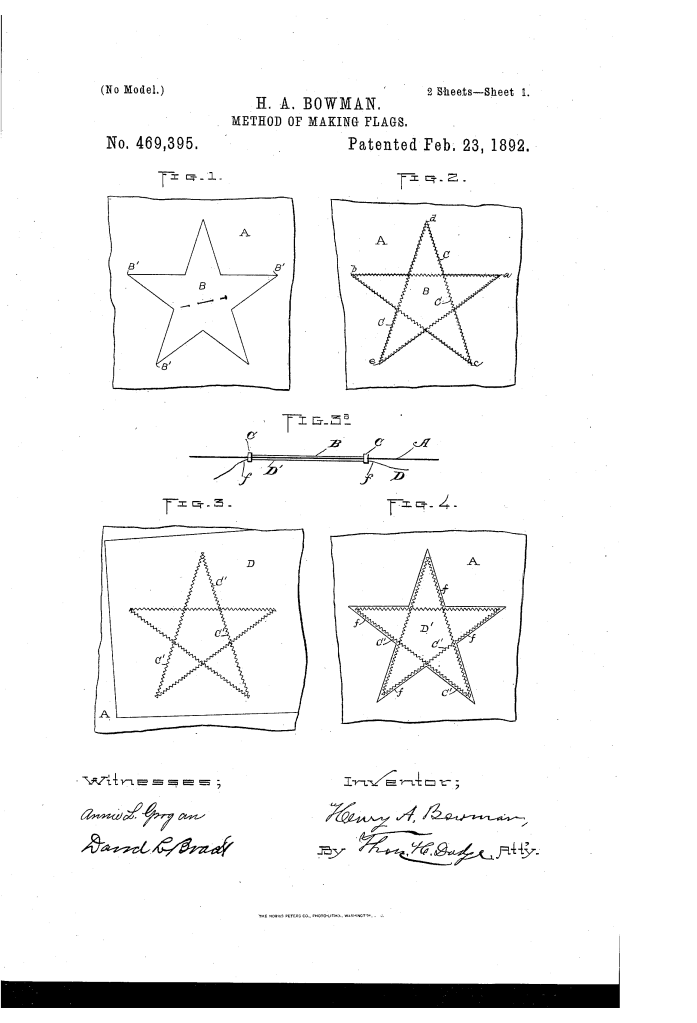
Method of Making Flags (1892)
U.S. Patent No. 469,395, granted on February 23, 1892, to Henry A. Bowman, introduces a streamlined and precise industrial method for affixing stars and emblems to flags. Bowman, an inventor based in Worcester, Massachusetts, sought to solve a common manufacturing headache: the labor-intensive process of perfectly aligning identical emblems on both the front and back of a flag’s field.
Before this invention, ensuring that stars on opposite sides of a flag corresponded accurately required “especial care and attention” from the operator, often leading to high costs and inconsistent quality. Bowman’s method allowed for “economic facility,” significantly reducing the time and expense of production.
The Innovation: The “Blank-and-Trim” Technique
The core of Bowman’s invention is a three-layer “sandwich” approach that uses the finished face-side emblem as the master template for the reverse side. Instead of trying to align two pre-cut stars, the manufacturer only uses one pre-cut star and a larger, unformed piece of fabric.
- The Master Star: An accurately formed star is cut using a die and pinned to the face of the flag field.
- The Underlying Blank: An unformed “blank” of fabric—larger than the star—is pinned or basted to the back of the flag, directly behind the master star.
- Simultaneous Stitching: The operator stitches through all three layers (Face Star, Field, and Back Blank) following the exact edge of the face star.
How the Method Functions
The process follows a specific mechanical sequence to ensure a smooth, flat-laid attachment without stiffening the flag:
- Step 1: Placement: The operator uses a pattern-sheet (E)—a guide with openings slightly larger than the stars—to quickly and uniformly position the face stars across the field.
- Step 2: The Stitching Path: Stitching begins at a specific point and follows a continuous line (e.g., from points a to b to c), crossing over the base of the star points.
- Step 3: The Overseam: A zigzag or overseam stitch is used. This is critical because it “lays the raw-cut edge closely to the field fabric,” preventing the edges from fraying or wearing off during use.
- Step 4: Trimming: Once the stitching is complete, the “surplus cloth” of the blank on the back is trimmed away close to the stitch line. This leaves a perfectly shaped star on the reverse side that is an exact duplicate of the front.
Key Technical Components
| Component | Function |
| Field Fabric (A) | The ground material of the flag upon which emblems are secured. |
| Formed Star (B) | The pre-cut master emblem used as the guide for the stitching. |
| Unformed Blank (D) | The raw fabric on the reverse side; in small flags, this may cover the entire field for efficiency. |
| Zigzag Stitching (O) | The binding agent that secures all plies and protects raw edges from unraveling. |
| Pattern-Sheet (E) | A layout tool with cutouts that ensures “exactness and uniformity” in the arrangement of the stars. |
Historical and Scientific Impact
Henry A. Bowman’s method moved flag-making from a painstaking craft to a more efficient industrial process.
- Accuracy: By using the stitching itself to “trace” the pattern onto the back, the stars on both sides are made accurately opposite to each other by default.
- Versatility: While the patent focuses on the American stars-and-stripes, Bowman noted the method was applicable to any design, such as an anchor (G) or other complex emblems.
- Durability: The use of the zigzag overseam was a significant improvement over traditional flat stitches, as it encased the “raw-cut edges,” making the flag more resistant to the high-velocity snapping and wind-wear that typically destroys outdoor banners.
About the Inventor: Henry A. Bowman
Henry A. Bowman was a manufacturer and inventor active in the late 19th-century industrial hub of Worcester, Massachusetts. His work reflects the era’s drive toward “economic facility”—finding ways to use mechanical precision to replace slow, manual alignment tasks. His patent contributed to the mass production of high-quality national and maritime flags during a period of significant American naval and territorial expansion.
Summary of Claims
The patent explicitly claims:
- The method of duplicating emblems by stitching through a superposed formed emblem and an underlying blank, then trimming the blank.
- The use of overseam or zigzag stitching to embrace the raw-cut edges of the fabrics.
- A flag construction where emblems on opposite sides are secured by the same line of stitching, ensuring perfect symmetry and similarity of configuration.
