
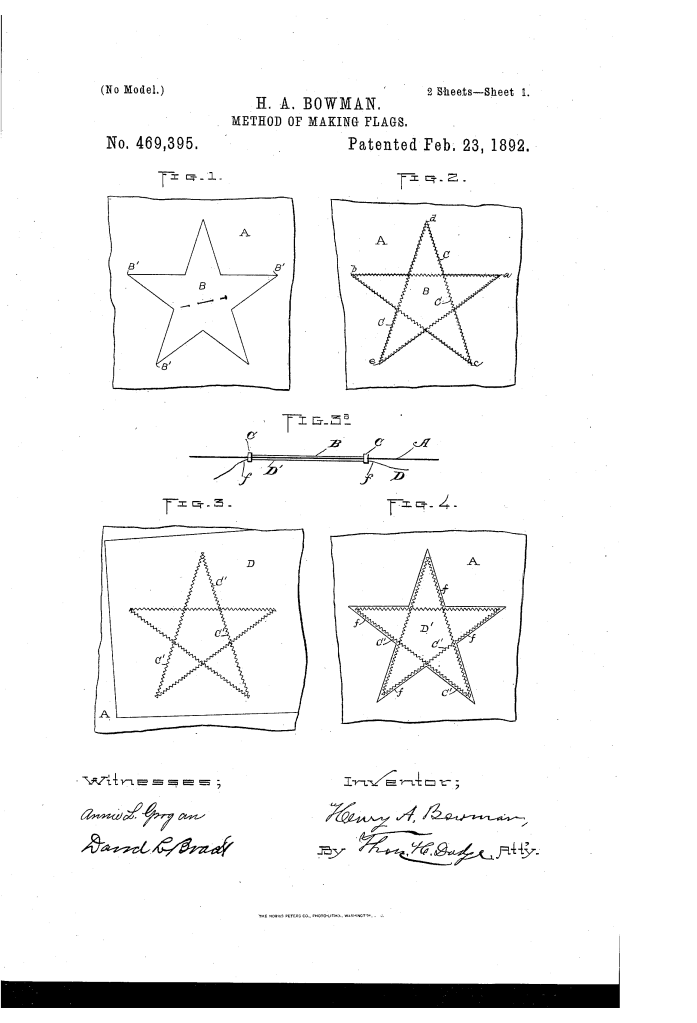
Henry A. Bowman’s patent for a Method of Making Flags, No. 469,395, describes an innovative process for efficiently manufacturing flags with emblems on both sides. Patented on February 23, 1892, the invention’s key contribution was a method for ensuring that emblems, such as the stars on the U.S. flag, were perfectly aligned on both sides without requiring a skilled operator to measure or align them manually.
The process was as follows:
- An accurately-cut emblem (e.g., a star) was placed and pinned onto the front of the flag fabric.
- A blank piece of fabric, large enough to cover the emblem, was pinned to the back of the flag fabric, directly behind the emblem.
- The flag was then stitched from the front, following the exact outline of the emblem. The stitching went through all three layers of fabric: the emblem, the flag field, and the blank backing.
- Once the stitching was complete, the flag was turned over and the excess fabric of the blank was trimmed away along the line of the stitching.
This method created a perfectly duplicated and aligned emblem on the back of the flag with minimal effort and with a clean, flat-laid appearance.
Societal Impact and Legacy
Bowman’s invention was a small but important contribution to the textile and manufacturing industries of the late 19th century.
- Manufacturing Efficiency: The process streamlined flag production, saving time, labor, and expense. By eliminating the need for precise manual alignment on both sides of the flag, it reduced the skill required and increased the speed of production. This was especially important for large flags and for mass production.
- Improved Product Quality: The method produced a higher-quality flag with emblems that were less prone to fraying due to the zigzag overseam stitching. The emblems were also flat and smooth, unlike some earlier methods that could leave them bulky.
- The Inventor’s Legacy: Unfortunately, despite his patent, Henry Bowman faced challenges in protecting his innovative technique. Others in the flag-making industry also began using the zig-zag stitching method, leading to disputes over intellectual property rights. In an effort to defend his patent, Bowman brought a case, Bowman v. De Grauw, et al., to the Circuit Court of New York on March 26, 1894. However, the court ruled against him, determining that the zig-zag stitching technique was not sufficiently novel to warrant patent protection. This ruling marked a setback for Bowman, and the legal battle ultimately led to the decline of his flag company.
- Henry A. Bowman’s story reflects the challenges faced by African American inventors and entrepreneurs during his time. Despite his innovation and patent, he was unable to protect his intellectual property and sustain his flag-making business. Nevertheless, his pioneering work in flag design and production remains a testament to his creativity and determination to contribute to American history.
