
Device for Applying Coloring Liquids to Sides of Soles or Heels of Shoes (1895)
U.S. Patent No. 535,820, granted on March 19, 1895, to Clatonia Joaquin Dorticus, addresses a persistent manufacturing problem in the 19th-century footwear industry: the messy, slow, and unreliable process of edge-blackening shoe soles and heels.
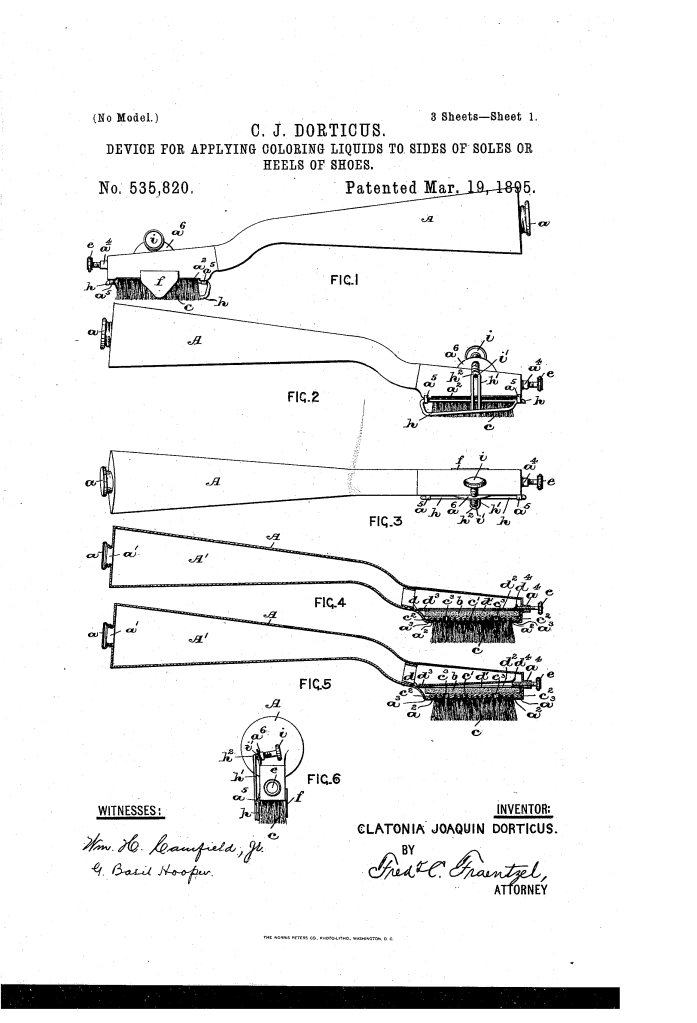
Traditionally, factory workers used standard brushes or sponges to apply ink, which frequently led to accidental staining of the expensive upper shoe leather (vamp) or the bottom of the sole. Dorticus, an inventor based in Newton, New Jersey, engineered an all-in-one fountain brush that completely automated liquid delivery while mechanically protecting the shoe from human error.
The Innovation: The “Regulated Reservoir” and Guard System
Instead of repeatedly dipping a brush into an open inkwell, Dorticus designed a hollow, sheet-metal handle that doubled as an airtight fluid reservoir. The true brilliance of the invention, however, lay in its dual-regulation system: it controlled exactly how much ink reached the bristles, and it physically adapted to the variable thickness of different shoe soles.
Why this Design Excelled:
- Leak Prevention: A specialized internal valve ensured ink only flowed when the tool was actively being prepared for use.
- Variable Width: The operator could mechanically narrow or widen the brush bristles on the fly to match the exact profile of the sole.
- Edge Protection: Built-in metal shields acted as physical barriers between the wet ink and the finished leather.
How the Apparatus Functions
The device relies on a precise sequence of fluid mechanics and physical guides to ensure a clean, high-speed application:
| Step | Action | Industrial Purpose |
| 1. Charging | Ink is poured into the handle reservoir (A1) and sealed with a removable plug (a1). | Contains the volatile coloring liquid in an airtight chamber to prevent drying. |
| 2. Valve Adjustment | The operator turns an external adjusting screw (e) to lift a spring-loaded plate (d1). | Regulates the precise rate of ink saturation, avoiding oversaturation and dripping. |
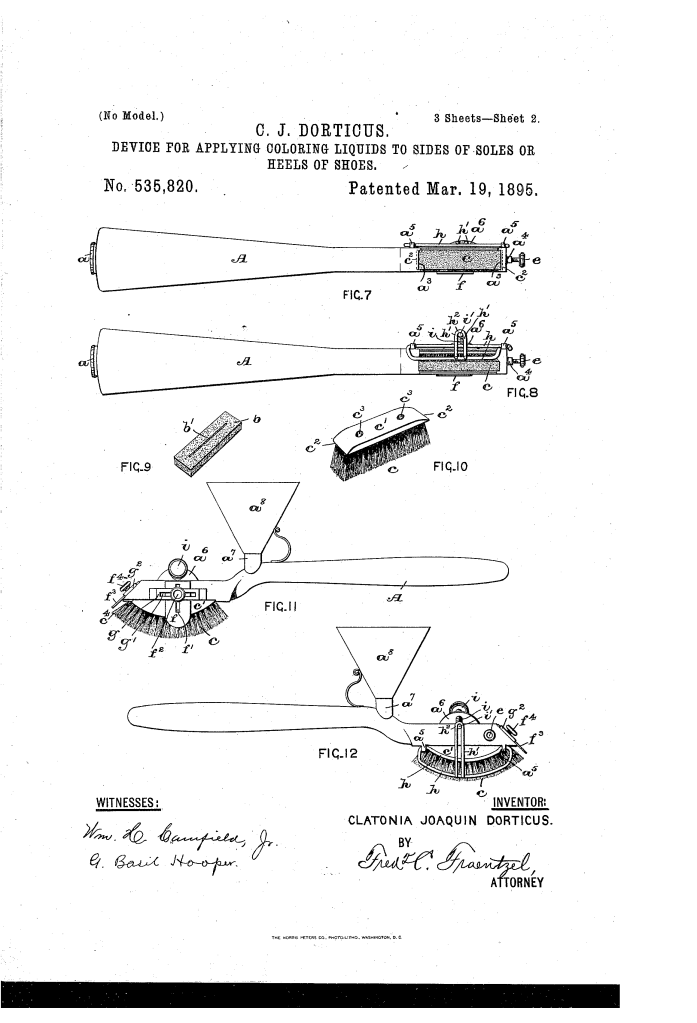
| 3. Saturation | Liquid passes through the valve into a slitted felt pad (b) and down through a perforated brush backing (c). | Distributes ink evenly across the core of the bristles rather than just the tips. |
| 4. Edge Alignment | The rounded guide plate (f) is placed directly into the joint where the sole meets the upper leather. | Acts as a physical track, letting the operator slide the brush rapidly along the shoe without slipping. |
Key Mechanical Components
Dorticus configured the tool as a modular, multi-part assembly where every component served to prevent waste and damage:
- Spring Valve (d1): A resilient metal plate that naturally defaults to a closed position, stopping ink flow entirely when the tool is resting on a workbench.
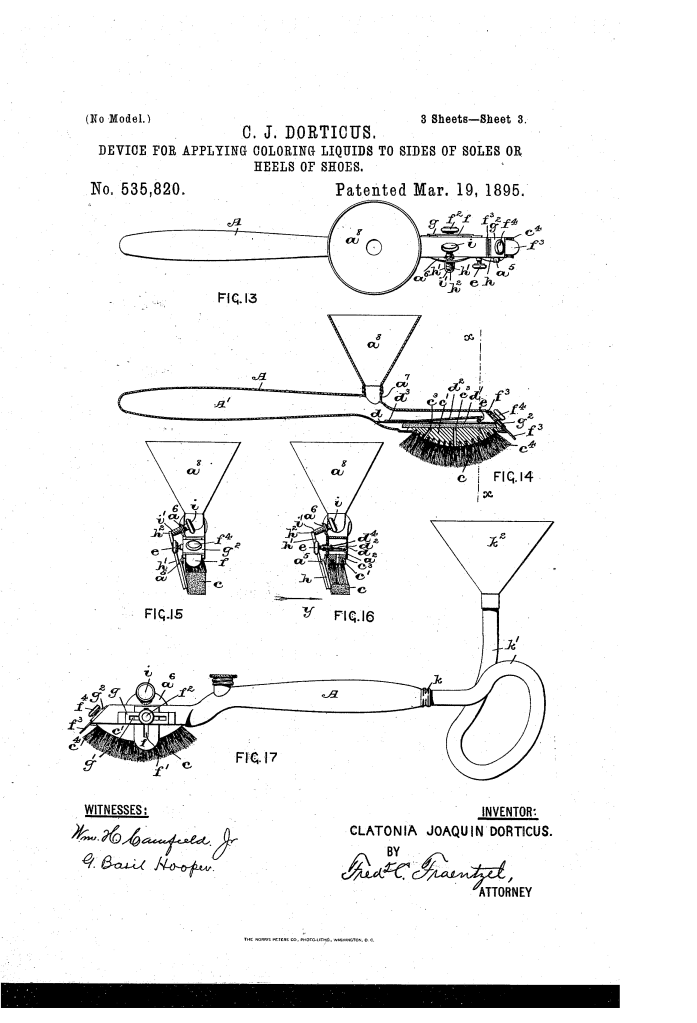
- Adjustable Guide Plates (f, f2): Mounted to the side and end of the brush holder via set-screws. These plates could be adjusted vertically or horizontally to accommodate different shoe styles, ensuring the upper leather remained completely isolated from the ink.
- The Bristle Compression Frame (h): A pivotable wire frame attached to the side of the brush. By turning a top-mounted compression screw (i), the operator forces the wire frame against the sides of the bristles, squeezing them tightly together to safely ink thin soles without spilling over the margins.
Historical and Industrial Impact
Clatonia Joaquin Dorticus’s invention fundamentally upgraded the finishing department of late-Victorian shoe factories.
- Cost Reduction: By preventing accidental stains, the device dramatically cut down on the number of “seconds”—shoes that had to be sold at a loss or discarded due to cosmetic ink damage.
- Labor Efficiency: The fountain design eliminated the constant “dip-and-paint” rhythm, allowing operators to finish significantly more pairs of shoes per hour than could be done using traditional sponges.
- System Maintenance: Dorticus designed the brush handle to separate into two distinct pieces, allowing workers to easily flush out the sediment and precipitates common in 19th-century inks before they could clog the internal pads.
About the Inventor: Clatonia Joaquin Dorticus
Clatonia Joaquin Dorticus was a highly versatile African American inventor active during the late 19th century.
- Invention Portfolio: Beyond his contributions to the shoemaking industry, Dorticus held several notable patents in the field of photography, including a specialized print-washing machine and an automatic embossing device for photographic mounts.
- Legacy: Operating out of New Jersey during the post-Reconstruction era, Dorticus’s patents demonstrate a sharp focus on industrial efficiency, mechanical precision, and solving the highly specific friction points of rapid, Gilded Age manufacturing.
Summary of Claims
The patent explicitly claims:
- A hollow handle forming an ink reservoir with a rectangular lower opening holding a perforated-back brush and a slitted fluid-distribution pad.
- A fluid-regulation valve consisting of an internal plate and an adjustable external screw to control the saturation of the pad.
- A mechanical bristle compression device utilizing a pivoted wire frame and a regulatory screw to adjust the working width of the brush.
