
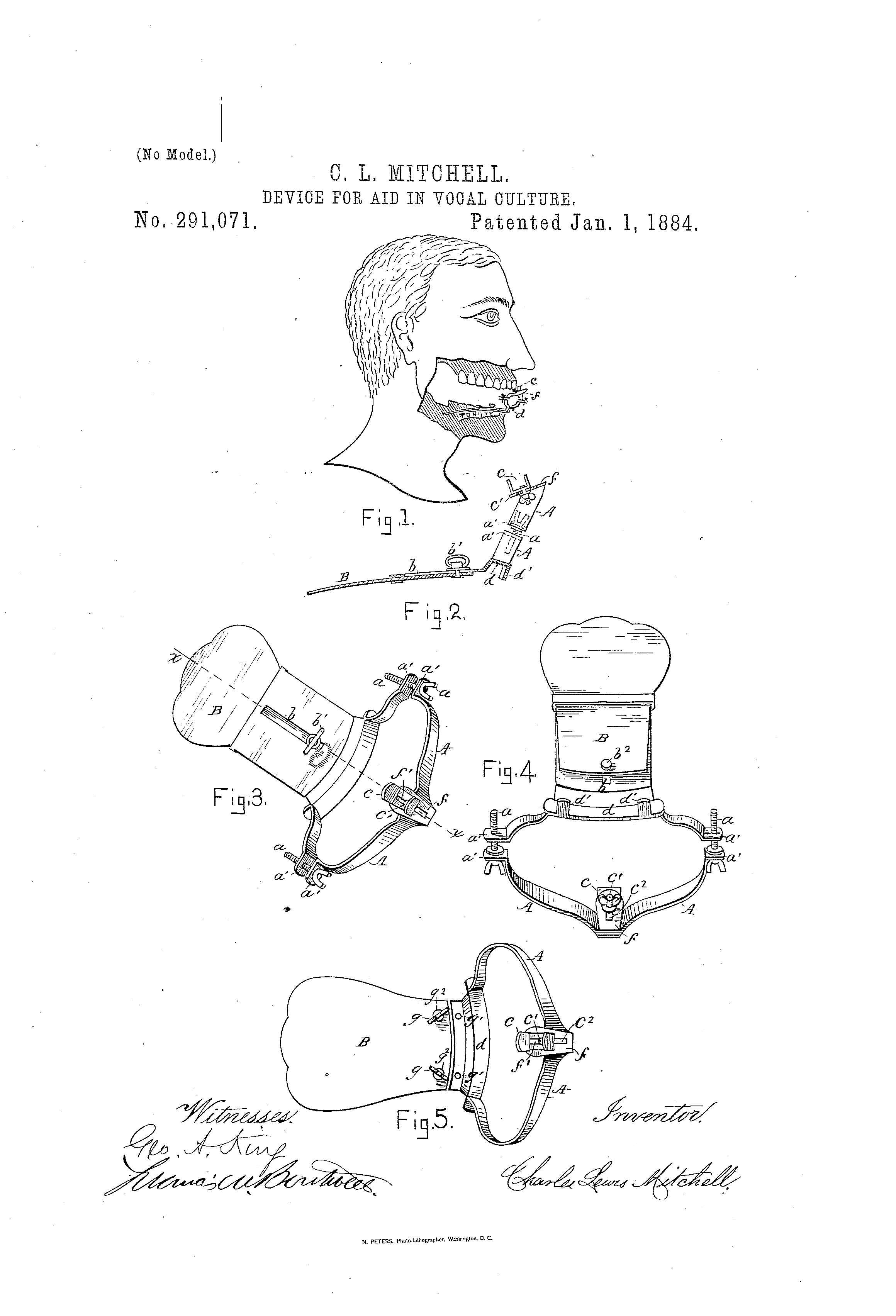
Device for Aid in Vocal Culture (Charles Lewis Mitchell, No. 291,071)
The patent by Charles Lewis Mitchell of Boston, Massachusetts, describes an Improved Device for Aid in Vocal Culture (Patent No. 291,071, 1884). The device is designed to help unskilled vocal pupils by preventing the tongue from interfering with the emission of a full tone. Its secondary use is for holding the mouth and tongue open during dental or surgical operations.
Inventor Background: Charles Lewis Mitchell
Charles Lewis Mitchell was an inventor focused on specialized tools for training, medicine, and service. His invention addresses a common problem in vocal training and a critical need in medical/dental procedures: mechanically controlling the position of the tongue and jaw safely and comfortably.
Invention and Mechanism
The device is a brace that holds the mouth open and the tongue down, featuring multiple adjustment points for a custom fit.
- Mouth Holder (Jaw Brace):
- Holder (A): The main piece, shaped to hold the mouth open and keep the jaw in a natural, comfortable position.
- Lips/Set Screws: The holder has lips at each end with a set-screw ($a$) to adjust the holder’s length, fitting it to the width of the user’s mouth.
- Tooth Holder (Jaw Lock):
- Holder (c): A piece set upon the main holder (A) that receives the upper teeth (Fig. 1).
- Adjustment: The tooth holder is mounted in a slot and secured by a set-screw ($c^{2}$), allowing it to be adjusted laterally (side-to-side) to suit the mouth’s position.
- Tongue Plate (The Depressor) (Key Innovation):
- Tongue-Plate (B): A plate designed to hold the tongue down upon the bottom of the mouth.
- Adjustable Length: The tongue-plate is made in two lapping sections with an elongated slot ($b$) and a set-screw.
- Function: By adjusting the screw in the slot, the tongue-plate can be lengthened or shortened to suit the depth of the mouth and length of the tongue of the user.
- Attachment: The tongue-plate is designed to be detachable from the mouth holder for cleaning or to be used in non-adjustable versions.
Concepts Influenced by This Invention
Mitchell’s device influenced subsequent designs for medical, dental, and training tools by pioneering adjustable mechanical methods for safely controlling biological structures.
- Adjustable Oral Restraints: The design concept of a multi-part, adjustable apparatus to safely hold the mouth open and the tongue immobilized influenced the engineering of modern dental mouth props, surgical retractors, and oral appliances
- Sliding/Lapping Adjustments for Fit: The use of lapping sections with elongated slots and set-screws for both the lateral position (tooth holder $c$) and the longitudinal position (tongue plate B) influenced the design of specialty tools and jigs that require high-precision, variable adjustment for custom fit.
- Specialized Training Tools: The invention influenced the development of tools and equipment designed specifically for vocal culture, speech therapy, and musical training where specific muscular control (like controlling the tongue) is required but difficult for a novice to achieve without mechanical aid.
- Hygiene and Detachability: The design includes provisions for the tongue-plate to be easily detached from the main holder, emphasizing hygiene and ease of cleaning, a crucial consideration for any medical or oral device.
