
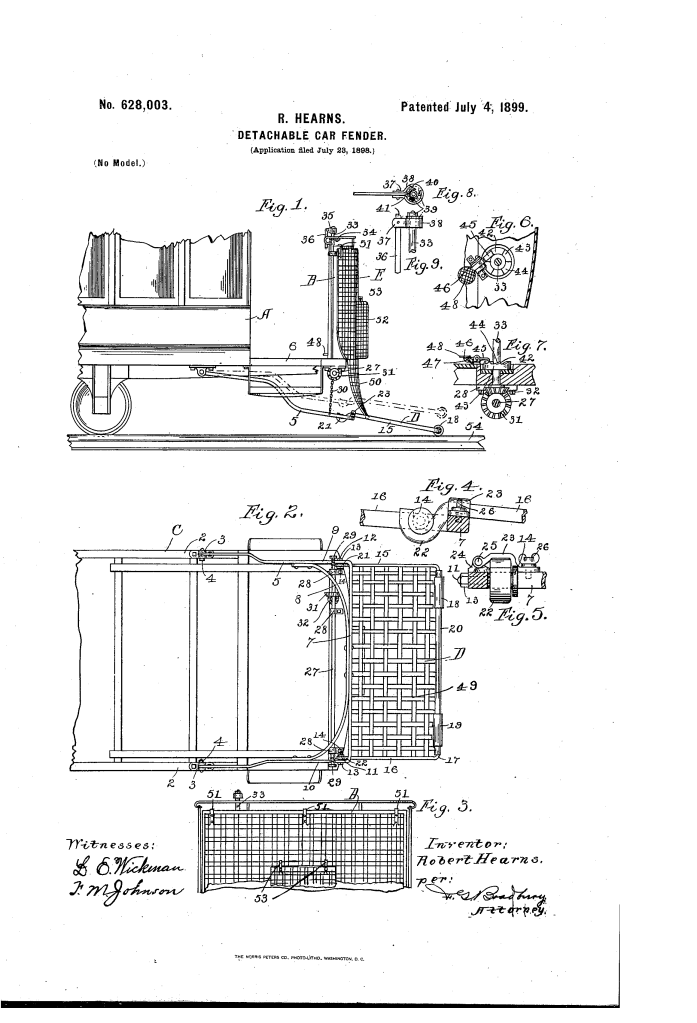
The patent by Robert Hearns of St. Paul, Minnesota, describes a Detachable Car-Fender (Patent No. 628,003, 1899). The objectives are to provide a fender that is quickly detachable (for reversing to opposite ends of the car), readily adjustable in height above the rails, and designed to cushion and contain an object upon contact.
Inventor Background: Robert Hearns
Robert Hearns was an inventor focusing on commercial security and safety systems, also known for his Sealing Attachment for Bottles (No. 598,929). His work in rail safety addressed the critical need for quick-response, flexible safety equipment on urban streetcars, which often needed fenders to be swapped or adjusted rapidly between runs.
Invention and Mechanism (Simplified)
The fender is a complex, articulated frame that can be raised, lowered, and quickly detached, all controlled by the motorman.
1. Frame and Detachment (Key Innovation)
- Hanger Frame (5): A support frame that slopes down from the car’s underside toward the track. It is adjustable in height.
- Fender (D): The main framework of the fender is a separate piece with a cross-arm (17) and rollers (18, 19).
- Removable Fastening: The fender (D) is attached to the hanger frame (5) by hooks (21, 22) that pass beneath bolts (11, 12).
- Hinged Clasps (23): Hinged clasps are secured to the framework and lock over the hooks/bolts.
- Function: By loosening a simple thumb-screw (26) on the clasps, the fender (D) can be quickly removed from the car’s support frame without using complex tools, allowing for rapid reversal or replacement.
2. Height Adjustment and Locking
- Chain and Shaft (27): Chains (30) connect the hanger frame (5) to a shaft (27) journaled beneath the platform. Turning the shaft winds or unwinds the chains.
- Gearing and Handle (35): The shaft (27) is operated via bevel gears (31, 32) and a vertical standard (33). The standard is turned by a handle (35).
- Handle Lock (Fig. 8): The handle (35) has an engaging tooth (41) that engages teeth (40) on the standard when raised into the horizontal position. This allows the motorman to turn the standard to raise/lower the fender.
- Ratchet Lock (42): A circular plate with ratchet-teeth (44) is engaged by a foot-pawl (45), which is held by a spring (47).
- Function (Quick Drop): This ratchet retains the fender in the raised position. The motorman presses a foot-plate (48) to release the pawl, allowing the fender to drop instantly into position on the rails.
3. Cushioning and Containment
- Rollers (18, 19): Positioned on the forward end to contact the track rails and support the fender close to the ground when lowered.
- Padding (E): Cushioning material covers the dash (B).
- Life-Guard Shield (50): A flexible shield connects the fender to the dash padding, preventing the person from being thrown over or passing beneath the car.
Concepts Influenced by This Invention
Hearns’s fender influenced subsequent designs for specialized equipment that must be rapidly adjustable, quickly detachable, and fail-safe to deploy.
- Tool-less Quick-Change Attachments: The system of using simple hooks (21) and hinged clasps (23) secured by a thumb-screw (26) for rapid attachment/detachment influenced the design of various modular systems (e.g., snowplow attachments, accessory mounts) that require quick field removal and reversal without complex tools.
- Integrated Height Control and Quick-Release: The combination of a screw/gear-driven height adjustment system with a separate, foot-actuated ratchet lock (42) for instantaneous deployment influenced the design of industrial and safety equipment that needs to be precisely positioned but released instantly in an emergency.
- Mechanical Quick-Drop Actuation: The use of a spring-held pawl and ratchet system to secure a heavy component (the fender) and rely on the component’s own weight for rapid deployment when the pawl is released is a fundamental principle in safety engineering.
- Concealed/Collapsible Handle Actuation: The handle that locks horizontally to operate the mechanism and releases automatically to a normal (vertical/safe) position influenced the design of various control knobs and levers.
