
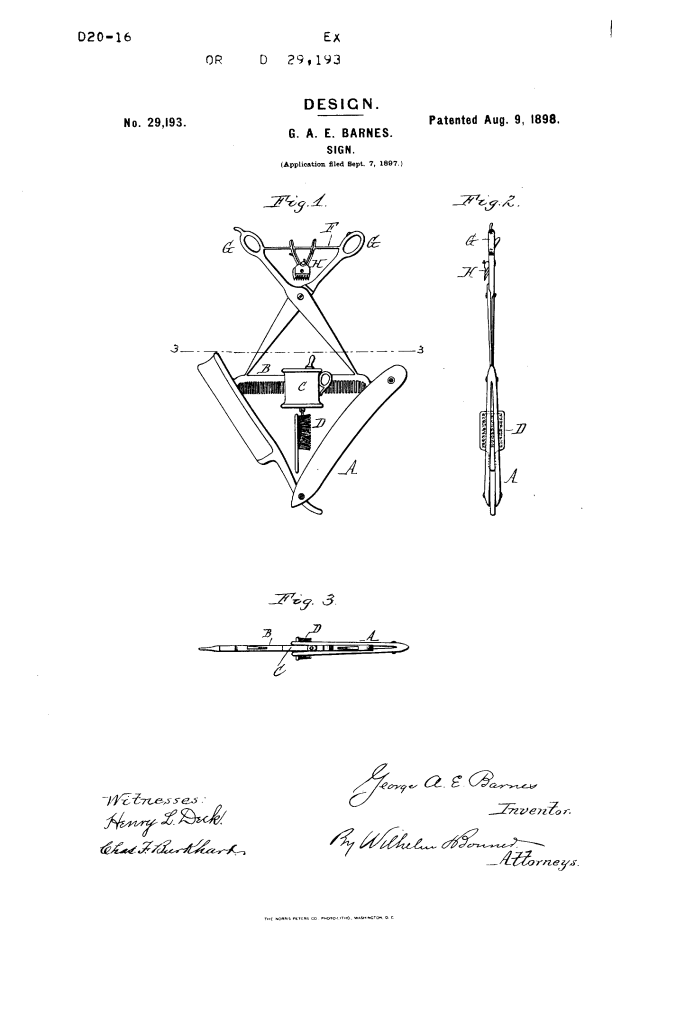
Design for a Barber’s Sign (1898)
U.S. Design Patent No. D29,193, granted on August 9, 1898, to George A. E. Barnes, provides an ornamental design for an eye-catching trade sign intended specifically for the use of barbers. Residing in Depew, Erie County, New York, Barnes sought to capture the tools of the grooming craft in a single, interconnected visual emblem.
During the late 19th century, commercial storefronts relied heavily on bold, symbolic iconography to attract foot traffic. Barnes moved beyond the traditional barber pole, creating a composite sculptural silhouette composed entirely of standard barbering tools configured into a unified framework.
The Core Design: The Interlocking Tool Silhouette
The central innovation of the design is how each piece of equipment serves as both a literal representation of the trade and a structural component of the sign itself.
- The Razor Base (A)The foundation of the entire structure is an open straight razor oriented with its hinge pointing downward. The spread between the razor’s handle and blade forms the wide, supportive lower cradle of the sign.
- The Segmented Comb and Centerpiece (B, C, D)Spanning horizontally across the gap between the razor’s blade and handle is a divided, sectional comb (B). Interposed directly between the sections of the comb sits the outline of a shaving mug (C), with a traditional hairbrush (D) suspended directly beneath it.
- The Upper Scissor Framework (E, F, H)Resting its open blades atop the comb is a pair of open shears or scissors (E). A cross-rod (F) spans the space between the finger rings or eyes (G) of the scissors. Suspended from this rod, centered in the open triangular space enclosed by the handles, hangs a mechanical hair-clipper (H).
Technical & Visual Components
| Component | Design Feature | Visual & Structural Role |
| Open Razor (A) | Hinged at bottom, open upward | Forms the lower cradle and visual foundation |
| Sectional Comb (B) | Horizontally split bar | Serves as the central crossbeam linking the base to the top |
| Shaving Mug (C) | Central container silhouette | Positioned directly between the comb sections as a centerpiece |
| Hairbrush (D) | Bristle brush outline | Suspended from the bottom of the shaving mug |
| Open Scissors (E) | Blades resting on the comb | Forms the upper triangular arch of the sign |
| Crossbar Rod (F) | Spans the scissor eyes (G) | Stabilizes the upper framework and anchors the top element |
| Hair-Clipper (H) | Suspended mechanical clipper | Fills the negative triangular space between the scissor arms |
Historical Context: Visual Trade Signs of the Late 1800s
George A. E. Barnes filed this design application on September 7, 1897, at a time when American streetscapes were becoming dense with retail competition.
Trade Recognition: In an era when urban centers were filled with diverse and multilingual populations, pictorial signs allowed businesses to instantly broadcast their specialized services without relying solely on written text.
Tool Diversity: Rather than representing a single element like a pole or a simple razor, Barnes cataloged the full daily toolkit of the turn-of-the-century barber—shears, manual clippers, lather mug, bristle brush, comb, and straight razor—into a single ornamental silhouette.
Summary of Claims
The patent explicitly claims:
- The ornamental design for a sign, substantially as shown and described, characterized by the specific arrangement and connection of trade accessories into a singular, unified figure.
